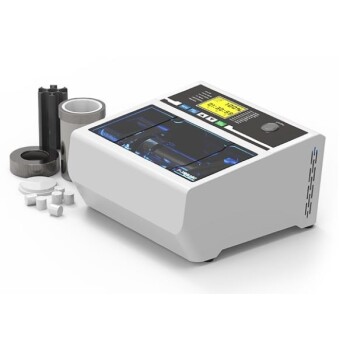
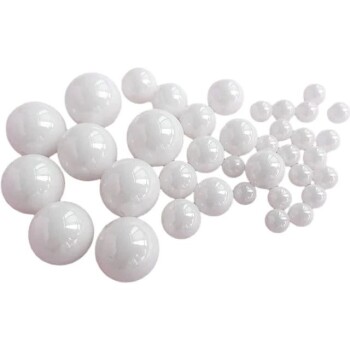
Silicon nitride and zirconia are preferred specifically for their exceptional hardness and chemical inertness. When preparing iodo-vanadate-lead precursors, the process involves high-energy planetary ball milling which generates significant impact forces. These specific materials resist this physical stress, preventing the generation of wear debris that would otherwise contaminate the high-purity powder mixture.
The choice of milling media is a critical contamination control strategy; using silicon nitride or zirconia ensures the chemical integrity of the final ceramic waste containment form remains uncompromised by foreign impurities.
The Critical Role of Material Hardness
Withstanding High-Energy Impact
Planetary ball milling is an aggressive process designed to reduce particle size through intense kinetic energy. The milling jars and balls are subjected to constant, high-velocity collisions.
Silicon nitride and zirconia possess the necessary fracture toughness to endure this environment. Unlike softer materials, they do not chip or crack under the significant impact energy required to mill the precursors.
Eliminating Wear Debris
The primary mechanical risk in milling is "wear debris"—microscopic particles shedding from the grinding media into the sample.
Because these materials are exceptionally hard, they maintain their surface integrity. This drastic reduction in wear ensures that the volume of material inside the jar consists only of the intended precursors, not the grinding tool itself.
Chemical Inertness and Purity
Protecting Precursor Chemistry
Iodo-vanadate-lead precursors are chemically sensitive and require high purity to function correctly.
Silicon nitride and zirconia are chemically inert, meaning they do not react with the precursor powders. This prevents cross-contamination, which occurs when the milling media introduces foreign elements that alter the chemical composition of the batch.
Ensuring Final Product Stability
The ultimate goal of this process is to create a ceramic waste containment form.
The stability of this final waste form relies on precise chemical stoichiometry. By preventing contamination at the milling stage, these materials ensure the chemical stability and integrity of the final product are not jeopardized by impurities.
Understanding the Trade-offs
The Consequence of Subpar Media
Using standard milling media (such as stainless steel or softer ceramics) inevitably leads to sample contamination.
While alternative materials may be less expensive, the wear debris they generate introduces impurities that can destabilize the final ceramic structure. In the context of waste containment, where long-term stability is paramount, this loss of integrity is an unacceptable failure mode.
Making the Right Choice for Your Goal
To ensure the success of your iodo-vanadate-lead preparation, align your material selection with your processing objectives:
- If your primary focus is Chemical Purity: Use silicon nitride or zirconia to eliminate the risk of cross-contamination from wear debris.
- If your primary focus is Final Waste Stability: distinctively avoid softer media to ensure the ceramic waste form retains the precise chemical composition required for containment.
By selecting the correct milling media, you safeguard the fundamental chemistry required for a stable and effective waste containment form.
Summary Table:
| Feature | Silicon Nitride / Zirconia | Standard Milling Media |
|---|---|---|
| Hardness Level | Exceptional (High-Energy Resistant) | Low to Moderate |
| Wear Debris | Minimal / Negligible | Significant Contamination |
| Chemical Reactivity | Inert (No Cross-Contamination) | Potential for Chemical Reaction |
| Application Suitability | High-Purity Precursor Preparation | General-Purpose Grinding |
| Final Product Impact | Ensures Chemical Stability | Risks Structural Destabilization |
Elevate Your Material Purity with KINTEK Solutions
Achieve uncompromising precision in your research with KINTEK’s high-performance milling solutions. Whether you are preparing sensitive iodo-vanadate-lead precursors or advanced ceramic materials, our crushing and milling systems—including premium silicon nitride and zirconia jars and balls—are designed to eliminate wear debris and ensure chemical integrity.
Why Choose KINTEK?
- Specialized Lab Equipment: From high-temperature furnaces and hydraulic presses to advanced electrolytic cells and cooling solutions.
- Contamination Control: Our high-hardness consumables (PTFE, ceramics, and crucibles) safeguard your chemical stoichiometry.
- Comprehensive Support: We provide the tools needed for battery research, waste containment, and high-pressure reactions.
Don't let subpar media compromise your results. Contact our technical experts today to find the perfect milling configuration for your laboratory needs.
References
- Erik V. Johnstone, Neil C. Hyatt. Synthesis and characterization of iodovanadinite using PdI<sub>2,</sub> an iodine source for the immobilisation of radioiodine. DOI: 10.1039/d0ra04114a
This article is also based on technical information from Kintek Solution Knowledge Base .
Related Products
- Laboratory Jar Ball Mill with Alumina Zirconia Grinding Jar and Balls
- Laboratory Jar Mill with Agate Grinding Jar and Balls
- Laboratory Single Horizontal Jar Mill
- Laboratory Micro Horizontal Jar Mill for Precision Sample Preparation in Research and Analysis
- Laboratory Ten-Body Horizontal Jar Mill for Lab Use
People Also Ask
- What are the primary functions of using a ball mill for BZCY72 powder? Achieve High Purity and Enhanced Sintering
- In what way does a laboratory ball mill affect material properties when modifying PHBV/pulp fiber composites?
- Why is a laboratory ball mill required for ultra-fine fly ash? Unlock Nano-Scale Adsorption Power
- What is the function of a laboratory ball mill in the preparation of AMMCs? Optimize Dispersion & Grain Refinement
- What is the function of a laboratory ball mill in the pretreatment of waste tire char (WTC)? Optimize Material Reactivity