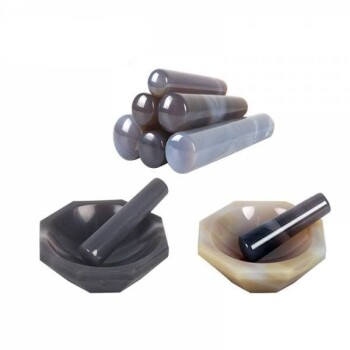
The primary function involves mechanical refinement and homogenization. In the initial stage of the solid-state reaction method, the agate mortar and pestle provide essential mechanical grinding power through high-intensity friction and impact. This process thoroughly mixes and refines the raw material powders—specifically calcium carbonate, zinc oxide, and ammonium dihydrogen phosphate—to create a uniform precursor mixture.
By significantly increasing the contact area between reactants, this grinding stage promotes the diffusion necessary during heat treatment, serving as the foundational step for ensuring the successful formation of nanoscale particles.
The Mechanics of Pre-Treatment
Achieving Uniform Homogeneity
The agate mortar and pestle are not merely crushing tools; they are essential for blending. Through mechanical friction, distinct raw materials are forced into a cohesive mixture. This ensures that the distribution of reactants is uniform before any thermal processing begins.
Refining Particle Size
Beyond mixing, the impact of the pestle physically breaks down the raw powders. This refinement reduces the initial particle size of the precursors. Smaller precursor particles are critical for the efficiency of the solid-state reaction method.
Impact on Synthesis Quality
Maximizing Contact Area
The efficiency of a solid-state reaction relies heavily on the proximity of reactant particles. Mechanical grinding significantly increases the contact area between the calcium, zinc, and phosphate sources. Without this tight contact, the chemical reaction would be sluggish or incomplete.
Promoting Chemical Diffusion
Solid-state synthesis is diffusion-dependent. The thorough mixing facilitates the movement of ions across particle boundaries during the subsequent heat treatment. This enhanced diffusion is the mechanism that drives the actual chemical transformation.
Enabling Nanostructure Formation
The ultimate goal is the creation of VO2+ doped Calcium Zinc Phosphate nanopowders. The reference material identifies this mechanical prep as fundamental to this outcome. Proper grinding ensures the final product achieves the desired nanoscale dimensions rather than forming bulk agglomerates.
Understanding the Trade-offs
The Risk of Insufficient Grinding
If the grinding process is cut short to save time, the reactant contact area will remain low. This often leads to incomplete reactions or chemically heterogeneous products. Uniform mechanical mixing is non-negotiable for high-quality nanomaterial synthesis.
Manual Consistency
Using a mortar and pestle introduces a variable of manual effort. Consistency in the intensity of friction and impact is required for reproducible results. Variations in grinding time or force can alter the final particle size distribution.
Ensuring Synthesis Success
To optimize your pre-treatment strategy for Calcium Zinc Phosphate nanopowders, consider these factors:
- If your primary focus is Reaction Efficiency: Ensure you grind until the mixture is visibly homogeneous to maximize the contact area for ion diffusion.
- If your primary focus is Nanoparticle Size: Prioritize high-intensity friction to refine the raw powders as much as possible before heat treatment.
Detailed mechanical preparation is the invisible foundation upon which high-quality solid-state nanomaterials are built.
Summary Table:
| Process Stage | Primary Function | Impact on Nanopowder Quality |
|---|---|---|
| Mechanical Refinement | Particle size reduction | Increases surface area for faster chemical kinetics |
| Homogenization | Uniform precursor blending | Prevents chemical heterogeneity & incomplete reactions |
| Ion Diffusion | Enhanced contact area | Enables successful solid-state reaction during heating |
| Nano-Control | Agglomerate prevention | Ensures the final product achieves targeted nanoscale dimensions |
Elevate Your Material Synthesis with KINTEK Precision
High-quality nanomaterials like VO2+ doped Calcium Zinc Phosphate require more than just the right recipe—they demand the right tools. At KINTEK, we specialize in providing researchers with the high-performance laboratory equipment and consumables needed for meticulous pre-treatment and synthesis.
Whether you are refining precursors with our premium agate mortar and pestles, processing materials in our advanced high-temperature furnaces, or utilizing our crushing and milling systems, we ensure your laboratory has the foundation for excellence. From hydraulic pellet presses for solid-state reactions to PTFE products and ceramics, KINTEK is your partner in achieving consistent, reproducible results.
Ready to optimize your lab's output? Contact us today to explore our full range of solutions!
References
- Pravesh Kumar, R.V.S.S.N. Ravikumar. Synthesis and spectral characterizations of VO2+ ions-doped CaZn2(PO4)2 nanophosphor. DOI: 10.1007/s42452-019-0903-8
This article is also based on technical information from Kintek Solution Knowledge Base .
Related Products
- Nature Agate Mortar and Pestle for Grinding and Mixing
- Laboratory Jar Mill with Agate Grinding Jar and Balls
People Also Ask
- Why are agate mortars and pestles used for grinding iron oxide? Ensure Sample Purity for XRD Analysis
- What is the function of an agate mortar and pestle? Ensure Purity in Halide Solid-State Electrolyte Synthesis
- Why is an agate mortar and pestle required for grinding Zr3(Al1-xSix)C2? Ensure Maximum Sample Purity
- Why is an agate mortar and pestle preferred for grinding MAX phase? Ensure Sample Purity & Zero Contamination
- Why is an agate mortar and pestle preferred for melamine condensates? Achieve Molecular Purity in Nanomaterial Synthesis