Knowledge How does a Vibratory Mill improve niobium recovery efficiency? Optimize Waste Pre-treatment for Maximum Yield
Author avatar

Tech Team · Kintek Solution

Updated 2 days ago

How does a Vibratory Mill improve niobium recovery efficiency? Optimize Waste Pre-treatment for Maximum Yield


A Vibratory Mill improves extraction efficiency by subjecting industrial waste to high-frequency mechanical vibrations that fundamentally alter the material's structure. This process, known as mechanical activation, generates impact and shear forces that refine particle size and distort the mineral lattice, thereby exposing encapsulated niobium to chemical reagents.

Core Takeaway

The primary value of a Vibratory Mill lies in its ability to transform waste from a passive solid into a reactive material. By breaking down physical barriers like clay and carbonates while simultaneously increasing surface area, it removes the structural impediments that typically hinder chemical extraction.

The Mechanics of Activation

Generating Impact and Shear Forces

The Vibratory Mill does not simply crush material; it utilizes high-frequency mechanical vibrations. These vibrations generate intense impact and shear forces within the chamber. This specific mechanical environment is necessary to initiate the physical and chemical changes required for efficient recovery.

Inducing Mechanical Activation

The application of these forces triggers a process called mechanical activation. This is not merely size reduction; it is an accumulation of energy within the material that makes it physically unstable and more chemically reactive.

Structural Lattice Distortion

Beyond external changes, the mill affects the internal structure of the waste minerals. The process causes mineral lattice distortion and defect generation. By disrupting the orderly arrangement of atoms in the crystal lattice, the material becomes more susceptible to chemical attack during subsequent processing stages.

Overcoming Physical Barriers

Increasing Specific Surface Area

The impact forces lead to significant particle refinement. By reducing the size of the waste particles, the mill drastically increases the specific surface area available for reaction. A larger surface area ensures that chemical reagents have more contact points with the niobium-bearing material.

Breaking Encapsulation

In many industrial waste streams, niobium particles are trapped inside other materials. The Vibratory Mill effectively breaks down clay and carbonate components that encapsulate the niobium.

Exposing the Target Mineral

Once these protective clay and carbonate layers are shattered, the niobium is no longer isolated. The milling process leaves the niobium accessible to chemical reagents, allowing for a much higher recovery rate than would be possible with untreated material.

Understanding the Process Dependencies

The Necessity of Chemical Follow-up

It is critical to understand that the Vibratory Mill is a pre-treatment solution, not a standalone extraction method. Its function is to facilitate accessibility. The actual recovery of niobium still relies on the introduction of chemical reagents after the milling process is complete.

The Role of Defect Generation

Efficiency relies heavily on the creation of lattice defects. If the milling process does not generate sufficient lattice distortion, the material may remain too stable for reagents to work effectively, regardless of how small the particle size becomes.

Making the Right Choice for Your Goal

To maximize the benefits of a Vibratory Mill in your recovery circuit, align the process parameters with your specific extraction targets.

  • If your primary focus is Reaction Speed: Prioritize particle refinement to maximize specific surface area, allowing reagents to contact the material instantly.
  • If your primary focus is Total Yield: Focus on the breakdown of encapsulating layers (clays and carbonates) to ensure every particle of niobium is exposed to the leaching agents.

Summary: The Vibratory Mill acts as a critical key, unlocking the structural and physical barriers of industrial waste to ensure chemical reagents can reach and recover the valuable niobium inside.

Summary Table:

Feature Mechanism of Action Impact on Niobium Recovery
Particle Refinement High-frequency impact/shear forces Increases specific surface area for faster chemical reaction.
Mechanical Activation Energy accumulation in material Increases chemical reactivity by making solids physically unstable.
Lattice Distortion Disruption of mineral crystal structure Generates defects that make minerals more susceptible to chemical attack.
Breakdown of Encapsulation Shattering clay and carbonate layers Exposes trapped niobium to reagents for higher total yield.

Maximize Your Niobium Recovery with KINTEK Precision Solutions

Don't let valuable minerals stay trapped in industrial waste. KINTEK specializes in advanced laboratory equipment designed to overcome structural barriers and enhance your extraction efficiency. Our robust crushing and milling systems, including high-performance vibratory mills, are engineered to deliver the precise mechanical activation and particle refinement your research and production require.

Whether you are focusing on high-temperature processing with our muffle or vacuum furnaces or require specialized hydraulic presses and autoclaves for material synthesis, KINTEK provides the comprehensive tools needed for end-to-end mineral recovery research.

Ready to transform your waste into wealth? Contact our technical experts today to find the perfect equipment configuration for your lab's specific needs.

Related Products

People Also Ask

Related Products

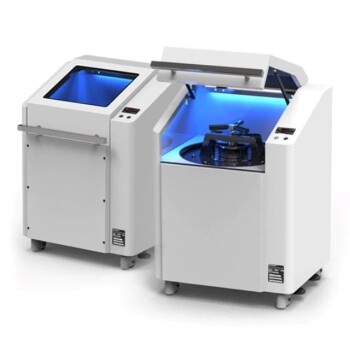
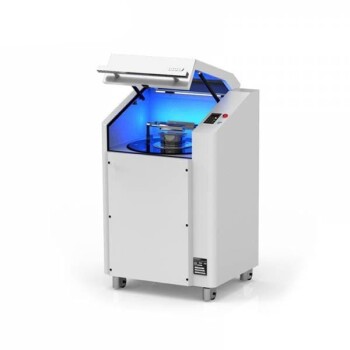
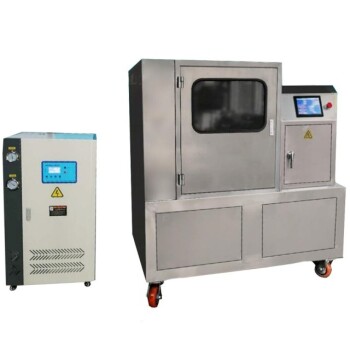
Low-Temperature Water-Cooled Touchscreen Vibratory Ultrafine Pulverizer

Low-Temperature Water-Cooled Touchscreen Vibratory Ultrafine Pulverizer

Low-temperature water-cooled vibratory pulverizer for ultrafine grinding. Preserves material integrity. Ideal for labs and production. Learn more.

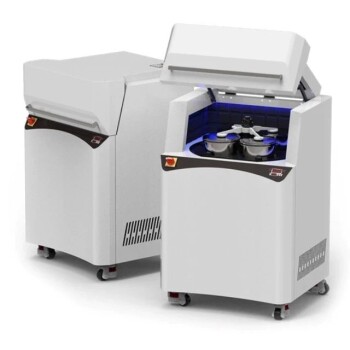
lab cryogenic grinding use liquid-nitrogen for pulverizing plastic raw materials and heat sensitive materials

lab cryogenic grinding use liquid-nitrogen for pulverizing plastic raw materials and heat sensitive materials

Discover the KT-CG01 Liquid Nitrogen Cryogenic Pulverizer, Ideal for Plastic and Heat-Sensitive Material Pulverization, Preserving Material Integrity and Delivering Ultra-Fine Results.

Laboratory Vibratory Sieve Shaker Machine for Dry and Wet Three-Dimensional Sieving

Laboratory Vibratory Sieve Shaker Machine for Dry and Wet Three-Dimensional Sieving

KT-VD200 can be used for sieving tasks of dry and wet samples in the laboratory. The screening quality is 20g-3kg. The product is designed with a unique mechanical structure and an electromagnetic vibrating body with a vibration frequency of 3000 times per minute.

Laboratory Vibratory Sieve Shaker Machine Slap Vibrating Sieve

Laboratory Vibratory Sieve Shaker Machine Slap Vibrating Sieve

KT-T200TAP is a slapping and oscillating sieving instrument for laboratory desktop use, with 300 rpm horizontal circular motion and 300 vertical slapping motions to simulate manual sieving to help sample particles pass through better.

Laboratory Test Sieves and Vibratory Sieve Shaker Machine

Laboratory Test Sieves and Vibratory Sieve Shaker Machine

Efficiently process powders, granules, and small blocks with a high-frequency vibration sieve. Control vibration frequency, screen continuously or intermittently, and achieve accurate particle size determination, separation, and classification.

Rubber Vulcanizer Vulcanizing Machine Plate Vulcanizing Press for Lab

Rubber Vulcanizer Vulcanizing Machine Plate Vulcanizing Press for Lab

The Plate vulcanizing press is a kind of equipment used in the production of rubber products, mainly used for the vulcanization of rubber products. Vulcanization is a key step in rubber processing.

Lab Internal Rubber Mixer Rubber Kneader Machine for Mixing and Kneading

Lab Internal Rubber Mixer Rubber Kneader Machine for Mixing and Kneading

Lab internal rubber mixer is suitable for mixing, kneading and dispersing various chemical raw materials such as plastics, rubber, synthetic rubber, hot melt adhesive and various low-viscosity materials.

Portable Digital Display Automatic Laboratory Sterilizer Lab Autoclave for Sterilization Pressure

Portable Digital Display Automatic Laboratory Sterilizer Lab Autoclave for Sterilization Pressure

Portable autoclave sterilization pressure is a device that uses pressure saturated steam to quickly and effectively sterilize items.

Laboratory Sterilizer Lab Autoclave Herbal Powder Sterilization Machine for Plant

Laboratory Sterilizer Lab Autoclave Herbal Powder Sterilization Machine for Plant

The herbal powder sterilization autoclave machine for Chinese medicine uses saturated steam for effective sterilization. It utilizes the heat and penetrative properties of steam, achieves sterilization after heat preservation, and maintains a good drying effect with a dedicated drying system.

Automatic Heated Hydraulic Press Machine with Heated Plates for Laboratory Hot Press 25T 30T 50T

Automatic Heated Hydraulic Press Machine with Heated Plates for Laboratory Hot Press 25T 30T 50T

Efficiently prepare your samples with our Automatic Heated Lab Press. With a pressure range up to 50T and precise control, it's perfect for various industries.

Heated Hydraulic Press Machine with Integrated Manual Heated Plates for Lab Use

Heated Hydraulic Press Machine with Integrated Manual Heated Plates for Lab Use

Efficiently process heat-pressing samples with our Integrated Manual Heated Lab Press. With a heating range up to 500°C, it's perfect for various industries.

Small Injection Molding Machine for Lab Use

Small Injection Molding Machine for Lab Use

The small injection molding machinehas fast and stable movements; good controllability and repeatability, super energy saving; the product can be automatically dropped and formed; the machine body is low, convenient for feeding, easy to maintain, and no height restrictions on the installation site.

Lab Sterile Slapping Type Homogenizer for Tissue Mashing and Dispersing

Lab Sterile Slapping Type Homogenizer for Tissue Mashing and Dispersing

The slapping sterile homogenizer can effectively separate the particles contained in and on the surface of solid samples, ensuring that the mixed samples in the sterile bag are fully representative.

Single Punch Electric Tablet Press Machine TDP Tablet Punching Machine

Single Punch Electric Tablet Press Machine TDP Tablet Punching Machine

The electric tablet punching machine is a laboratory equipment designed for pressing various granular and powdery raw materials into discs and other geometric shapes. It is commonly used in pharmaceutical, healthcare products, food, and other industries for small batch production and processing. The machine is compact, lightweight, and easy to operate, making it suitable for use in clinics, schools, laboratories, and research units.

XRF & KBR steel ring lab Powder Pellet Pressing Mold for FTIR

XRF & KBR steel ring lab Powder Pellet Pressing Mold for FTIR

Produce perfect XRF samples with our steel ring lab powder pellet pressing mold. Fast tableting speed and customizable sizes for accurate molding every time.

Electric Split Lab Cold Isostatic Press CIP Machine for Cold Isostatic Pressing

Electric Split Lab Cold Isostatic Press CIP Machine for Cold Isostatic Pressing

Split cold isostatic presses are capable of providing higher pressures, making them suitable for testing applications that require high pressure levels.

Benchtop Laboratory Vacuum Freeze Dryer

Benchtop Laboratory Vacuum Freeze Dryer

Benchtop laboratory freeze dryer for efficient lyophilization of biological, pharmaceutical, and food samples. Features intuitive touchscreen, high-performance refrigeration, and durable design. Preserve sample integrity—consult now!

Lab Plastic PVC Calender Stretch Film Casting Machine for Film Testing

Lab Plastic PVC Calender Stretch Film Casting Machine for Film Testing

The cast film machine is designed for the molding of polymer cast film products and has multiple processing functions such as casting, extrusion, stretching, and compounding.

Single Punch Tablet Press Machine and Mass Production Rotary Tablet Punching Machine for TDP

Single Punch Tablet Press Machine and Mass Production Rotary Tablet Punching Machine for TDP

Rotary tablet punching machine is an automatic rotating and continuous tableting machine. It is mainly used for tablet manufacturing in the pharmaceutical industry, and is also suitable for industrial sectors such as food, chemicals, batteries, electronics, ceramics, etc. to compress granular raw materials into tablets.

High Performance Laboratory Freeze Dryer for Research and Development

High Performance Laboratory Freeze Dryer for Research and Development

Advanced laboratory freeze dryer for lyophilization, preserving sensitive samples with precision. Ideal for biopharmaceuticals, research & food industries.


Leave Your Message