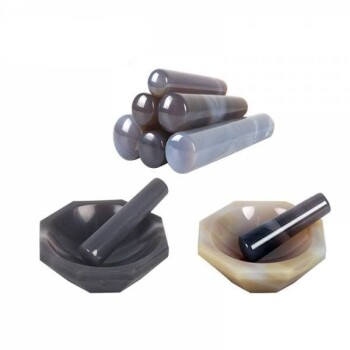
Knowledge Why is an agate mortar and pestle required for grinding Zr3(Al1-xSix)C2? Ensure Maximum Sample Purity
Author avatar

Tech Team · Kintek Solution

Updated 2 days ago

Why is an agate mortar and pestle required for grinding Zr3(Al1-xSix)C2? Ensure Maximum Sample Purity


The primary requirement for an agate mortar and pestle stems from its exceptional hardness and chemical stability, which prevents the contamination of synthesized Zr3(Al1-xSix)C2 bulk materials. Unlike metal tools, agate ensures that the mechanical process of grinding does not introduce metallic impurities that would skew downstream analysis.

Core Takeaway Using agate is a critical quality control measure to eliminate the introduction of foreign elements, such as iron or nickel, into the sample. This high level of purity is mandatory for obtaining reliable data during X-ray diffraction (XRD) and scanning electron microscopy (SEM) evaluations.

The Critical Role of Material Purity

Avoiding Metallic Contamination

When you grind hard bulk materials like Zr3(Al1-xSix)C2, substantial friction and pressure are generated. Standard metal grinding tools are prone to degradation under these conditions.

If you were to use a steel or iron mortar, the abrasive action would inevitably strip microscopic particles of iron (Fe) or nickel (Ni) from the tool. These particles mix with your synthesized powder, permanently altering its chemical composition.

Chemical Stability and Inertness

Agate is a form of silica (SiO2) known for being chemically inert.

It does not react with the ceramic phases of Zr3(Al1-xSix)C2. This ensures that the powder collected after grinding is chemically identical to the bulk material synthesized, preserving the stoichiometry of your sample.

Ensuring Analytical Accuracy

Fidelity in X-ray Diffraction (XRD)

XRD analysis is used to determine the phase purity and crystal structure of your material. It is highly sensitive to the presence of foreign crystalline phases.

If metallic impurities from a grinding tool are present, they will generate extraneous peaks in the diffraction pattern. This "noise" can mask the signals of the actual material or lead to incorrect conclusions about the phase composition of the Zr3(Al1-xSix)C2.

Integrity in Microstructural Observations (SEM)

Scanning Electron Microscopy (SEM) allows you to visualize the morphology and microstructure of the powder.

Contaminants from softer grinding tools can appear as distinct artifacts or inclusions within the sample. Using agate ensures that the features you observe under the microscope are intrinsic to the synthesized material, rather than debris from the preparation equipment.

Understanding the Trade-offs

Efficiency vs. Purity

While agate is superior for purity, it is generally less robust than hardened steel for impact tasks.

Agate is brittle. It excels at grinding (shear force) but can crack under heavy impact (percussive force). Consequently, the grinding process in agate may take longer and require more patience than using metal tools, but this time investment is the cost of analytical precision.

Manual vs. Automated Processing

Agate mortars are often manual tools, whereas many metal grinding systems are automated (ball mills).

While automated systems exist for agate (using agate jars and balls), manual grinding gives the researcher tactile control. This prevents over-grinding, which can sometimes induce amorphization (loss of crystal structure) in the sample surface.

Making the Right Choice for Your Goal

  • If your primary focus is Phase Identification (XRD): You must use agate to prevent metallic peaks from obscuring your diffraction data.
  • If your primary focus is Microstructural Analysis (SEM): You must use agate to ensure observed particles are the synthesized ceramic, not tool debris.
  • If your primary focus is Rough Bulk Processing: You might consider harder automated media, but only if trace impurities do not affect your final application.

Ultimately, the use of agate is not a suggestion but a prerequisite for verifiable, high-quality material characterization.

Summary Table:

Feature Agate Mortar & Pestle Metal Grinding Tools
Material Composition Natural High-Purity Silica (SiO2) Hardened Steel / Iron Alloy
Contamination Risk Extremely Low (Inert) High (Metallic Fe/Ni Particles)
Chemical Stability Chemically Inert May React with Ceramic Phases
Analytical Impact Clean XRD Peaks; No SEM Artifacts Extraneous XRD Peaks; Surface Noise
Primary Use Case Precision Lab Research & Analysis High-Volume Bulk Processing

Elevate Your Material Analysis with KINTEK Precision Tools

Don't let sample contamination compromise your research integrity. KINTEK specializes in high-performance laboratory equipment, providing the ultra-pure consumables needed for advanced material science. Whether you are synthesizing Zr3(Al1-xSix)C2 or exploring complex ceramic phases, our premium agate mortar and pestle sets, crushing and milling systems, and high-purity crucibles ensure your XRD and SEM data remain flawlessly accurate.

From high-temperature furnaces to advanced hydraulic presses, KINTEK supports every stage of your lab's workflow. Contact us today to find the perfect grinding solution for your application!

References

  1. Eugenio Zapata‐Solvas, William Lee. Experimental synthesis and density functional theory investigation of radiation tolerance of Zr <sub>3</sub> (Al <sub>1‐</sub> <scp> <sub>x</sub> S </scp> i <sub>x</sub> )C <sub>2</sub> <scp>MAX</scp> phases. DOI: 10.1111/jace.14742

This article is also based on technical information from Kintek Solution Knowledge Base .

Related Products

People Also Ask

Related Products

High Energy Planetary Ball Mill for Laboratory Horizontal Tank Type Milling Machine

High Energy Planetary Ball Mill for Laboratory Horizontal Tank Type Milling Machine

KT-P4000H uses the unique Y-axis planetary motion trajectory, and utilizes the collision, friction and gravity between the sample and the grinding ball to have a certain anti-sinking ability, which can obtain better grinding or mixing effects and further improve the sample output.

High Energy Planetary Ball Mill Milling Machine for Laboratory

High Energy Planetary Ball Mill Milling Machine for Laboratory

Experience fast and effective sample processing with the F-P2000 high-energy planetary ball mill. This versatile equipment offers precise control and excellent grinding capabilities. Perfect for laboratories, it features multiple grinding bowls for simultaneous testing and high output. Achieve optimal results with its ergonomic design, compact structure, and advanced features. Ideal for a wide range of materials, it ensures consistent particle size reduction and low maintenance.

High Energy Planetary Ball Mill Milling Machine for Laboratory

High Energy Planetary Ball Mill Milling Machine for Laboratory

The biggest feature is that the high energy planetary ball mill can not only perform fast and effective grinding, but also has good crushing ability

Vibrating Disc Mill Small Laboratory Grinding Machine

Vibrating Disc Mill Small Laboratory Grinding Machine

Discover the versatile Vibrating Disc Mill for efficient laboratory grinding. Ideal for geology, metallurgy, biology, and more. Explore now!

Laboratory Ten-Body Horizontal Jar Mill for Lab Use

Laboratory Ten-Body Horizontal Jar Mill for Lab Use

The Ten-body horizontal jar mill is for 10 ball mill pots (3000ml or less). It has frequency conversion control, rubber roller movement, and PE protective cover.

Cold Isostatic Pressing Machine CIP for Small Workpiece Production 400Mpa

Cold Isostatic Pressing Machine CIP for Small Workpiece Production 400Mpa

Produce uniformly high-density materials with our Cold Isostatic Press. Ideal for compacting small workpieces in production settings. Widely used in powder metallurgy, ceramics, and biopharmaceutical fields for high-pressure sterilization and protein activation.

Laboratory Oscillating Orbital Shaker

Laboratory Oscillating Orbital Shaker

Mixer-OT orbital shaker uses brushless motor, which can run for a long time. It is suitable for vibration tasks of culture dishes, flasks and beakers.

Custom PTFE Teflon Parts Manufacturer for PTFE Mesh F4 Sieve

Custom PTFE Teflon Parts Manufacturer for PTFE Mesh F4 Sieve

PTFE mesh sieve is a specialized test sieve designed for particle analysis in various industries, featuring a non-metallic mesh woven from PTFE filament. This synthetic mesh is ideal for applications where metal contamination is a concern . PTFE sieves are crucial for maintaining the integrity of samples in sensitive environments, ensuring accurate and reliable results in particle size distribution analysis.

Twin Screw Extruder Plastic Granulation Machine

Twin Screw Extruder Plastic Granulation Machine

Twin screw extruder plastic granulation machine is designed for the mixing and processing experiments of engineering plastics, modified plastics, waste plastics and masterbatches.

Laboratory Scientific Electric Heating Blast Drying Oven

Laboratory Scientific Electric Heating Blast Drying Oven

The desktop fast autoclave sterilizer is a compact and reliable device used for rapid sterilization of medical, pharmaceutical, and research items.

Laboratory Test Sieves and Vibratory Sieve Shaker Machine

Laboratory Test Sieves and Vibratory Sieve Shaker Machine

Efficiently process powders, granules, and small blocks with a high-frequency vibration sieve. Control vibration frequency, screen continuously or intermittently, and achieve accurate particle size determination, separation, and classification.

Custom PTFE Teflon Parts Manufacturer for Culture Dish and Evaporation Dish

Custom PTFE Teflon Parts Manufacturer for Culture Dish and Evaporation Dish

The PTFE culture dish evaporating dish is a versatile laboratory tool known for its chemical resistance and high-temperature stability. PTFE, a fluoropolymer, offers exceptional non-stick properties and durability, making it ideal for various applications in research and industry, including filtration, pyrolysis, and membrane technology.

1200℃ Muffle Furnace Oven for Laboratory

1200℃ Muffle Furnace Oven for Laboratory

Upgrade your lab with our 1200℃ Muffle Furnace. Achieve fast, precise heating with Japan alumina fibers and Molybdenum coils. Features TFT touch screen controller for easy programming and data analysis. Order now!

Vertical Laboratory Tube Furnace

Vertical Laboratory Tube Furnace

Elevate your experiments with our Vertical Tube Furnace. Versatile design allows for operation under various environments and heat treatment applications. Order now for precise results!

High Temperature Muffle Oven Furnace for Laboratory Debinding and Pre Sintering

High Temperature Muffle Oven Furnace for Laboratory Debinding and Pre Sintering

KT-MD High temperature debinding and pre-sintering furnace for ceramic materials with various molding processes. Ideal for electronic components such as MLCC and NFC.

Vacuum Heat Treat and Pressure Sintering Furnace for High Temperature Applications

Vacuum Heat Treat and Pressure Sintering Furnace for High Temperature Applications

Vacuum pressure sintering furnaces are designed for high temperature hot pressing applications in metal and ceramic sintering. Its advanced features ensure precise temperature control, reliable pressure maintenance, and a robust design for seamless operation.

Benchtop Laboratory Freeze Dryer for Lab Use

Benchtop Laboratory Freeze Dryer for Lab Use

Premium benchtop laboratory freeze dryer for lyophilization, preserving samples with ≤ -60°C cooling. Ideal for pharmaceuticals & research.

Single Punch Electric Tablet Press Machine TDP Tablet Punching Machine

Single Punch Electric Tablet Press Machine TDP Tablet Punching Machine

The electric tablet punching machine is a laboratory equipment designed for pressing various granular and powdery raw materials into discs and other geometric shapes. It is commonly used in pharmaceutical, healthcare products, food, and other industries for small batch production and processing. The machine is compact, lightweight, and easy to operate, making it suitable for use in clinics, schools, laboratories, and research units.

Lab Blown Film Extrusion Three Layer Co-Extrusion Film Blowing Machine

Lab Blown Film Extrusion Three Layer Co-Extrusion Film Blowing Machine

Lab blown film extrusion is mainly used to detect the feasibility of film blowing of polymer materials and the colloid condition in the materials, as well as the dispersion of colored dispersions, controlled mixtures, and extrudates;

Dental Porcelain Zirconia Sintering Ceramic Furnace Chairside with Transformer

Dental Porcelain Zirconia Sintering Ceramic Furnace Chairside with Transformer

Experience top-notch sintering with Chairside Sintering Furnace with Transformer. Easy to operate, noise-free pallet, and automatic temperature calibration. Order now!


Leave Your Message