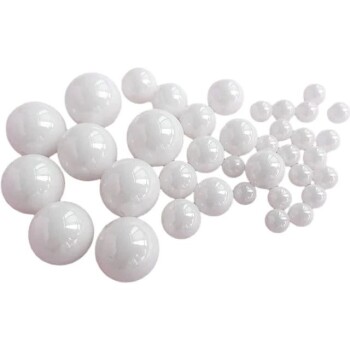
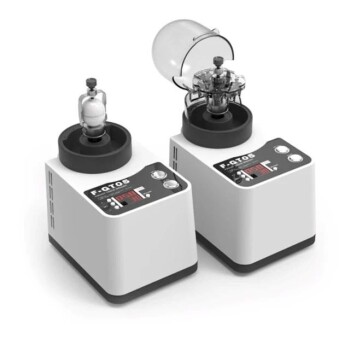
The primary function of a planetary ball mill in this context is the high-energy pulverization of hard ceramic bodies. It acts as a refinement tool to crush previously sintered LLZTO targets into sub-micron fillers, reducing the average particle size to approximately 0.20 µm.
Core Insight: The value of this process lies not just in crushing the material, but in drastically increasing the specific surface area. This physical transformation is the critical prerequisite for integrating LLZTO into polymer matrices, which directly dictates the ionic conductivity of the final composite electrolyte.
Transforming Bulk Ceramics into Functional Fillers
Mechanical Pulverization of Sintered Bodies
Unlike mixing raw soft powders, processing a sintered LLZTO target requires significant mechanical force. The planetary ball mill applies high-energy impact to break down the dense, hard ceramic structure that was formed during the initial sintering phase.
Precise Particle Size Reduction
The objective is to refine the material from a bulk state down to a precise sub-micron scale. While raw materials may start at larger sizes (e.g., 10 micrometers), the milling process is tuned to achieve a final average particle size of roughly 0.20 µm (200 nm).
Elimination of Agglomerates
Sintered materials and fine powders naturally tend to clump together. The shear forces generated by the ball mill effectively break down these agglomerates, ensuring that the resulting powder consists of discrete, individual particles rather than clusters.
The Role in Composite Electrolytes
Maximizing Interfacial Contact
The deep need for this process is driven by the requirements of composite electrolytes. By refining the LLZTO to 0.20 µm, you significantly increase the contact area between the ceramic phase and the polymer matrix.
Enhancing Ionic Conductivity
This increased surface area is the mechanism that improves performance. A higher degree of contact allows the ceramic fillers to more effectively facilitate lithium-ion transport through the composite material.
Enabling Conductive Percolation
Reduction to the nanometer scale (in some cases down to ~40 nm) helps achieve a percolation effect. This ensures the conductive ceramic particles form a continuous network within the electrolyte, preventing "dead zones" where ions cannot flow.
Critical Considerations and Trade-offs
The Necessity of Uniformity
Achieving a mere reduction in size is insufficient; the distribution must be uniform. If the milling duration or energy is inadequate, agglomerates will remain, leading to poor dispersion in the polymer matrix and inconsistent conductivity.
Managing High-Energy Input
The process utilizes intense mechanical force to achieve the required sub-micron size. While necessary for pulverization, this high-energy input requires careful monitoring to ensure the "hard" sintered target is refined without introducing excessive contamination from the milling media itself.
Making the Right Choice for Your Goal
To maximize the utility of your milled LLZTO, align your processing parameters with your specific end-goal:
- If your primary focus is Ionic Conductivity: Prioritize milling protocols that achieve the smallest possible average particle size (aiming for 0.20 µm or lower) to maximize the ceramic-polymer interface.
- If your primary focus is Composite Homogeneity: Focus on the dispersion aspect of the milling process to ensure all agglomerates are eliminated, guaranteeing a uniform distribution of fillers within the matrix.
Successful processing transforms a rigid ceramic target into a high-surface-area active filler, unlocking the electrochemical potential of your composite electrolyte.
Summary Table:
| Feature | Detail |
|---|---|
| Primary Function | High-energy pulverization of hard sintered ceramic bodies |
| Target Particle Size | Refinement down to approximately 0.20 µm (200 nm) |
| Key Outcome | Drastic increase in specific surface area for polymer integration |
| Performance Impact | Enhances ionic conductivity via improved interfacial contact |
| Structural Benefit | Effective elimination of agglomerates for uniform dispersion |
Elevate Your Battery Research with KINTEK Precision
Unlock the full electrochemical potential of your LLZTO composite electrolytes with high-performance processing solutions. KINTEK specializes in advanced laboratory equipment designed for the rigorous demands of material science.
Our planetary ball mills and crushing systems provide the high-energy impact necessary to refine hard ceramics into sub-micron fillers, while our battery research tools, glove boxes, and sintering furnaces ensure a seamless workflow from powder synthesis to final cell testing.
Why choose KINTEK?
- Precision Milling: Achieve consistent sub-micron particle sizes for maximum ionic conductivity.
- Comprehensive Range: From high-temperature furnaces to hydraulic pellet presses and electrolytic cells.
- Expert Support: Tailored equipment solutions for solid-state battery and ceramic research.
Ready to optimize your material refinement? Contact us today to find the perfect equipment for your lab!
Related Products
- High Energy Planetary Ball Mill for Laboratory Horizontal Tank Type Milling Machine
- Mini Planetary Ball Mill Machine for Laboratory Milling
- Laboratory Planetary Ball Mill Cabinet Planetary Ball Milling Machine
- High-Energy Omnidirectional Planetary Ball Mill Milling Machine for Laboratory
- Laboratory Horizontal Planetary Ball Mill Milling Machine
People Also Ask
- What is the role of a planetary ball mill in sulfide-based solid-state batteries? Engineer High-Performance Cathodes
- What are the parameters of a planetary ball mill? Master Speed, Time, and Media for Perfect Grinding
- What is the function of a planetary ball mill for nanostructured eutectic steel? Essential Prep for High-Strength Alloys
- What role does a planetary ball mill play in the preparation of NASICON-type solid electrolytes like LATP and LAGP?
- What is the function of a planetary ball mill in solid-state electrolyte prep? Milling vs. SDS Methods Explained