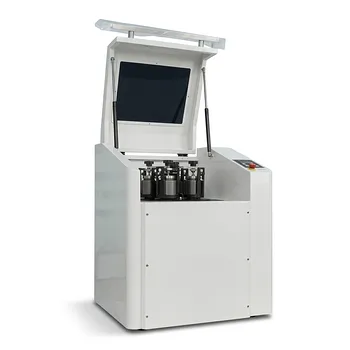
The primary function of a planetary ball mill in this context is to facilitate mechanical alloying through the generation of intense impact and shear forces. Specifically, it is employed to break down the agglomeration of nano-reinforcement phases and uniformly disperse raw materials—such as copper and carbon-based additives—within a liquid medium to ensure optimal particle contact.
Core Takeaway The planetary ball mill acts as the critical homogenization step. By utilizing high-energy grinding in a liquid medium, it overcomes the natural tendency of nanoparticles to cluster, ensuring that every constituent particle is discrete and sufficiently in contact with the matrix for subsequent processing.
The Mechanics of Preparation
Generating Mechanical Force
The planetary ball mill operates by subjecting the powder mixture to high-energy impact and shear forces.
As the milling jar rotates, the grinding media (balls) collide with the powder and the jar walls. This mechanical energy is transferred directly to the materials, driving the physical changes necessary for composite formation.
Facilitating Mechanical Alloying
Beyond simple mixing, this process induces mechanical alloying.
The repeated cold welding, fracturing, and re-welding of particles allow for the synthesis of composite powders at room temperature or low heat. This is essential for integrating materials that might be difficult to combine through thermal means alone.
Achieving Microstructural Integrity
Breaking Down Agglomeration
A major challenge in nanocomposite preparation is the tendency of nano-sized reinforcement phases to clump together.
The primary role of the ball mill here is to effectively shatter these agglomerates. By refining the particle size, the mill ensures that the reinforcement phase is not isolated in clusters but is spread evenly throughout the copper matrix.
Uniform Dispersion in Liquid Medium
The process typically utilizes a liquid medium, such as tert-butanol, to facilitate wet milling.
The liquid aids in the suspension of particles, preventing re-agglomeration during the milling process. This environment allows for the uniform dispersion of the copper powder, carbon sources (such as carbon nanotubes), and any doping agents (like lanthanum) typically used in these specific composite formulations.
Ensuring Component Contact
The ultimate goal of this dispersion is to maximize interfacial contact.
By ensuring all components are thoroughly mixed at a microscopic level, the process guarantees that the reacting phases are physically touching. This "sufficient contact" is a prerequisite for the stability and performance of the final composite material.
Understanding the Trade-offs
Risk of Impurities
High-energy milling involves constant friction between the grinding balls and the jar liner.
This can lead to abrasive wear, introducing microscopic impurities from the grinding media (e.g., steel or zirconia) into your Cu/Ti3SiC2/C powder. This contamination can degrade the electrical or mechanical properties of the final product.
Structural Damage from Over-milling
While reducing particle size is beneficial, excessive milling energy or duration can be detrimental.
Over-milling can destroy the crystalline structure of the Ti3SiC2 phase or damage the aspect ratio of carbon nanotubes. Finding the precise balance between dispersion and structural preservation is critical.
Making the Right Choice for Your Goal
To optimize the preparation of your nanocomposite powders, consider your specific objectives:
- If your primary focus is Microstructural Homogeneity: Prioritize the use of a wet milling medium (like tert-butanol) to prevent agglomeration and ensure even distribution of the nano-reinforcements.
- If your primary focus is Purity: Select grinding media that matches the hardness of your hardest powder or use liners compatible with your matrix to minimize the impact of abrasive contamination.
The planetary ball mill is not just a mixer; it is a high-energy tool that defines the interface quality of your final nanocomposite.
Summary Table:
| Function | Mechanism | Benefit to Nanocomposite |
|---|---|---|
| De-agglomeration | Intense impact & shear forces | Breaks down nano-phase clusters for fine particle size |
| Mechanical Alloying | Repeated welding & fracturing | Synthesizes composite powders at low temperatures |
| Homogenization | Wet milling in liquid medium | Ensures uniform dispersion of carbon and Ti3SiC2 |
| Interfacial Contact | High-energy grinding | Maximizes contact between matrix and reinforcement phases |
Elevate Your Materials Research with KINTEK
Precision in nanocomposite preparation starts with superior mechanical alloying. KINTEK specializes in advanced laboratory equipment, offering high-energy planetary ball mills, crushing and milling systems, and sieving equipment designed to achieve perfect microstructural integrity.
Whether you are synthesizing Cu/Ti3SiC2/C powders or developing next-gen battery materials, our comprehensive portfolio—including hydraulic presses, high-temperature furnaces, and specialized crucibles—provides the reliability your research demands.
Ready to optimize your milling process? Contact our experts today to find the perfect equipment solution for your laboratory!
Related Products
- High Energy Planetary Ball Mill for Laboratory Horizontal Tank Type Milling Machine
- Laboratory Planetary Ball Mill Rotating Ball Milling Machine
- High-Energy Omnidirectional Planetary Ball Mill Milling Machine for Laboratory
- High Energy Planetary Ball Mill Milling Machine for Laboratory
- Laboratory Horizontal Planetary Ball Mill Milling Machine
People Also Ask
- What is the role of a planetary ball mill in sulfide-based solid-state batteries? Engineer High-Performance Cathodes
- What are the parameters of a planetary ball mill? Master Speed, Time, and Media for Perfect Grinding
- What is the function of a planetary ball mill for nanostructured eutectic steel? Essential Prep for High-Strength Alloys
- What role does a planetary ball mill play in the preparation of NASICON-type solid electrolytes like LATP and LAGP?
- What is the function of a planetary ball mill in solid-state electrolyte prep? Milling vs. SDS Methods Explained