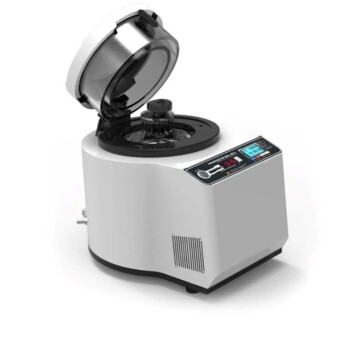
The planetary high-energy ball mill serves as the critical refinement stage in the processing of LLZTO garnet-type ceramic powders. It utilizes high-frequency impact and shear forces to crush coarse powders previously synthesized through solid-state reactions. This mechanical action is necessary to reduce particle size from approximately 5 µm down to the sub-micron level (around 200 nm).
The central value of this process lies in transforming coarse, reactive products into functional sub-micron fillers. By reducing particle size to ~200 nm, the ball mill enables the construction of efficient ionic conduction paths and ensures uniform dispersion within composite electrolytes.
The Mechanism of Refinement
High-Frequency Impact and Shear
The planetary ball mill operates by generating intense mechanical energy.
As the milling jars rotate, the grinding media inside subjects the material to high-frequency impact and shear forces.
This mechanical aggression is not merely for mixing; it is capable of fracturing hard ceramic structures.
Crushing Solid-State Reaction Products
LLZTO powders are typically synthesized using high-temperature solid-state reactions.
While this thermal process creates the correct crystal phase, it often results in coarse particles averaging 5 µm in size.
The ball mill targets these coarse precursors, breaking them down into usable, fine powders.
Achieving Sub-Micron Granularity
The defining metric of success for this process is particle size reduction.
The mill refines the powder from the initial 5 µm down to sub-micron levels, specifically targeting a size of approximately 200 nm.
This drastic reduction in size is the primary objective of the high-energy milling stage.
Why Particle Size Dictates Performance
Optimizing Ceramic Filler Dispersion
The functionality of LLZTO often depends on its integration into composite electrolytes.
Coarse particles (5 µm) tend to settle or clump, leading to uneven performance.
Sub-micron particles (200 nm) possess a surface area that allows for uniform dispersion, preventing the formation of "dead zones" in the material.
Constructing Ionic Conduction Paths
The ultimate goal of a garnet-type ceramic is to conduct lithium ions.
Large, irregular particles create disjointed pathways that impede ion movement.
The refined, sub-micron powder creates a tighter, more continuous network, effectively constructing the ionic conduction paths required for high-performance batteries.
Understanding the Process Context
The Distinction Between Synthesis and Refinement
It is crucial to distinguish the role of the furnace from the role of the ball mill.
High-temperature furnaces are responsible for the chemical reaction and phase transformation that creates the cubic phase LLZTO structure.
The planetary ball mill is responsible for the physical morphology of that material after it has been synthesized.
The Necessity of Mechanical Activation
While the primary goal is size reduction, the high-energy impact also increases the specific surface area of the powder.
In broader ceramic processing, this "mechanical activation" often breaks down agglomerations that form during heating.
Without this step, the synthesized powder would be too coarse and agglomerated to achieve high densification or conductivity in subsequent processing.
Making the Right Choice for Your Goal
When integrating a planetary high-energy ball mill into your LLZTO workflow, align your parameters with your specific end-goal:
- If your primary focus is Composite Electrolytes: Prioritize the reduction to ~200 nm to ensure the ceramic filler disperses uniformly without agglomerating.
- If your primary focus is Ionic Conductivity: Focus on the refining capability to maximize the surface contact area between particles, which establishes robust ionic conduction paths.
The planetary ball mill transforms LLZTO from a chemically correct raw material into a physically functional component ready for high-performance applications.
Summary Table:
| Process Feature | Specification/Role |
|---|---|
| Core Mechanism | High-frequency impact and shear forces |
| Starting Particle Size | Approximately 5 µm (solid-state reaction product) |
| Final Particle Size | Sub-micron level (~200 nm) |
| Key Outcome | Improved ionic conduction paths & uniform dispersion |
| Primary Function | Physical refinement and mechanical activation |
Elevate Your Battery Material Research with KINTEK
Precise particle size is the foundation of high-performance LLZTO electrolytes. KINTEK specializes in advanced laboratory equipment designed for the rigorous demands of ceramic processing. From our high-energy planetary ball mills and crushing and milling systems that achieve sub-micron granularity, to our high-temperature furnaces used for the initial synthesis, we provide the complete toolset for material innovation.
Whether you are constructing ionic conduction paths or optimizing composite fillers, our range of milling jars, grinding media, and sintering solutions ensures consistent, scalable results for laboratory and pilot-scale battery research.
Ready to refine your material performance? Contact KINTEK today for expert equipment solutions!
Related Products
- High Energy Planetary Ball Mill for Laboratory Horizontal Tank Type Milling Machine
- High Energy Planetary Ball Mill Milling Machine for Laboratory
- High Energy Planetary Ball Mill Milling Machine for Laboratory
- High Energy Planetary Ball Mill Machine for Laboratory Horizontal Tank Type
- High-Energy Omnidirectional Planetary Ball Mill Milling Machine for Laboratory
People Also Ask
- What is the role of a planetary ball mill in sulfide-based solid-state batteries? Engineer High-Performance Cathodes
- What are the parameters of a planetary ball mill? Master Speed, Time, and Media for Perfect Grinding
- What is the function of a planetary ball mill for nanostructured eutectic steel? Essential Prep for High-Strength Alloys
- What role does a planetary ball mill play in the preparation of NASICON-type solid electrolytes like LATP and LAGP?
- What is the function of a planetary ball mill in solid-state electrolyte prep? Milling vs. SDS Methods Explained