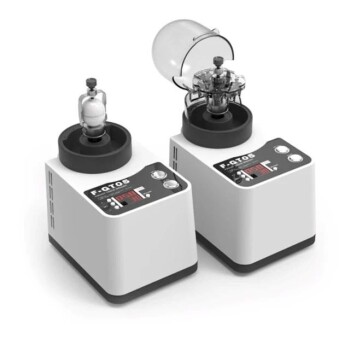
The primary role of a planetary ball mill in the preparation of Al-LLZ lithium garnet powder is to mechanically activate the precursor materials through high-energy grinding. By utilizing impact and friction, the device uniformly mixes and refines raw powders—specifically LiOH, Al2O3, La2O3, and ZrO2—to create the physical conditions necessary for a successful solid-state reaction.
The planetary ball mill solves the fundamental challenge of solid-state synthesis: slow diffusion rates. By pulverizing materials into microscopic particles, it drastically shortens the distance ions must travel to react, enabling the formation of high-purity phases at lower temperatures.
The Mechanics of Preparation
Generating High-Energy Impact
The planetary ball mill does not simply stir the materials; it subjects them to intense mechanical forces. Through planetary motion, the grinding media delivers high-energy impacts and shear forces to the raw powder mixture.
Refining the Raw Materials
The primary target of this mechanical force is the mixture of LiOH, Al2O3, La2O3, and ZrO2. The milling process physically crushes these powders, significantly reducing their particle size and breaking down agglomerates.
Ensuring Microscopic Homogeneity
Beyond simple size reduction, the process ensures a uniform distribution of the multi-component raw materials. This creates a homogeneous mixture where different elements are in intimate contact at the microscopic scale.
Why This is Critical for Al-LLZ Synthesis
Shortening Diffusion Distances
Solid-state reactions rely on the diffusion of atoms across particle boundaries, which is inherently a slow process. By pulverizing the powder, the ball mill increases the specific surface area and shortens the physical distance atoms must diffuse to react.
Lowering Reaction Temperatures
Because the reactants have a larger contact area and shorter diffusion paths, the activation energy required to drive the reaction decreases. This allows the synthesis of Al-LLZ to proceed efficiently at lower temperatures than would be required for coarser powders.
Guaranteeing Phase Purity
The uniformity achieved during milling is directly responsible for the quality of the final product. A well-milled precursor mixture ensures the formation of a single, high-purity garnet phase, preventing the creation of unwanted secondary phases due to poor mixing.
Understanding the Process Dependencies
The Necessity of Physical Activation
It is important to recognize that the ball mill provides the physical foundation for the chemical reaction, but not the reaction itself. If the milling energy or duration is insufficient, the particle size will remain too large.
The Risk of Incomplete Reactions
Without the significant refinement provided by high-energy milling, the contact area between reactants remains low. This leads to incomplete solid-phase diffusion during calcination, resulting in a final material that lacks the desired crystal structure or conductivity.
Making the Right Choice for Your Goal
To optimize your Al-LLZ preparation, consider your specific priorities when configuring your milling parameters:
- If your primary focus is Phase Purity: Ensure extended milling times to achieve maximum homogeneity, which prevents the formation of secondary phases during sintering.
- If your primary focus is Energy Efficiency: Focus on achieving a specific sub-micron particle size threshold to lower the required calcination temperature as much as possible.
Mechanical activation via planetary ball milling is the non-negotiable prerequisite for synthesizing high-quality, homogeneous solid-state electrolytes.
Summary Table:
| Key Milling Function | Impact on Al-LLZ Synthesis | Benefit to Final Product |
|---|---|---|
| High-Energy Impact | Breaks down LiOH, Al2O3, La2O3, ZrO2 | Accelerates solid-state reaction kinetics |
| Particle Refinement | Drastically reduces particle size | Lowers required calcination temperatures |
| Microscopic Homogeneity | Ensures uniform multi-component distribution | Prevents formation of secondary phases |
| Surface Area Increase | Shortens atomic diffusion distances | Guarantees high phase purity and conductivity |
Elevate Your Solid-State Battery Research with KINTEK
High-performance solid-state electrolytes like Al-LLZ require precision at the microscopic level. KINTEK specializes in advanced crushing and milling systems, providing the high-energy planetary ball mills and zirconia grinding media essential for achieving sub-micron homogeneity.
Beyond milling, our comprehensive portfolio supports your entire workflow with:
- High-Temperature Muffle & Vacuum Furnaces for precise calcination and sintering.
- Hydraulic Pellet Presses (Pellet, Hot, Isostatic) for dense electrolyte membrane fabrication.
- High-Purity Ceramics & Crucibles to ensure zero contamination during thermal processing.
Ready to optimize your material synthesis? Contact our laboratory specialists today to find the perfect equipment configuration for your research goals.
Related Products
- Laboratory Jar Ball Mill with Alumina Zirconia Grinding Jar and Balls
- High Energy Planetary Ball Mill for Laboratory Horizontal Tank Type Milling Machine
- Mini Planetary Ball Mill Machine for Laboratory Milling
- High-Energy Omnidirectional Planetary Ball Mill Milling Machine for Laboratory
- High Energy Planetary Ball Mill Milling Machine for Laboratory
People Also Ask
- What are the primary functions of using a ball mill for BZCY72 powder? Achieve High Purity and Enhanced Sintering
- In what way does a laboratory ball mill affect material properties when modifying PHBV/pulp fiber composites?
- Why is a laboratory ball mill required for ultra-fine fly ash? Unlock Nano-Scale Adsorption Power
- What is the function of a laboratory ball mill in the preparation of AMMCs? Optimize Dispersion & Grain Refinement
- What is the function of a laboratory ball mill in the pretreatment of waste tire char (WTC)? Optimize Material Reactivity