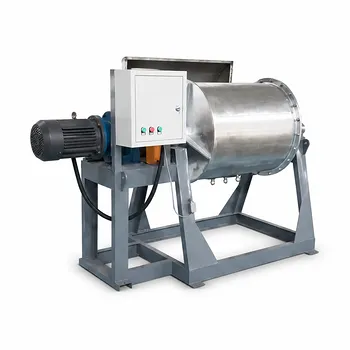
The primary function of a planetary ball mill in the preparation of NiCrAlY-Mo-Ag composite powders is to facilitate high-energy mechanical alloying. Through the generation of intense impact and shear forces, the device thoroughly mixes and refines the NiCrAlY, Molybdenum (Mo), and Silver (Ag) powders into a cohesive precursor.
By leveraging complex mechanical movements, the planetary ball mill ensures the uniform distribution of both the soft silver phase and the hard molybdenum phase within the matrix. This homogeneity provides the essential foundation required to achieve a dense microstructure during the subsequent sintering process.
The Mechanics of High-Energy Alloying
Generating Impact and Shear
The planetary ball mill does not simply stir the materials; it utilizes high-energy kinetic forces.
The complex movement of the grinding jars and balls generates significant impact and shear forces. These forces are necessary to mechanically process the raw powders rather than just blending them superficially.
Refining the Powder Mixture
The mechanical action physically refines the particle size of the raw ingredients.
This refinement process breaks down the distinct NiCrAlY, Mo, and Ag powders. It forces them to interact at a microscopic level, transitioning the mixture from separate elemental powders into a mechanically alloyed composite.
Achieving Structural Homogeneity
Managing Contrasting Hardness
A specific challenge with NiCrAlY-Mo-Ag composites is the difference in material properties between the components.
The composite includes both a soft phase (Silver/Ag) and a hard phase (Molybdenum/Mo). The planetary ball mill effectively disperses these disparate materials evenly throughout the matrix, preventing segregation that could occur with lower-energy mixing methods.
Foundation for Sintering
The quality of the final material is determined during this milling stage.
By ensuring a uniform distribution of the phases, the milling process creates a high-quality precursor. This structural uniformity is the critical prerequisite for achieving a dense, void-free microstructure after the material undergoes sintering.
Understanding the Process Requirements
The Necessity of Intensity
It is important to recognize that this process relies on aggressive mechanical force.
Simple mixing or low-energy tumbling is insufficient for this composite. To properly embed the soft silver and hard molybdenum into the NiCrAlY matrix, the high-energy impact provided specifically by planetary motion is non-negotiable.
Mechanochemical Potential
While the primary goal is physical distribution, the high energy can also induce favorable changes at the atomic level.
As seen in similar high-energy milling processes, this intensity helps break down agglomerates and can enhance the reactivity of the powder surface. This ensures the powder is in the optimal state for consolidation during later processing steps.
Making the Right Choice for Your Goal
When employing a planetary ball mill for NiCrAlY-Mo-Ag composites, consider your specific objectives to adjust the processing parameters:
- If your primary focus is Phase Distribution: Ensure the milling duration and speed are sufficient to generate the shear forces needed to disperse the soft Ag evenly without agglomeration.
- If your primary focus is Final Density: Prioritize particle refinement, as the "foundation" built during milling directly correlates to the microstructural density achievable during sintering.
The planetary ball mill acts as the critical bridge between raw elemental powders and a high-performance, dense composite material.
Summary Table:
| Feature | Function in NiCrAlY-Mo-Ag Preparation |
|---|---|
| Core Mechanism | High-energy impact and shear forces via planetary motion |
| Material Mixing | Disperses soft Silver (Ag) and hard Molybdenum (Mo) phases |
| Particle Refinement | Breaks down raw powders into a refined, alloyed composite |
| Process Goal | Creates a uniform precursor for high-density sintering |
| Key Advantage | Prevents phase segregation in disparate material properties |
Elevate Your Advanced Material Synthesis with KINTEK
Achieving the perfect NiCrAlY-Mo-Ag composite requires more than just mixing—it demands the precision and power of high-energy mechanical alloying. KINTEK specializes in high-performance crushing and milling systems, including advanced planetary ball mills designed for rigorous research and industrial applications.
From refining powders to ensuring phase homogeneity, our equipment provides the kinetic energy necessary for superior material precursors. Explore our comprehensive range of laboratory solutions, including high-temperature furnaces, isostatic presses, and high-pressure reactors to complete your sintering and consolidation workflow.
Ready to optimize your powder metallurgy process? Contact KINTEK today for expert guidance and reliable equipment!
Related Products
- High Energy Planetary Ball Mill for Laboratory Horizontal Tank Type Milling Machine
- Laboratory Planetary Ball Mill Rotating Ball Milling Machine
- High-Energy Omnidirectional Planetary Ball Mill Milling Machine for Laboratory
- High Energy Planetary Ball Mill Milling Machine for Laboratory
- Laboratory Horizontal Planetary Ball Mill Milling Machine
People Also Ask
- What is the role of a planetary ball mill in sulfide-based solid-state batteries? Engineer High-Performance Cathodes
- What are the parameters of a planetary ball mill? Master Speed, Time, and Media for Perfect Grinding
- What is the function of a planetary ball mill for nanostructured eutectic steel? Essential Prep for High-Strength Alloys
- What role does a planetary ball mill play in the preparation of NASICON-type solid electrolytes like LATP and LAGP?
- What is the function of a planetary ball mill in solid-state electrolyte prep? Milling vs. SDS Methods Explained