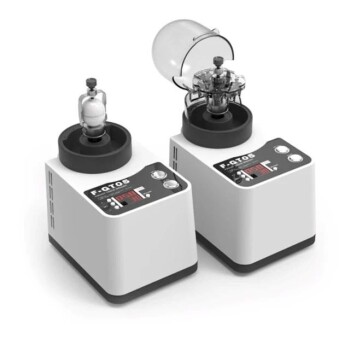
A planetary ball mill serves as the critical mechanical activation step in the synthesis of NASICON-type inorganic solid electrolytes like LATP and LAGP. It utilizes high-energy centrifugal and frictional forces to pulverize and intimately mix raw precursor powders containing lithium, aluminum, titanium, or germanium. This mechanical processing is the prerequisite for creating a high-purity ceramic material.
Core Takeaway The planetary ball mill is not merely a mixing device; it is a kinetic facilitator. By reducing particle size to the nano-scale and maximizing surface contact, it overcomes diffusion barriers, significantly lowering the temperature required for solid-state reactions and ensuring the structural integrity of the final electrolyte.
The Mechanisms of Refinement and Mixing
Applying High-Energy Mechanical Force
The planetary ball mill operates by generating intense centrifugal and shear forces through high-speed rotation.
This mechanical energy is transferred to the raw materials, physically breaking down agglomerates and forcing particles into intimate contact.
Achieving Nano-Scale Refinement
A primary function of the mill is to reduce the particle size of raw powders—such as lithium carbonate, aluminum oxide, and germanium oxide.
This process refines these materials down to the micron or even nano-scale. Smaller particles possess a vastly larger surface area, which is critical for increasing the reactivity of the mixture.
Ensuring Compositional Homogeneity
For complex ceramics like LATP (Lithium Aluminum Titanium Phosphate) and LAGP (Lithium Aluminum Germanium Phosphate), the stoichiometric ratio must be precise throughout the entire sample.
The mill disperses components uniformly within a liquid medium (often ethanol or isopropyl alcohol). This prevents localized "hotspots" of one element, ensuring that the final material has a consistent chemical composition.
Facilitating the Solid-State Reaction
Overcoming Diffusion Barriers
Solid-state reactions rely on atoms diffusing across particle boundaries to form new crystal structures.
By maximizing the contact surface area between reactants, the planetary ball mill minimizes the distance atoms must travel. This effectively overcomes the natural diffusion barriers that exist between coarse raw material powders.
Lowering Reaction Temperatures
Because the reactants are highly activated and intimately mixed, the energy required to initiate the chemical phase change is reduced.
This allows for lower temperatures during the subsequent calcination and sintering phases. Lower processing temperatures can help prevent lithium loss (volatilization), which is a common issue in high-temperature synthesis.
Promoting Pure-Phase Formation
The ultimate goal of using a planetary ball mill is to ensure the formation of a pure-phase crystalline structure.
Thorough mixing prevents the formation of secondary, unwanted phases that can block ion conduction. A pure NASICON phase is essential for achieving high ionic conductivity in the final electrolyte.
Understanding the Operational Trade-offs
Processing Duration vs. Efficiency
Achieving the necessary refinement is time-intensive. Protocols often require grinding durations extending from 24 to 48 hours to ensure complete homogenization.
Shortcutting this process can lead to incomplete reactions later, while excessive milling consumes significant energy and time.
Solvent Selection Implications
The process typically requires a wet medium, such as anhydrous ethanol or isopropyl alcohol, to facilitate dispersion.
The choice of solvent affects how well the particles disperse. Furthermore, the solvent must be removed strictly before sintering, adding a drying step to the manufacturing workflow.
Making the Right Choice for Your Goal
To optimize the preparation of NASICON electrolytes, align your milling parameters with your specific performance targets:
- If your primary focus is Ionic Conductivity: Prioritize extended milling times to ensure maximum homogeneity and pure-phase formation, as secondary phases will impede lithium-ion movement.
- If your primary focus is Process Efficiency: Optimize the rotation speed to generate sufficient shear force to reduce particle size quickly, but monitor heat generation to avoid premature side reactions.
- If your primary focus is Material Purity: Use high-purity milling media and a compatible solvent (like anhydrous ethanol) to prevent contamination during the long grinding cycles.
The planetary ball mill acts as the foundational step that defines the quality limits of the final solid-state battery material.
Summary Table:
| Feature | Impact on NASICON Synthesis (LATP/LAGP) |
|---|---|
| Particle Refinement | Reduces precursors to nano-scale, increasing surface area and reactivity. |
| Homogenization | Ensures precise stoichiometric distribution, preventing localized phase impurities. |
| Energy Input | Overcomes diffusion barriers, lowering required calcination and sintering temperatures. |
| Phase Purity | Promotes the formation of high-conductivity crystalline structures without secondary phases. |
| Lithium Retention | Lower processing temperatures minimize lithium loss via volatilization. |
Elevate Your Battery Research with KINTEK Precision
High-performance solid-state electrolytes demand uncompromising material uniformity. KINTEK provides the advanced crushing and milling systems, including high-energy planetary ball mills and premium ceramics/crucibles, essential for synthesizing pure-phase LATP and LAGP materials.
From high-temperature furnaces for sintering to specialized battery research tools and cooling solutions, our comprehensive portfolio empowers laboratory researchers and industrial manufacturers to achieve superior ionic conductivity.
Ready to optimize your NASICON electrolyte preparation? Contact KINTEK experts today for tailored equipment solutions.
Related Products
- High Energy Planetary Ball Mill for Laboratory Horizontal Tank Type Milling Machine
- High-Energy Omnidirectional Planetary Ball Mill Milling Machine for Laboratory
- Laboratory Planetary Ball Mill Rotating Ball Milling Machine
- High Energy Planetary Ball Mill Milling Machine for Laboratory
- High Energy Planetary Ball Mill Machine for Laboratory Horizontal Tank Type
People Also Ask
- What is the role of a planetary ball mill in sulfide-based solid-state batteries? Engineer High-Performance Cathodes
- What are the parameters of a planetary ball mill? Master Speed, Time, and Media for Perfect Grinding
- What is the function of a planetary ball mill for nanostructured eutectic steel? Essential Prep for High-Strength Alloys
- What is the function of a planetary ball mill in solid-state electrolyte prep? Milling vs. SDS Methods Explained
- What is the specific function of a planetary ball mill in preparing Cr-50 wt% Si alloy? Master Mechanical Alloying