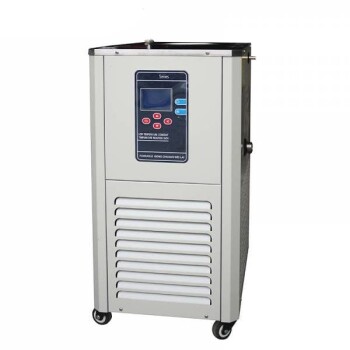
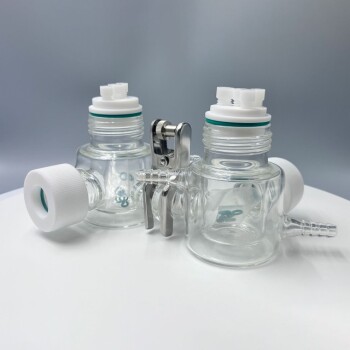
A water bath functions as an indirect thermal transfer system. It operates by bringing a fluid held within a dedicated container to a specific, user-defined temperature. Samples, typically sealed in glass vials, are then immersed in this fluid, allowing the temperature to transfer from the liquid to the sample material.
By maintaining a fluid at a constant temperature and submerging samples within it, water baths provide a stable environment that heats or cools materials without the risks associated with direct contact heating.
The Mechanics of Operation
The Container and Fluid Medium
The foundation of the system is a container designed to hold a specific volume of fluid. This fluid serves as the thermal mass that retains and distributes heat or cold.
While often water, the fluid can be changed depending on the temperature requirements.
Active Temperature Regulation
The device actively heats or cools the fluid bath to reach a "set point." Sensors monitor the fluid temperature to ensure it remains at the desired level.
This regulation creates a stable thermal environment that resists fluctuations from the ambient room temperature.
Sample Immersion
Samples are not placed directly into the fluid; they are usually contained within glass vials.
These vials are submerged in the bath. The fluid surrounds the vial, ensuring that the temperature is applied to the sample from all sides simultaneously.
Why Immersion Matters
Uniform Thermal Distribution
Because the fluid envelops the sample container, thermal energy is transferred evenly across the entire surface area of the vial.
This eliminates the "hot spots" often found in direct heating methods, such as hot plates or Bunsen burners.
Gentle Temperature Changes
The fluid acts as a buffer between the energy source and the sample.
This prevents thermal shock, making water baths ideal for sensitive chemical reactions or biological samples that might degrade under rapid temperature spikes.
Understanding the Trade-offs
Thermal Inertia
Because the system relies on heating a volume of fluid, it reacts slower than direct heating methods.
Changing the temperature of the entire bath takes time, making this method less suitable for applications requiring rapid thermal cycling.
Container Constraints
The effectiveness of the heat transfer relies on the sample being properly sealed in a vial.
If the vial is not sealed correctly, the bath fluid can contaminate the sample, or the sample can leak into the bath.
Making the Right Choice for Your Goal
To determine if a water bath is the correct tool for your application, consider your specific needs regarding precision and speed.
- If your primary focus is sample integrity: The immersion method offers the gentle, uniform heating required to protect delicate biological materials or volatile chemicals.
- If your primary focus is rapid processing: Be aware that the time required to heat or cool the fluid bath may introduce a bottleneck in high-throughput workflows.
Reliable results depend on the consistent, uniform temperature environment that only fluid immersion can provide.
Summary Table:
| Feature | Description | Benefit for Laboratory Samples |
|---|---|---|
| Thermal Mass | Fluid (water/oil) acts as a temperature buffer | Prevents rapid temperature spikes and thermal shock |
| Uniformity | Sample vials are enveloped by the fluid medium | Eliminates 'hot spots' for even heat distribution |
| Temperature Control | Sensors actively monitor and regulate set points | Maintains a stable environment regardless of ambient conditions |
| Sample Protection | Indirect contact via sealed glass vials | Protects delicate biological and chemical materials from damage |
Optimize Your Sample Stability with KINTEK Solutions
Achieve unmatched precision in your thermal processing. KINTEK specializes in advanced laboratory equipment designed for the most demanding research environments. Whether you need reliable cooling solutions like ULT freezers and chillers, or high-precision heating systems, our portfolio provides the uniform temperature control your samples deserve.
From high-temperature furnaces and vacuum reactors to essential PTFE consumables and glass vials, KINTEK is your partner in laboratory excellence. Don't let thermal fluctuations compromise your results—contact our technical experts today to find the perfect solution for your workflow.
Contact KINTEK for a Consultation
Related Products
- Multifunctional Electrolytic Electrochemical Cell Water Bath Single Layer Double Layer
- 50L Chiller Water Bath Cooling Circulator Low Temperature Constant Temperature Reaction Bath
- Optical Water Bath Electrolytic Electrochemical Cell
- 10L Chilling Circulator Cooling Water Bath Low Temperature Constant Temperature Reaction Bath
- Double Layer Five-Port Water Bath Electrolytic Electrochemical Cell
People Also Ask
- What does the routine maintenance of a double-layer water-bath electrolytic cell involve? A Guide to Ensuring Precision and Longevity
- When is professional repair required for a double-layer water-bath electrolytic cell? Protect Your Lab's Precision and Safety
- What are the key features of a double-layer water-bath electrolytic cell? Achieve Precise Temperature Control for Your Experiments
- What are the procedures for after using a double-layer water-bath electrolytic cell? Ensure Equipment Longevity and Data Accuracy
- What is the typical experimental system used with a double-layer water-bath electrolytic cell? Achieve Precise Electrochemical Control