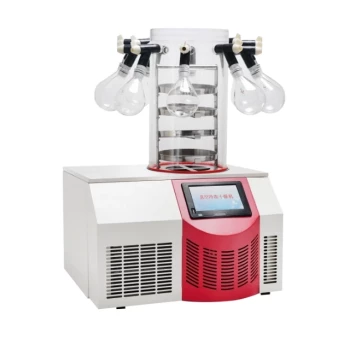
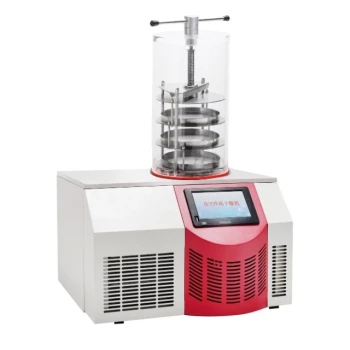
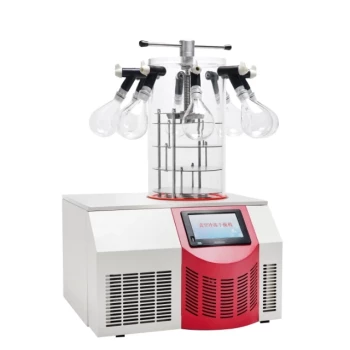
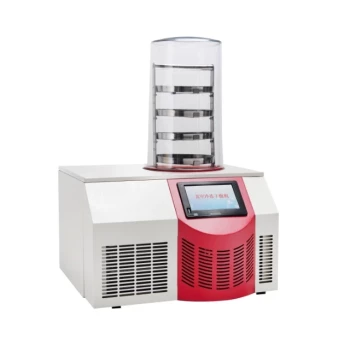
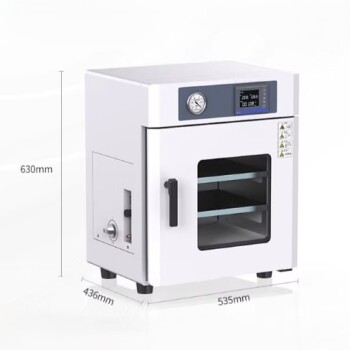
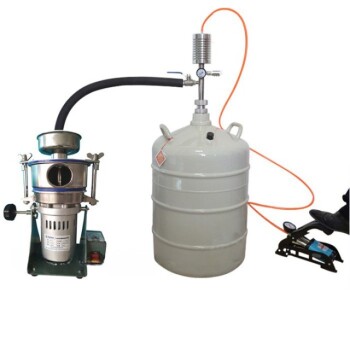
The fundamental advantage of a laboratory freeze dryer lies in its ability to remove solvents through sublimation rather than evaporation. By transitioning moisture directly from a solid to a gas, freeze drying bypasses the liquid phase entirely, eliminating the capillary forces that cause synthesized polymer gels to shrink or collapse. This process is the only way to reliably preserve the intricate, three-dimensional micro-nanoscale network required for high-performance material science.
Freeze drying protects the physical integrity and porosity of polymer gels by avoiding surface tension effects, whereas standard ovens often lead to structural collapse and densification. This makes freeze drying essential for producing materials that require high surface area, precise microscopic morphology, and superior dispersibility.
Preventing Structural Collapse and Shrinkage
The Elimination of Capillary Pressure
Standard drying ovens rely on liquid phase evaporation, which creates significant surface tension at the liquid-gas interface. This tension exerts capillary pressure on the delicate walls of the polymer gel, often causing the pores to pull inward and collapse.
Maintaining Three-Dimensional Networks
A laboratory freeze dryer operates via vacuum freeze-drying (sublimation), removing moisture from a frozen state. This allows the polymer to maintain its original micro-nanoscale three-dimensional network, ensuring the dry product is a faithful structural replica of the wet gel.
Avoiding Thermal Shrinkage
Conventional thermal drying in an oven often leads to thermal collapse and macroscopic shrinkage of the sample. Freeze drying preserves the protein skeleton or polymer frame in its wet-state dimensions, providing a more representative reflection of the actual network.
Enhancing Material Performance and Quality
Maximizing Specific Surface Area
For researchers producing biomass-derived carbon materials, maintaining a fine network of micropores and mesopores is critical. Freeze drying ensures a high specific surface area, which is vital for efficient ion storage and transport in the final synthesized product.
Preventing Hard Agglomerates
Standard heat drying often results in the formation of hard agglomerates due to the forces involved in evaporation. Freeze drying maintains a loose, porous, and soft-agglomerated structure, which significantly improves the powder's dispersibility and its activity during subsequent sintering.
Preservation of Heat-Sensitive Components
Many synthesized gels contain heat-sensitive or unstable biological elements that degrade at oven temperatures. The low-temperature vacuum environment of a freeze dryer allows these materials to be dried without damaging their physical structure or chemical viability.
Operational and Environmental Advantages
Oxygen-Free Processing
Drying occurs within an oxygen-free vacuum chamber, preventing the oxidation of sensitive polymers. This environment ensures the quality of the material remains consistent and comparable to high-grade industrial freeze-dried standards.
Organic Solvent Recovery
Laboratory freeze dryers are often equipped to recycle organic solvents used during synthesis. This capability reduces production costs, protects the environment, and makes the process safer for materials containing volatile organic compounds.
Improved Storage and Rehydration
Freeze-dried gels possess a porous architecture that allows for much easier rehydration and reusability compared to oven-dried materials. The removal of moisture to extremely low levels also prevents microbial growth, extending the shelf life of the samples without the need for refrigeration.
Understanding the Trade-offs
Equipment Complexity and Initial Cost
While freeze drying offers superior material properties, the equipment is significantly more complex and expensive than a standard drying oven. It requires high-performance vacuum pumps, refrigeration systems, and precise control interfaces, leading to higher initial investment and maintenance needs.
Processing Time and Energy
Although some vacuum-assisted freeze-drying processes can be faster than traditional vacuum ovens for specific materials, the sublimation process is generally energy-intensive. Maintaining deep vacuums and ultra-low temperatures over long cycles requires more energy per kilogram of solvent removed than simple convective heating.
Requirement for Pre-Freezing
Unlike an oven where samples can often be placed directly inside, freeze drying requires the sample to be completely frozen before the vacuum is applied. If the freezing process is not controlled (forming large ice crystals), it can sometimes damage the very microstructures the researcher is trying to save.
How to Apply This to Your Project
When choosing between a freeze dryer and a standard oven, your decision should be driven by the required morphology of your final polymer.
- If your primary focus is high porosity and surface area: Use a laboratory freeze dryer to prevent capillary-induced pore collapse and maximize the material's functional performance.
- If your primary focus is high-throughput, bulk drying of stable materials: A standard drying oven is likely the more cost-effective choice, provided structural shrinkage does not impact your results.
- If your primary focus is heat-sensitive or biological polymers: A freeze dryer is mandatory to ensure the chemical and physical integrity of the sample remains intact throughout the drying cycle.
- If your primary focus is synthesizing powders for sintering: Utilize freeze drying to avoid hard agglomeration and ensure the high dispersibility required for high-quality ceramic or carbon precursors.
Choosing the right drying technology ensures that the sophisticated architecture you synthesize in the liquid phase is successfully translated into the final dry material.
Summary Table:
| Feature | Laboratory Freeze Dryer | Standard Drying Oven |
|---|---|---|
| Moisture Removal | Sublimation (Solid to Gas) | Evaporation (Liquid to Gas) |
| Structural Integrity | Preserves 3D micro-nanoscale network | Causes shrinkage and collapse |
| Surface Area | High specific surface area | Reduced due to densification |
| Product Texture | Loose, porous, soft agglomerates | Hard agglomerates |
| Thermal Risk | Low (protects heat-sensitive items) | High (potential thermal degradation) |
Elevate Your Material Science with KINTEK Precision
Precision drying is the bridge between successful synthesis and high-performance materials. At KINTEK, we understand that preserving the delicate 3D architecture of your polymer gels is critical to your research success. Our advanced laboratory freeze dryers and cooling solutions (including ULT freezers and freeze dryers) are engineered to eliminate capillary pressure, preventing structural collapse and maximizing surface area.
Beyond drying, KINTEK offers a comprehensive portfolio to support your entire workflow—from high-temperature high-pressure reactors for synthesis to crushing and milling systems and high-purity ceramic crucibles for material processing.
Ready to achieve superior material integrity? Contact KINTEK Experts Today to find the ideal equipment solution tailored to your laboratory's specific needs.
References
- Jijun Wang, Jinlong Zhao. Enhancement of microwave absorption performance of porous carbon induced by Ce (CO3) OH. DOI: 10.3389/fchem.2022.1100111
This article is also based on technical information from Kintek Solution Knowledge Base .
Related Products
- High Performance Laboratory Freeze Dryer
- High Performance Laboratory Freeze Dryer for Research and Development
- Benchtop Laboratory Freeze Dryer for Lab Use
- Benchtop Laboratory Vacuum Freeze Dryer
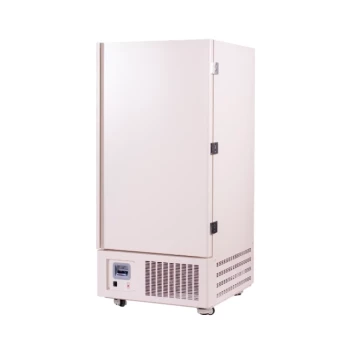
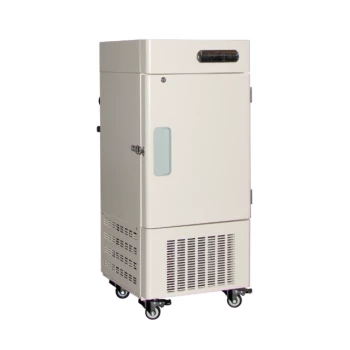
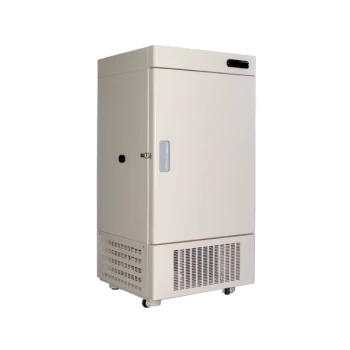
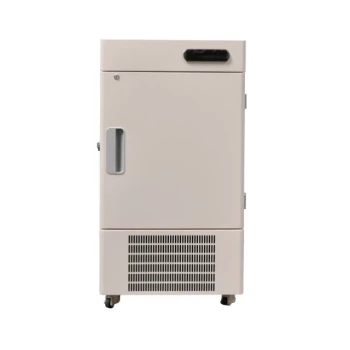
- 808L Precision Laboratory Vertical Ultra Low Temperature Freezer
People Also Ask
- What role does a laboratory freeze dryer play in the synthesis of graphene-based electrocatalysts? Preserve 3D Structures
- What are the technical advantages of using a laboratory freeze dryer for porous carbon precursors? Preserve 3D Networks
- What types of liquid samples can be processed using a laboratory freeze dryer? Preserve Your Sensitive Materials
- How do laboratory freeze dryers support scientific research? Preserve Sample Integrity for Reproducible Results
- Why is a laboratory freeze dryer preferred over traditional heating? Preserve Biochar Structure & Maximize Porosity