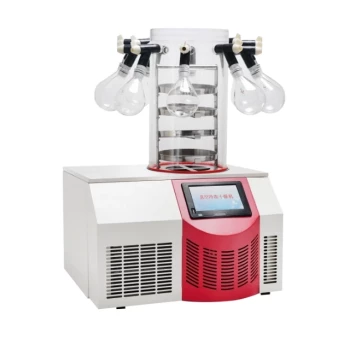
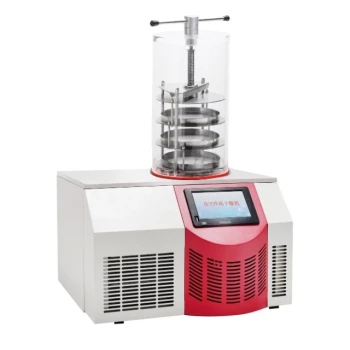
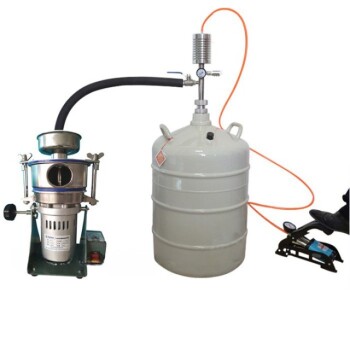
The primary technical advantage of using a laboratory freeze dryer for porous carbon precursors lies in its ability to eliminate the liquid-gas interface during dehydration. By employing sublimation—transitioning ice directly to vapor under vacuum—freeze drying bypasses the destructive capillary forces and surface tension that cause structural collapse during traditional heat drying. This preservation is critical for maintaining the high specific surface area and interconnected pore networks required for advanced electrochemical applications.
Freeze drying protects the architectural integrity of carbon precursors by preventing physical shrinkage and particle agglomeration, ensuring that the final carbon material retains the micro- and mesoporous structures necessary for efficient ion transport and storage.
Preservation of Structural Integrity
Eliminating Capillary Collapse
Traditional heat drying relies on liquid evaporation, which creates a liquid-gas interface within the precursor's pores. The resulting surface tension generates massive capillary forces that pull pore walls together, leading to the permanent collapse of the internal architecture. Freeze drying avoids this by keeping the solvent in a solid state until it sublimates.
Maintaining Three-Dimensional Networks
For materials like biomass-derived carbon or carbon sheets, maintaining a three-dimensional flake structure is essential. Sublimation "locks" the precursor's morphology in place, preserving the interconnected channels that provide abundant pathways for ion migration. This is particularly vital for the performance of materials used in lithium-sulfur batteries or supercapacitors.
Preventing Morphology Shrinkage
In biomass mixtures, such as sweet potato vines or cotton templates, traditional thermal drying causes significant shrinkage of the internal biological structure. Freeze drying maintains the original morphology of these raw materials. This ensures that the final carbonized product inherits the desired natural porosity of the source material.
Enhanced Chemical and Physical Uniformity
Preventing Component Migration
During heat drying, dissolved activation agents or solutes often migrate toward the surface as the liquid solvent evaporates. Freeze drying fixes these components within a frozen matrix, ensuring a uniform distribution of agents throughout the precursor. This uniformity is essential for achieving consistent pore activation during the subsequent carbonization process.
Mitigating Particle Agglomeration
Dehydrating precursors like carbon black at ultra-low temperatures (e.g., -60°C) prevents particles from clumping together. By directly sublimating ice crystals, the process keeps particles separated and maintains a high specific surface area. This provides an ideal support structure for the uniform distribution of secondary nanoparticles, such as CeO2.
Protecting Heat-Sensitive Samples
Many organic precursors or biological templates are unstable or sensitive to high temperatures. Freeze drying operates at low temperatures, allowing these materials to be dried without thermal degradation. This preserves the chemical integrity of the precursor, ensuring it reacts as intended during the carbonization stage.
Process and Environmental Advantages
Oxygen-Free Processing
Freeze drying occurs within a vacuum chamber, creating an oxygen-free environment. This protects sensitive precursors from oxidation that might occur in a standard drying oven. It ensures the quality of the dried material is comparable to the original sample, with no unintended chemical changes.
Efficiency and Solvent Recovery
While often perceived as a slow process, specialized laboratory freeze dryers can significantly shorten drying times—sometimes by 3 to 10 times—compared to conventional vacuum ovens for certain materials. Furthermore, these systems allow for the recycling of organic solvents. This capability reduces production costs and minimizes the environmental footprint of the laboratory.
Understanding the Trade-offs
Equipment Investment and Maintenance
A laboratory freeze dryer represents a higher initial capital investment than a standard heat-drying oven. The systems also require consistent maintenance of vacuum pumps and condenser coils to ensure they reach the deep vacuum levels necessary for effective sublimation.
Pre-Freezing Requirements
The precursor must be completely and rapidly frozen before the vacuum is applied to the chamber. If the freezing process is too slow or incomplete, large ice crystals may form and damage the delicate pore walls, or the sample may experience "melt-back," leading to the very structural collapse the process is meant to avoid.
Material Compatibility
While excellent for aqueous and many organic solvent systems, the specific freezing point and vapor pressure of the solvent must be compatible with the freeze dryer's condenser temperature. Materials containing high concentrations of certain salts or solvents with very low freezing points may require specialized configurations.
Strategic Implementation for Carbon Synthesis
To maximize the performance of your porous carbon materials, the drying method must align with your specific material goals and the nature of your precursor.
- If your primary focus is maximizing ion storage and transport: Use freeze drying to preserve the fine network of micro- and mesopores that traditional heat drying would otherwise collapse.
- If your primary focus is increasing catalytic active site exposure: Utilize freeze drying to prevent the agglomeration of support particles, ensuring a high surface area for nanoparticle distribution.
- If your primary focus is biomass valorization: Choose freeze drying to maintain the original biological morphology of the raw material, which serves as a natural template for the final carbon structure.
- If your primary focus is environmental and cost efficiency with organic solvents: Implement freeze drying to utilize its solvent recycling capabilities and oxygen-free vacuum environment.
By leveraging the physics of sublimation, laboratory freeze drying serves as a foundational tool for engineering the next generation of high-performance, porous carbon materials.
Summary Table:
| Feature | Laboratory Freeze Drying | Traditional Heat Drying |
|---|---|---|
| Mechanism | Sublimation (Solid to Gas) | Evaporation (Liquid to Gas) |
| Structural Impact | Preserves 3D pores; No shrinkage | Capillary collapse; Structural shrinkage |
| Surface Area | High (Maintains micro/mesopores) | Low (Loss due to agglomeration) |
| Chemical Uniformity | Uniform agent distribution | Solute migration to surface |
| Environment | Oxygen-free vacuum; Low temp | Potential oxidation; High temp |
| Processing Cost | Higher investment & maintenance | Lower initial capital cost |
Elevate Your Material Science with KINTEK Solutions
Unlock the full potential of your porous carbon research with precision-engineered laboratory equipment. KINTEK specializes in advanced solutions for material synthesis, offering a comprehensive range of laboratory freeze dryers, vacuum systems, and high-temperature furnaces (muffle, tube, and atmosphere) designed to maintain the architectural integrity of your precursors.
Whether you are developing next-generation lithium-sulfur batteries or high-performance supercapacitors, our portfolio—including high-pressure reactors, electrolytic cells, and precision crushing systems—provides the reliability and control your lab demands.
Ready to achieve superior surface area and structural precision? Contact our technical experts today to find the perfect equipment fit for your carbon synthesis workflow.
References
- Shumeng Qin, Shicheng Zhang. In Situ N, O Co-Doped Nanoporous Carbon Derived from Mixed Egg and Rice Waste as Green Supercapacitor. DOI: 10.3390/molecules28186543
This article is also based on technical information from Kintek Solution Knowledge Base .
Related Products
- High Performance Laboratory Freeze Dryer
- High Performance Laboratory Freeze Dryer for Research and Development
- Benchtop Laboratory Freeze Dryer for Lab Use
- Benchtop Laboratory Vacuum Freeze Dryer
- 808L Precision Laboratory Vertical Ultra Low Temperature Freezer
People Also Ask
- What role does a laboratory freeze dryer play in the synthesis of graphene-based electrocatalysts? Preserve 3D Structures
- What types of liquid samples can be processed using a laboratory freeze dryer? Preserve Your Sensitive Materials
- How do laboratory freeze dryers support scientific research? Preserve Sample Integrity for Reproducible Results
- Why is a laboratory freeze dryer preferred over traditional heating? Preserve Biochar Structure & Maximize Porosity
- What precautions should be taken when using a laboratory freeze dryer? Essential Steps for Reliable Lyophilization