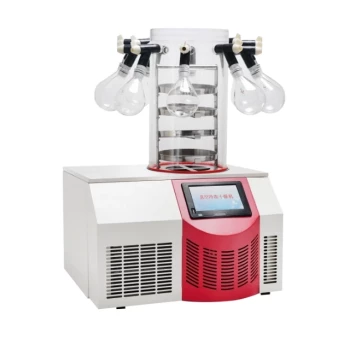
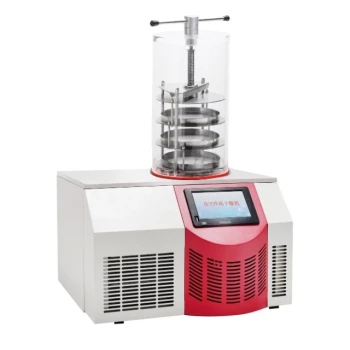
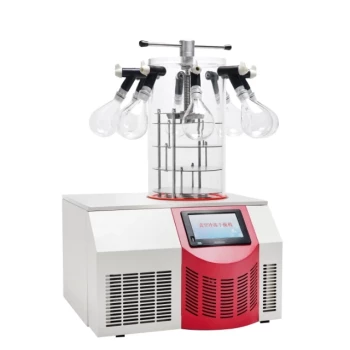
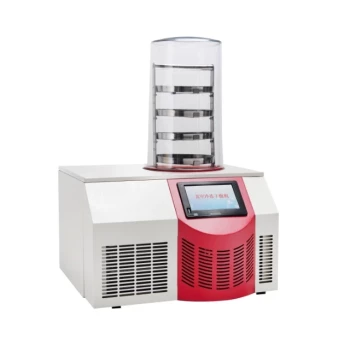
In the synthesis of graphene-based electrocatalysts, a laboratory freeze dryer acts as a structural preservation agent, playing a decisive role in determining the final morphology of the material. By removing water from graphene hydrogels via sublimation, it prevents the physical collapse of the material's internal architecture, converting the wet hydrogel into a dry, highly porous aerogel structure essential for catalytic performance.
Core Takeaway The freeze dryer's sublimation process eliminates the liquid surface tension forces that typically destroy porous networks during drying. This preserves a three-dimensional, interconnected structure with high surface area, which is critical for ensuring efficient mass transfer in electrochemical reactions.
Preventing Structural Collapse
The Danger of Conventional Drying
When graphene hydrogels undergo conventional thermal drying (such as in an oven), they face a liquid-to-solid phase transition. This process introduces significant surface tension forces as the solvent evaporates.
Avoiding Agglomeration
These forces cause severe agglomeration of the graphene sheets. Instead of remaining separated, the sheets stack and collapse upon themselves, destroying the delicate internal structure formed during the hydrogel phase.
The Sublimation Mechanism
A freeze dryer circumvents this issue by freezing the water within the hydrogel and then removing it through sublimation (transitioning directly from solid ice to vapor). This bypasses the liquid phase entirely, neutralizing the surface tension that would otherwise crush the pores.
Enhancing Electrochemical Performance
Preserving the 3D Skeleton
The primary outcome of freeze-drying is the preservation of the hydrogel's three-dimensional interconnected porous structure. The machine ensures that the complex skeleton formed during synthesis remains intact in the final dry state.
Maximizing Specific Surface Area
Because the graphene sheets are prevented from restacking, the final material retains a significantly high specific surface area. This maximizes the number of exposed active sites available for chemical reactions.
Enabling Efficient Mass Transfer
In electrochemical applications, the catalyst must interact with electrolytes and reactants. The porous network maintained by freeze-drying creates efficient mass transfer channels, allowing molecules to freely penetrate the material and contact catalytic sites without obstruction.
Common Pitfalls to Avoid
Misunderstanding the Drying Method
It is a critical error to assume all drying methods yield similar results for nanomaterials. Using heat evaporation instead of freeze-drying will fundamentally alter the material's properties, rendering it less effective for catalysis.
The "Collapse" Trade-off
If you choose conventional drying methods, you are effectively trading porosity and surface area for a denser, agglomerated solid. While this may be acceptable for some bulk materials, it is detrimental to electrocatalysts that rely on surface interactions.
Making the Right Choice for Your Goal
To ensure your graphene-based electrocatalyst performs as intended, align your drying method with your specific structural requirements:
- If your primary focus is electrochemical efficiency: You must use freeze-drying to preserve the high surface area and porous channels required for ion transport.
- If your primary focus is structural density: Conventional oven drying will lead to agglomeration, resulting in a compact solid with significantly reduced catalytic activity.
Ultimately, the freeze dryer is not just a drying tool, but a morphology-control device that unlocks the full potential of the synthesized hydrogel.
Summary Table:
| Feature | Freeze Drying (Sublimation) | Conventional Oven Drying (Evaporation) |
|---|---|---|
| Structural Impact | Preserves 3D porous skeleton | Causes severe sheet agglomeration/stacking |
| Surface Area | High specific surface area | Low surface area due to collapse |
| Mass Transfer | Efficient channels for electrolytes | Obstructed pathways for ions/reactants |
| Surface Tension | Neutralized (Ice to Vapor) | High (Liquid to Vapor) |
| Final Product | Aerogel with active sites | Dense, low-activity solid |
Elevate Your Nanomaterial Synthesis with KINTEK
Precise morphology control is the difference between a high-performance electrocatalyst and a failed experiment. KINTEK specializes in advanced laboratory equipment designed for the rigors of materials science. Our high-performance freeze dryers and cooling solutions ensure the structural integrity of your graphene aerogels, while our battery research tools, electrolytic cells, and high-temperature furnaces provide a complete ecosystem for your electrochemical innovations.
Don't let surface tension crush your research goals. From porous hydrogel preservation to high-pressure reactor synthesis, KINTEK provides the precision tools needed for superior catalytic efficiency.
Ready to optimize your lab’s workflow? Contact us today to explore our full range of laboratory solutions!
References
- Zesheng Li, Changlin Yu. Highly-dispersed and high-metal-density electrocatalysts on carbon supports for the oxygen reduction reaction: from nanoparticles to atomic-level architectures. DOI: 10.1039/d1ma00858g
This article is also based on technical information from Kintek Solution Knowledge Base .
Related Products
- High Performance Laboratory Freeze Dryer
- High Performance Laboratory Freeze Dryer for Research and Development
- Benchtop Laboratory Freeze Dryer for Lab Use
- Benchtop Laboratory Vacuum Freeze Dryer
- 808L Precision Laboratory Vertical Ultra Low Temperature Freezer
People Also Ask
- What are the technical advantages of using a laboratory freeze dryer for porous carbon precursors? Preserve 3D Networks
- What types of liquid samples can be processed using a laboratory freeze dryer? Preserve Your Sensitive Materials
- How do laboratory freeze dryers support scientific research? Preserve Sample Integrity for Reproducible Results
- Why is a laboratory freeze dryer preferred over traditional heating? Preserve Biochar Structure & Maximize Porosity
- What precautions should be taken when using a laboratory freeze dryer? Essential Steps for Reliable Lyophilization