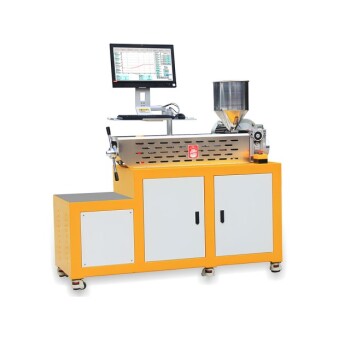
The primary advantage of a specialized dual-atmosphere test apparatus lies in its ability to replicate the complex chemical gradients found in actual Solid Oxide Electrolyzer Cell (SOEC) operations. By simultaneously exposing interconnect materials to oxidizing and reducing environments, this equipment identifies degradation mechanisms—specifically the "dual-atmosphere effect"—that single-side testing cannot detect. This approach ensures that protective coatings and metallic substrates are evaluated under the exact thermo-chemical stresses they will face in a functional stack.
Dual-atmosphere testing is essential because it uncovers how hydrogen diffusion through the metal substrate accelerates oxidation on the air-facing side. Without this specialized setup, researchers risk overestimating material longevity by ignoring the synergistic effects of simultaneous gas exposure.
Simulating Real-World Operational Environments
Mimicking Dual Gas Streams
In an SOEC stack, the interconnect acts as a physical barrier between the oxygen-rich side and the steam/hydrogen side. Dual-atmosphere rigs precisely replicate this partition by feeding distinct gas compositions to each face of the material sample. This setup ensures that the material experiences the same chemical environment as a component in a commercial electrolyzer.
Recreating Chemical Gradients
High-temperature operations create intense chemical potential gradients across the thickness of the interconnect. These gradients drive mass transport processes and diffusion pathways that are completely absent in standard, single-atmosphere furnace testing. Replicating these gradients is critical for predicting how the material will behave over thousands of hours of service.
Uncovering the Dual-Atmosphere Effect
The Impact of Hydrogen Diffusion
Small hydrogen molecules can diffuse through the metallic substrate from the reducing (steam) side to the oxidizing (oxygen) side. This internal migration often leads to accelerated oxidation or the formation of sub-surface voids at the metal-oxide interface. Specialized rigs are the only way to observe how this "leakage" at the atomic level compromises the structural integrity of the part.
Evaluating Coating Resilience
Protective coatings must resist not only surface-level oxidation but also the internal stresses caused by hydrogen ingress from the "back" side of the metal. Dual-atmosphere testing allows researchers to measure how well a coating maintains its protective barrier properties under these multi-directional chemical attacks. This leads to the development of more robust coating chemistries that can withstand complex SOEC environments.
Understanding the Trade-offs
System Complexity and Cost
Maintaining hermetic seals between the two gas environments at high temperatures is a significant technical challenge. This complexity makes dual-atmosphere equipment substantially more expensive to design, build, and maintain than standard laboratory furnaces.
Data Interpretation Challenges
The interplay of multiple variables—such as temperature, gas flow rates, and diffusion speeds—makes it harder to isolate the specific cause of a material failure. Researchers must utilize high-precision monitoring and control systems to ensure that environmental conditions remain stable and reproducible across long test cycles.
How to Apply This to Your Project
Before investing in specialized testing, consider your current stage of development and your specific performance goals.
- If your primary focus is initial material screening: Use standard single-atmosphere furnaces to quickly and cheaply narrow down candidates based on basic oxidation resistance.
- If your primary focus is stack-level validation: Implement dual-atmosphere testing to confirm the long-term durability of the chosen interconnect and coating system before moving to full-scale production.
- If your primary focus is root-cause failure analysis: Utilize these specialized rigs to replicate and study specific degradation patterns seen in fielded SOEC units that cannot be explained by surface oxidation alone.
Moving beyond simplified testing to specialized dual-atmosphere evaluation is the critical step in bridging the gap between laboratory discovery and the deployment of commercially viable SOEC technology.
Summary Table:
| Key Advantage | Impact on SOEC Material Evaluation |
|---|---|
| Real-World Simulation | Mimics simultaneous oxygen-rich and hydrogen-rich environments. |
| Detection of Diffusion | Reveals how hydrogen migration accelerates internal oxidation. |
| Coating Resilience | Evaluates barrier performance under multi-directional chemical stress. |
| Stack Validation | Bridges the gap between basic screening and full-scale production. |
Elevate Your SOEC Research with KINTEK Precision
Transitioning from laboratory discovery to commercially viable SOEC technology requires equipment that can handle the most extreme thermo-chemical stresses. KINTEK provides a comprehensive range of laboratory solutions, including atmosphere and vacuum furnaces, CVD/PECVD systems, and high-temperature high-pressure reactors designed to replicate complex operational environments.
Whether you are testing interconnect materials, developing protective coatings, or refining battery research, our high-performance tools—from technical ceramics and crucibles to precision hydraulic presses—ensure your data is accurate and reproducible. Partner with KINTEK to uncover hidden degradation mechanisms and accelerate your path to stack-level validation.
Contact KINTEK today to find the ideal testing solutions for your project!
References
- Fengyu Shen, Michael C. Tucker. Dynamic oxidation of (Mn,Co)3O4-Coated interconnects for solid oxide electrolysis cells. DOI: 10.1016/j.ijhydene.2023.05.110
This article is also based on technical information from Kintek Solution Knowledge Base .
Related Products
- Oxygen Probe to Measure Temperature and Active Oxygen Content in Molten Steel
- Filter Testing Machine FPV for Dispersion Properties of Polymers and Pigments
- Laboratory Oscillating Orbital Shaker
People Also Ask
- What are the primary advantages and disadvantages of using an oxygen probe? Optimize Your Atmosphere Control Strategy
- How do you measure melting? Mastering Temperature & Rate for Lab & Industry
- How is a galvanostat used to evaluate F-rGO layers? Quantifying Protective Performance in Lithium Metal Batteries
- What are the hazards of molten metals? Beyond Burns to Explosions and Toxic Fumes
- Why use gold for sputtering? Unlock Unmatched Conductivity and Corrosion Resistance