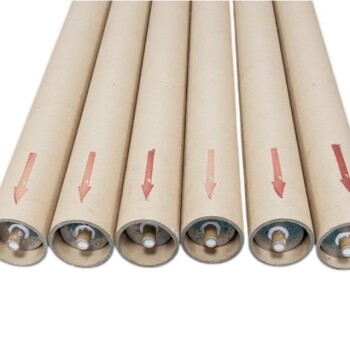
The primary advantages of using an oxygen probe for atmosphere control include high accuracy, rapid response times, and the ability to provide a direct readout of carbon potential. However, these benefits are counterbalanced by significant vulnerabilities: the device's accuracy is compromised if Carbon Monoxide (CO) levels deviate from a fixed standard, and the ceramic construction makes it prone to breakage from thermal or mechanical shock.
Core Takeaway Oxygen probes offer a low-maintenance, high-precision solution for monitoring high-temperature carburizing processes. However, their reliability is strictly tied to a stable CO atmosphere; if your process variables fluctuate, the probe’s readings may become inaccurate without you realizing it.
The Strategic Advantages
Precision and Speed
The most immediate benefit of an oxygen probe is its operational responsiveness. It provides a fast, accurate measurement of the atmosphere, allowing for real-time adjustments during heat treatment.
Direct Process Intelligence
Unlike systems that require complex interpretation, an oxygen probe delivers a direct readout of the carbon potential. This simplifies the control loop, giving operators immediate insight into the carburizing capability of the furnace atmosphere.
Suitability for Harsh Environments
These probes are specifically designed for high-temperature carburizing environments. Despite the harsh conditions inside the furnace, they require minimal maintenance to remain operational during their lifespan.
Understanding the Trade-offs: Critical Limitations
The Carbon Monoxide Dependency
The most significant technical limitation of an oxygen probe is its mathematical reliance on a constant variable. The probe calculates carbon potential based on the assumption that the CO content in the atmosphere is fixed, typically at 20% or 23%.
If the actual CO level in your furnace deviates from this fixed value, the probe cannot compensate on its own. Consequently, the readout becomes erroneous, potentially leading to out-of-spec parts if not verified by other means.
Material Fragility
Because the probe is constructed as a ceramic component, it lacks the ruggedness of metallic sensors. It is highly vulnerable to thermal shock (rapid temperature changes) and mechanical shock (physical impact).
Lifecycle and Replacement Costs
Due to the harsh operating environment and material fragility, oxygen probes are not permanent fixtures. They are consumable items that require periodic replacement, typically on an annual basis, which must be factored into the ongoing operational budget.
Making the Right Choice for Your Process
Before integrating oxygen probes into your control strategy, evaluate your process stability and handling procedures.
- If your primary focus is process consistency: Ensure your gas generator or atmosphere source maintains strict CO levels (20-23%) to guarantee the probe's accuracy.
- If your primary focus is equipment longevity: Implement strict protocols to prevent thermal shock during insertion or removal to maximize the one-year lifespan of the ceramic component.
Oxygen probes are powerful tools for precision control, provided you maintain the specific atmospheric conditions they require to function correctly.
Summary Table:
| Feature | Advantages | Disadvantages |
|---|---|---|
| Performance | High accuracy & real-time response | Inaccurate if CO levels deviate |
| Process Insight | Direct carbon potential readout | Mathematical reliance on fixed CO % |
| Durability | Built for high-temp carburizing | Highly prone to thermal/mechanical shock |
| Maintenance | Minimal maintenance required | Annual replacement needed (consumable) |
| Material | Specialized ceramic construction | Fragile; lacks ruggedness of metallic sensors |
Elevate Your Heat Treatment Precision with KINTEK
Precise atmosphere control is the backbone of successful carburizing and material research. Whether you are managing complex high-temperature furnaces or looking for durable laboratory consumables, KINTEK provides the expertise and equipment you need to ensure consistent results.
From our advanced high-temperature muffle, tube, and vacuum furnaces to essential specialized ceramics and crucibles, we offer a comprehensive portfolio tailored for demanding laboratory and industrial environments. We also specialize in crushing and milling systems, hydraulic presses, and battery research tools designed to streamline your workflow.
Ready to optimize your furnace performance? Contact KINTEK today to speak with our technical experts about our high-precision solutions and let us help you achieve superior process stability.
Related Products
- Oxygen Probe to Measure Temperature and Active Oxygen Content in Molten Steel
- Sub-Lance Probe for Molten Steel Temperature Carbon Content Oxygen Content Measurement and Steel Sample Collection
- Hydrogen Determination Probe for Quickly Measuring Hydrogen Content with High Success Rate
- Bomb Type Probe for Steelmaking Production Process
People Also Ask
- How do you measure melting? Mastering Temperature & Rate for Lab & Industry
- How is a galvanostat used to evaluate F-rGO layers? Quantifying Protective Performance in Lithium Metal Batteries
- What are the hazards of molten metals? Beyond Burns to Explosions and Toxic Fumes
- Why use gold for sputtering? Unlock Unmatched Conductivity and Corrosion Resistance
- What is a gold sputtering target? A High-Purity Source for Precision Gold Coatings