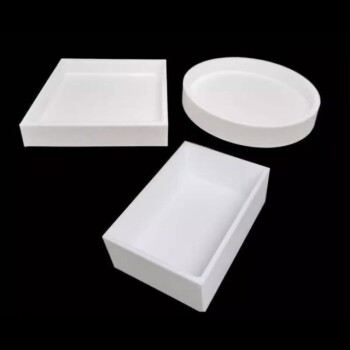
The primary function of using a PTFE container with a metal base is to enforce a strict vertical temperature gradient within the lignin suspension. The metal base acts as a highly conductive interface to transfer cold from liquid nitrogen, while the PTFE walls serve as thermal insulators to block cooling from the sides. This precise manipulation of heat transfer is the critical mechanism that creates the desired honeycomb microstructure.
By decoupling the cooling source from the container walls, this setup forces ice crystals to grow exclusively from the bottom up. This longitudinal growth acts as a physical template, compressing the lignin into a highly oriented, honeycomb-like cell wall structure.
The Physics of Directional Freezing
To understand why this specific container is necessary, one must look at how thermal conductivity dictates crystal alignment.
The Role of the Metal Base
The metal base is selected for its high thermal conductivity.
When placed in contact with liquid nitrogen, the metal instantly transfers the extreme cold to the bottom layer of the lignin suspension.
This establishes the "cold source" at the very bottom of the container, initiating the freezing process at the base interface.
The Function of PTFE Insulation
PTFE (polytetrafluoroethylene) is used for the container walls specifically because of its low thermal conductivity.
These walls act as a thermal barrier, preventing the cold temperature of the environment from penetrating the suspension from the sides.
Without this insulation, the suspension would cool radially (from the outside in), which would disrupt the vertical alignment of the structure.
How Structure Follows Temperature
The container is not just a vessel; it is a tool for controlling the geometry of ice crystal growth.
Enforcing Longitudinal Growth
Because the metal base cools rapidly and the PTFE walls prevent side cooling, a specific temperature gradient is formed.
The cold moves strictly from the bottom to the top.
Physics dictates that ice crystals grow parallel to the direction of the thermal gradient, causing them to propagate longitudinally upward through the liquid.
Creating the Honeycomb Architecture
As these vertical ice crystals grow, they act as physical pillars.
The growing ice pushes the solid lignin components out of the way, compressing them into the interstitial spaces between the crystals.
This process essentially molds the lignin into a highly oriented, honeycomb cell wall structure that remains once the ice is removed.
Understanding the Trade-offs
While this setup is effective for creating honeycomb structures, it relies heavily on maintaining a perfect thermal contrast.
Sensitivity to Material Properties
The success of this method depends entirely on the stark difference in conductivity between the base and the walls.
If the wall material is not sufficiently insulating, "side creep" of ice will occur, creating a chaotic structure rather than a uniform honeycomb.
Gradient Limitations
The metal base must maintain contact with the cooling medium (liquid nitrogen) consistently.
If the thermal transfer at the base is interrupted, the vertical velocity of the ice growth changes, potentially altering the pore size or density of the foam unpredictably.
Making the Right Choice for Your Goal
To ensure you achieve the correct foam morphology, apply these principles to your equipment setup:
- If your primary focus is strict vertical alignment: Ensure your container walls are made of high-grade PTFE or equivalent insulators to completely eliminate radial cooling.
- If your primary focus is rapid crystallization: Maximize the surface area of the metal base in contact with the liquid nitrogen to steepen the vertical temperature gradient.
Control the direction of the heat transfer, and you control the architecture of the material.
Summary Table:
| Component | Material | Thermal Property | Functional Role in Directional Freezing |
|---|---|---|---|
| Container Base | Metal | High Conductivity | Rapidly transfers cold from liquid nitrogen to initiate base-up freezing. |
| Container Walls | PTFE | Low Conductivity | Acts as a thermal barrier to prevent side cooling and radial ice growth. |
| Cooling Source | Liquid Nitrogen | Cryogenic | Provides the extreme thermal gradient necessary for longitudinal growth. |
| Resultant Structure | Lignin Foam | Honeycomb | Vertical ice crystals template the lignin into highly oriented cell walls. |
Precision Equipment for Advanced Material Synthesis
At KINTEK, we understand that controlling thermal gradients is the key to mastering material architecture. Whether you are developing honeycomb lignin foams or advanced composites, our specialized laboratory solutions provide the precision you need.
Our extensive portfolio includes high-quality PTFE products and ceramics, alongside essential tools for material research such as high-temperature furnaces, crushing and milling systems, and hydraulic presses. For researchers working with complex chemical processes, we offer high-temperature high-pressure reactors, autoclaves, and electrolytic cells designed to withstand the most demanding environments.
Ready to optimize your directional freezing setup or upgrade your lab?
Contact KINTEK today to discuss your project requirements!
References
- Zhihui Zeng, Xuehong Lu. Biomass-based honeycomb-like architectures for preparation of robust carbon foams with high electromagnetic interference shielding performance. DOI: 10.1016/j.carbon.2018.08.061
This article is also based on technical information from Kintek Solution Knowledge Base .
Related Products
- Custom PTFE Teflon Parts Manufacturer for PTFE Containers
- Custom PTFE Teflon Parts Manufacturer PTFE Beaker and Lids
- Custom PTFE Teflon Parts Manufacturer for Microwave Digestion Tank
- Custom PTFE Teflon Parts Manufacturer F4 Conical Flask Triangular Flask 50 100 250ml
- Customizable PTFE Wafer Carriers for Semiconductor and Lab Applications
People Also Ask
- Why are PTFE containers required for PCT leaching tests? Ensure Chemical Inertness and Analytical Precision
- Why are PTFE containers necessary for selective HF etching of MAX phases? Ensure Safe & Pure MXene Synthesis
- Why is PTFE Mandatory for Hydrofluoric Acid (HF) Handling? Ensure Safety and Data Integrity in Corrosion Testing
- Why is a PTFE container required for acid leaching of silicon nanosheets? Ensure High Purity and Safety
- Why are polytetrafluoroethylene (PTFE) containers essential for assessing the corrosion resistance of glassified waste?