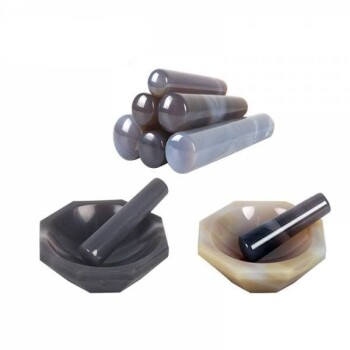
The use of an agate mortar in the synthesis of antimony trioxide is primarily driven by its exceptional hardness and chemical inertness. These properties allow for the intense mechanical grinding of reactants—specifically antimony trichloride and sodium hydroxide—without the risk of the mortar shedding material into the mixture. This ensures that the reactants achieve high microscopic uniformity and full contact, which is essential for a complete and efficient reaction.
The core advantage of an agate mortar lies in its ability to facilitate high-energy mechanical activation while maintaining a high-purity environment. By preventing the introduction of external contaminants and ensuring precise stoichiometry, it serves as a critical tool for producing high-quality antimony trioxide.
Achieving Microscopic Uniformity and Reactivity
High Hardness and Density
Agate is a naturally occurring form of silica characterized by its high hardness and density. This structural integrity allows the mortar to withstand the significant mechanical forces required to grind and mix solid reactants effectively.
Unlike softer materials, agate does not deform or wear down easily under pressure. This ensures that the energy applied during the grinding process is directed entirely toward the mechanical activation of the reactants.
Micro-scale Contact Efficiency
For the synthesis of antimony trioxide to be successful, the reactants must achieve full contact at the microscopic scale. The fine grinding enabled by agate increases the surface area of the particles.
This high level of uniformity ensures that the chemical reaction is consistent throughout the sample. It eliminates "dead zones" where reactants might otherwise remain unmixed and unreacted.
Safeguarding Chemical Purity
Prevention of Material Shedding
One of the most significant risks in mechanical synthesis is the introduction of impurities from the grinding tools themselves. Because agate is highly resistant to wear, it prevents the shedding of particles into the reaction mixture.
This is particularly vital when working with sensitive reactants like antimony trichloride. Maintaining a closed chemical system free from "tool debris" is necessary to ensure the chemical purity of the final antimony trioxide product.
Elimination of Metallic and Silicate Contaminants
Using agate mortars prevents the introduction of metallic or silicate impurities that are common when using steel or low-grade ceramic tools. Even trace amounts of these impurities can degrade the reaction efficiency.
In high-precision applications, such as the creation of sintering aids, maintaining precise stoichiometry is non-negotiable. Agate ensures that the final product forms a pure phase during subsequent heat treatments without interference from external elements.
Understanding the Trade-offs
Fragility and Thermal Sensitivity
While agate is hard, it is also brittle. It can chip or crack if subjected to sudden heavy impacts or extreme thermal shocks.
Users must handle agate tools with care and avoid using them for "crushing" large, hard chunks that require high-impact force. It is best suited for fine grinding and homogenization rather than primary size reduction.
Scalability and Labor Intensity
Manual grinding in an agate mortar is highly effective for small sample volumes and laboratory-scale synthesis. However, it is a labor-intensive process that may lack the throughput required for industrial production.
For larger scales, a Mortar Grinder (automated) using agate components may be necessary. This preserves the material advantages of agate while providing the reproducibility and efficiency of an automated system.
How to Apply This to Your Project
Recommendations Based on Your Synthesis Goals
Achieving the best results in antimony trioxide synthesis requires aligning your tool choice with your specific purity and volume requirements.
- If your primary focus is maximum chemical purity: Always utilize an agate mortar to eliminate the risk of metallic contamination and ensure the integrity of the final oxide.
- If your primary focus is reaction consistency and reproducibility: Consider an automated mortar grinder with agate attachments to maintain uniform pressure and grinding time across multiple batches.
- If your primary focus is high-volume throughput: Use agate only for the final homogenization stage, utilizing more robust (though potentially less pure) materials for initial bulk crushing.
Selecting an agate mortar is a strategic decision that prioritizes the chemical excellence and structural uniformity of your synthesized materials.
Summary Table:
| Key Feature | Advantage for Synthesis | Impact on Final Product |
|---|---|---|
| High Hardness | Resists wear and deformation | Efficient mechanical activation of reactants |
| Chemical Inertness | Prevents material shedding | Ensures high-purity, contaminant-free results |
| Dense Surface | Enables fine microscopic grinding | Achieves full contact and reaction consistency |
| Non-Metallic | No silicate or metal debris | Maintains precise stoichiometry and phase purity |
Elevate Your Material Synthesis with KINTEK
Precision in the laboratory starts with the right tools. KINTEK specializes in high-performance laboratory equipment designed to ensure the integrity of your chemical processes. From our high-purity agate mortars and automated crushing and milling systems to our comprehensive range of high-temperature furnaces (muffle, vacuum, CVD, and dental) and hydraulic pellet presses, we provide the solutions you need for consistent, high-quality results.
Whether you are synthesizing antimony trioxide, conducting battery research, or developing advanced ceramics, our team is here to support your goals with reliable equipment and expert technical advice.
Ready to optimize your lab's performance and ensure material purity? Contact KINTEK today to explore our full range of laboratory solutions and essential consumables.
References
- Duncan H. Moseley, Raphaël P. Hermann. Structure and Anharmonicity of α- and β-Sb2O3 at Low Temperature. DOI: 10.3390/cryst13050752
This article is also based on technical information from Kintek Solution Knowledge Base .
Related Products
- Nature Agate Mortar and Pestle for Grinding and Mixing
- Laboratory Jar Mill with Agate Grinding Jar and Balls
People Also Ask
- Why are agate mortars and pestles used for grinding iron oxide? Ensure Sample Purity for XRD Analysis
- What is the function of an agate mortar and pestle? Ensure Purity in Halide Solid-State Electrolyte Synthesis
- What is the primary function of an agate mortar and pestle? Optimize VO2+ CaZn2(PO4)2 Nanopowder Pre-Treatment
- Why is an agate mortar and pestle required for grinding Zr3(Al1-xSix)C2? Ensure Maximum Sample Purity
- Why is an agate mortar and pestle preferred for grinding MAX phase? Ensure Sample Purity & Zero Contamination