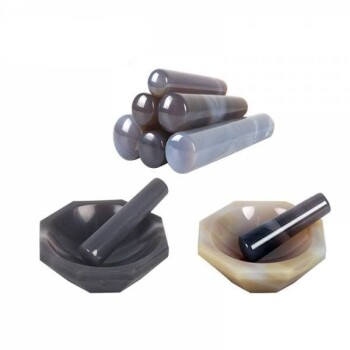
Agate is the preferred material because its exceptional hardness and wear resistance prevent the contamination of the sample during the fine grinding process. When processing melamine condensates and ammonium carbonate, using an agate mortar ensures that microscopic debris from the grinding tool itself does not enter the mixture.
The primary value of the agate mortar is its ability to maintain a chemically pure environment. This purity is critical for achieving molecular-level uniformity, which is the prerequisite for forming highly exfoliated nanosheet structures during subsequent high-temperature sintering.
The Imperative of Purity
Eliminating Mechanical Impurities
The most critical requirement in this process is preventing the introduction of foreign contaminants.
Standard grinding tools made of porcelain or glass are softer and more prone to abrasion.
As you grind hard materials, these softer tools can shed microscopic particles—"mechanical impurities"—into your sample.
High Wear Resistance
Agate is a naturally hard, dense stone with high wear resistance.
It withstands the friction of fine grinding without degrading.
This ensures that the final powder consists exclusively of your reactants, melamine and ammonium carbonate, with zero contribution from the mortar itself.
Facilitating Molecular Interaction
Achieving Uniform Mixing
The goal of this specific grinding process is not merely to reduce particle size, but to achieve homogeneity.
You are aiming for molecular-level uniform mixing between the melamine condensates and the ammonium carbonate.
The high-purity environment provided by the agate allows these components to mix intimately without the interference of impurity particles.
The Dynamic Gas Template
Ammonium carbonate serves a specific function here: it acts as a "dynamic gas template."
For this template to function correctly during heating, it must be perfectly distributed within the melamine matrix.
Any impurities introduced during grinding could disrupt this distribution, leading to defects in the final material structure.
The Impact on Sintering and Structure
Forming Nanosheet Structures
The ultimate goal of this preparation is to create specific nanostructures.
The uniform mixture established in the agate mortar lays the foundation for high-temperature sintering.
Specifically, it enables the formation of highly exfoliated nanosheet structures.
Avoiding Structural Defects
If impurities were present, they would act as nucleation points for defects or barriers to exfoliation.
By using agate, you ensure the precursor material is pure enough to exfoliate correctly under heat, resulting in the desired high-surface-area architecture.
Understanding the Trade-offs
Cost vs. Performance
While agate is chemically superior, it is significantly more expensive than ceramic or glass alternatives.
It is also brittle; while hard, it has low impact resistance and can crack if dropped or struck with a hammer-like motion.
When Agate is Overkill
For rough crushing of bulk materials where ppm-level purity is irrelevant, agate is unnecessary.
However, for synthesizing advanced nanomaterials like exfoliated nanosheets or MXenes, the cost is justified by the necessity of chemical inertness.
Making the Right Choice for Your Goal
To ensure you are applying this equipment correctly for your specific synthesis:
- If your primary focus is synthesizing high-performance nanosheets: Use an agate mortar exclusively to ensure the molecular uniformity required for exfoliation.
- If your primary focus is general bulk mixing: A standard porcelain mortar may suffice, provided the introduction of minor silica or metallic impurities does not affect your reaction.
Purity in the preparation phase is the defining factor in the quality of the final nanostructure.
Summary Table:
| Feature | Agate Mortar & Pestle | Porcelain/Glass Alternatives |
|---|---|---|
| Hardness | Exceptionally High | Moderate to Low |
| Wear Resistance | Superior (Minimal shedding) | Lower (Prone to abrasion) |
| Contamination Risk | Negligible | High (Mechanical impurities) |
| Best Use Case | Advanced Nanomaterials & Sintering | General Bulk Mixing |
| Primary Benefit | Molecular-level uniformity | Lower Initial Cost |
Elevate Your Material Synthesis with KINTEK
Precision in the preparation phase defines the quality of your final nanostructure. KINTEK specializes in high-performance laboratory equipment designed for the most demanding research environments. Whether you need the chemical purity of our premium agate mortar and pestle sets, the precision of our crushing and milling systems, or the thermal control of our advanced muffle and CVD furnaces, we provide the tools necessary for achieving highly exfoliated nanosheet structures and beyond.
From pellet and isostatic hydraulic presses to high-purity ceramics and crucibles, KINTEK is your partner in laboratory excellence. Don't let mechanical impurities compromise your research. Contact our technical experts today to find the perfect equipment for your specific synthesis needs!
References
- Sepideh Pourhashem, Davood Mohammady Maklavany. Developing a new method for synthesizing amine functionalized g-C3N4 nanosheets for application as anti-corrosion nanofiller in epoxy coatings. DOI: 10.1007/s42452-018-0123-7
This article is also based on technical information from Kintek Solution Knowledge Base .
Related Products
- Nature Agate Mortar and Pestle for Grinding and Mixing
- Laboratory Jar Mill with Agate Grinding Jar and Balls
People Also Ask
- Why are agate mortars and pestles used for grinding iron oxide? Ensure Sample Purity for XRD Analysis
- What is the function of an agate mortar and pestle? Ensure Purity in Halide Solid-State Electrolyte Synthesis
- What is the primary function of an agate mortar and pestle? Optimize VO2+ CaZn2(PO4)2 Nanopowder Pre-Treatment
- Why is an agate mortar and pestle required for grinding Zr3(Al1-xSix)C2? Ensure Maximum Sample Purity
- Why is an agate mortar and pestle preferred for grinding MAX phase? Ensure Sample Purity & Zero Contamination