Knowledge What is the function of a mortar and pestle in ZnS nanoparticle prep? Optimize Your Sample Refinement
Author avatar

Tech Team · Kintek Solution

Updated 1 day ago

What is the function of a mortar and pestle in ZnS nanoparticle prep? Optimize Your Sample Refinement


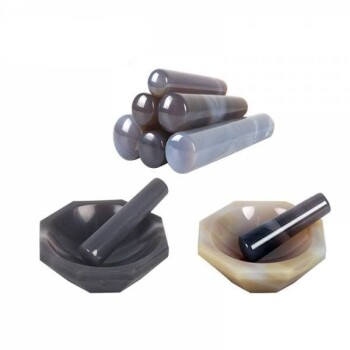
The primary function of a mortar and pestle in the preparation of Zinc Sulfide (ZnS) nanoparticle samples is the mechanical pulverization of dried bulk materials. Through manual grinding, you transform coarse, dried material into a fine powder with a uniform particle size. This physical refinement is a prerequisite for both accurate analytical characterization and the enhancement of the material's functional properties.

Core Takeaway While the synthesis process creates the chemical compound, the mortar and pestle define its physical utility. By grinding the bulk material into a fine powder, you maximize the effective surface area for photocatalytic activity and ensure the sample is compatible with sensitive analytical instruments.

The Mechanics of Sample Refinement

Achieving Particle Uniformity

The synthesis of Zinc Sulfide often results in dried "bulk" materials that are coarse or aggregated. Using a mortar and pestle allows for manual grinding to break down these aggregates. This process ensures the material reaches a consistent, fine texture necessary for reliable handling and testing.

Enhancing Material Reactivity

For nanomaterials like ZnS, performance is often dictated by surface interactions. Pulverization significantly increases the effective surface area of the powder. This expanded surface area directly correlates to enhanced photocatalytic activity, making the material more efficient in its intended chemical applications.

Enabling Accurate Characterization

Advanced analytical techniques require specific sample conditions to yield valid data. The fine powder produced by this method is specifically prepared for X-ray diffraction (XRD) and Scanning Electron Microscopy (SEM). Without this mechanical refinement, large particles could obscure structural details or lead to inconsistent imaging results.

Operational Considerations and Limitations

The Human Element

The primary reference highlights that this process involves manual grinding. Consequently, the uniformity of the final powder depends heavily on the operator's technique and persistence. Unlike automated milling, manual pulverization introduces a variable of human error that must be managed carefully.

Processing Stage Context

It is important to note that this grinding occurs only after the precursor synthesis and drying stages. While tools like heating magnetic stirrers are used earlier to dissolve raw materials (Zinc Sulfate and Sodium Sulfide) and ensure stoichiometry in the liquid phase, the mortar and pestle are reserved exclusively for the post-drying solid phase.

Optimizing Your Sample Preparation

To ensure your Zinc Sulfide samples perform effectively, align your grinding technique with your ultimate objective.

  • If your primary focus is Analytical Data: Ensure the powder is ground to maximum fineness to prevent artifacts in XRD and SEM imaging.
  • If your primary focus is Catalytic Performance: Prioritize a grinding duration that maximizes surface area to boost the material's chemical reactivity.

Proper mechanical pulverization is the bridge between a raw synthesized compound and a functional, testable nanomaterial.

Summary Table:

Feature Function in ZnS Preparation Impact on Results
Particle Size Pulverizes bulk material into fine powder Ensures uniformity and prevents imaging artifacts
Surface Area Breaks down aggregates and clusters Maximizes photocatalytic activity and reactivity
Compatibility Prepares sample for XRD and SEM Provides accurate structural and morphology data
Process Stage Post-drying mechanical refinement Bridges the gap between synthesis and analysis

Elevate Your Nanomaterial Precision with KINTEK

Transition from raw synthesis to high-performance research with KINTEK’s professional laboratory solutions. Whether you are refining Zinc Sulfide samples or developing next-generation catalysts, our high-precision crushing and milling systems, high-temperature furnaces, and PTFE consumables ensure your materials meet the most rigorous analytical standards.

Maximize your lab's efficiency and data accuracy today. KINTEK specializes in providing researchers with the tools needed for excellence—from hydraulic pellet presses for XRD prep to advanced vacuum furnaces for material synthesis.

Contact KINTEK for a Consultation and Quote

References

  1. G. Mahesh. Photocatalytic behavior of Undoped and Ni Doped ZnS Nanoparticles for Degradation of Methylene Blue Dye. DOI: 10.22214/ijraset.2018.5003

This article is also based on technical information from Kintek Solution Knowledge Base .

Related Products

People Also Ask

Related Products

Laboratory Grinding Mill Mortar Grinder for Sample Preparation

Laboratory Grinding Mill Mortar Grinder for Sample Preparation

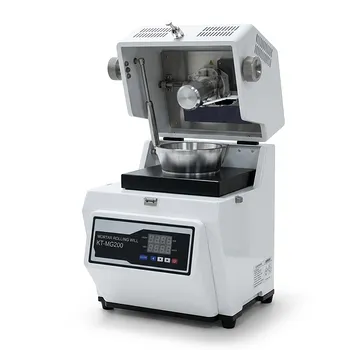
KT-MG200 mortar grinder can be used for mixing and homogenizing powder, suspension, paste and even viscous samples. It can help users realize the ideal operation of sample preparation with more regularization and higher repeatability.

Laboratory High Throughput Tissue Grinding Mill Grinder

Laboratory High Throughput Tissue Grinding Mill Grinder

KT-MT is a high-quality, small, and versatile tissue grinder used for crushing, grinding, mixing, and cell wall breaking in various fields, including food, medical, and environmental protection. It is equipped with 24 or 48 2ml adapters and ball grinding tanks and is widely employed for DNA, RNA, and protein extraction.

Laboratory Jar Ball Mill with Alumina Zirconia Grinding Jar and Balls

Laboratory Jar Ball Mill with Alumina Zirconia Grinding Jar and Balls

Grind to perfection with alumina/zirconia grinding jars and balls. Available in volume sizes from 50ml to 2500ml, compatible with various mills.

Laboratory Disc Cup Vibratory Mill for Sample Grinding

Laboratory Disc Cup Vibratory Mill for Sample Grinding

The vibrating disc mill is suitable for non-destructive crushing and fine grinding of samples with large particle sizes, and can quickly prepare samples with analytical fineness and purity.

Laboratory Micro Tissue Grinding Mill Grinder

Laboratory Micro Tissue Grinding Mill Grinder

KT-MT10 is a miniature ball mill with a compact structure design. The width and depth are only 15X21 cm, and the total weight is only 8 kg. It can be used with a minimum 0.2ml centrifuge tube or a maximum 15ml ball mill jar.

Small Cryogenic Grinder Cryomill Cryogrinder with Liquid Nitrogen for Laboratory Use

Small Cryogenic Grinder Cryomill Cryogrinder with Liquid Nitrogen for Laboratory Use

Our KINTEK Cryomilling is perfect for small runs and R&D trials. With a versatile cryogenic system, it can handle a variety of materials, including plastics, rubber, pharmaceuticals, and food grades. Plus, our specialized hydraulic laboratory crushers ensure accurate results through multiple passes, making it suitable for XRF analysis. Get finely-powdered samples with ease!

Laboratory Horizontal Planetary Ball Mill Milling Machine

Laboratory Horizontal Planetary Ball Mill Milling Machine

Improve sample uniformity with our Horizontal Planetary Ball Mills. KT-P400H reduces sample deposition and KT-P400E has multi-directional capabilities. Safe, convenient and efficient with overload protection.

Liquid Nitrogen Cryogenic Grinder Mill Cryomill Airflow Ultrafine Pulverizer

Liquid Nitrogen Cryogenic Grinder Mill Cryomill Airflow Ultrafine Pulverizer

Discover the Liquid Nitrogen Cryogenic Grinding Machine, perfect for lab use, ultra-fine pulverization, and preserving material properties. Ideal for pharmaceuticals, cosmetics, and more.

Laboratory Disc Rotary Mixer for Efficient Sample Mixing and Homogenization

Laboratory Disc Rotary Mixer for Efficient Sample Mixing and Homogenization

Efficient Laboratory Disc Rotary Mixer for Precise Sample Mixing, Versatile for Various Applications, DC Motor and Microcomputer Control, Adjustable Speed and Angle.

Automatic Laboratory Hydraulic Pellet Press Machine for Lab Use

Automatic Laboratory Hydraulic Pellet Press Machine for Lab Use

Experience efficient sample preparation with our Automatic Lab Press Machine. Ideal for material research, pharmacy, ceramics, and more. Features a compact size and hydraulic press functionality with heating plates. Available in various sizes.

Custom PTFE Teflon Parts Manufacturer for PTFE Mesh F4 Sieve

Custom PTFE Teflon Parts Manufacturer for PTFE Mesh F4 Sieve

PTFE mesh sieve is a specialized test sieve designed for particle analysis in various industries, featuring a non-metallic mesh woven from PTFE filament. This synthetic mesh is ideal for applications where metal contamination is a concern . PTFE sieves are crucial for maintaining the integrity of samples in sensitive environments, ensuring accurate and reliable results in particle size distribution analysis.

Cold Isostatic Pressing Machine CIP for Small Workpiece Production 400Mpa

Cold Isostatic Pressing Machine CIP for Small Workpiece Production 400Mpa

Produce uniformly high-density materials with our Cold Isostatic Press. Ideal for compacting small workpieces in production settings. Widely used in powder metallurgy, ceramics, and biopharmaceutical fields for high-pressure sterilization and protein activation.

Isostatic Molding Pressing Molds for Lab

Isostatic Molding Pressing Molds for Lab

Explore high-performance isostatic pressing molds for advanced material processing. Ideal for achieving uniform density and strength in manufacturing.

Custom PTFE Teflon Parts Manufacturer for PTFE Measuring Cylinder 10/50/100ml

Custom PTFE Teflon Parts Manufacturer for PTFE Measuring Cylinder 10/50/100ml

PTFE measuring cylinder are a rugged alternative to traditional glass cylinders. They are chemically inert over a wide temperature range (up to 260º C), have excellent corrosion resistance and maintain a low coefficient of friction, ensuring ease of use and cleaning.

Electrode Polishing Material for Electrochemical Experiments

Electrode Polishing Material for Electrochemical Experiments

Looking for a way to polish your electrodes for electrochemical experiments? Our polishing materials are here to help! Follow our easy instructions for best results.

Custom PTFE Teflon Parts Manufacturer for Acid and Alkali Resistant Chemical Powder Material Scoops

Custom PTFE Teflon Parts Manufacturer for Acid and Alkali Resistant Chemical Powder Material Scoops

Known for its excellent thermal stability, chemical resistance and electrical insulating properties, PTFE is a versatile thermoplastic material.

Vacuum Hot Press Furnace Machine for Lamination and Heating

Vacuum Hot Press Furnace Machine for Lamination and Heating

Experience clean and precise lamination with Vacuum Lamination Press. Perfect for wafer bonding, thin-film transformations, and LCP lamination. Order now!


Leave Your Message