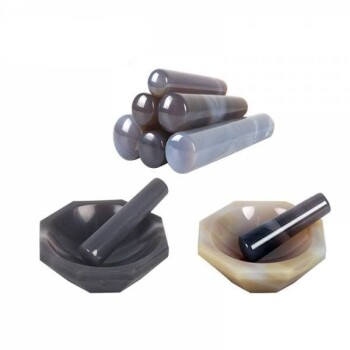
Knowledge What is the primary purpose of using grinding tools like agate mortars? Optimize LTO Electrode Performance
Author avatar

Tech Team · Kintek Solution

Updated 1 day ago

What is the primary purpose of using grinding tools like agate mortars? Optimize LTO Electrode Performance


The primary purpose of using grinding tools like agate mortars is to physically homogenize active materials, conductive additives, and electrolytes into a cohesive composite. By applying specific shear and compressive forces, this process ensures that conductive networks and ion transport channels are uniformly distributed around the active Lithium Titanate (LTO) particles.

Core Insight: The grinding process is less about particle size reduction and more about network formation. It forces the conductive additives and solid electrolytes to establish intimate contact with the active material, which is the prerequisite for both electronic and ionic conductivity in the final electrode.

The Mechanics of Composite Preparation

The Essential Components

To prepare a functional LTO composite electrode, you typically combine three distinct powders.

These include the active material (Lithium Titanate), conductive additives (such as carbon black), and solid electrolyte powders.

Applying Shear and Compressive Forces

The manual or mechanical action of an agate mortar generates specific physical forces.

Shear and compressive forces are applied to the mixture, pressing the lighter, smaller additive particles onto the surface of the larger active material particles.

Achieving Homogeneity

Simple stirring is often insufficient for dry powders due to agglomeration.

Grinding overcomes these cohesive forces, breaking apart clusters of carbon black or electrolyte powder to ensure a uniform blend throughout the sample.

Why Uniformity Matters for LTO

Establishing the Electronic Network

LTO requires a robust pathway for electron movement to function efficiently.

The grinding process distributes conductive additives like carbon black evenly, creating a continuous electronic conductive network that connects individual active particles.

Facilitating Ion Transport

In addition to electron movement, lithium ions must move freely between the electrolyte and the active material.

Proper grinding ensures that solid electrolyte powders are dispersed correctly, creating optimized ion transport channels essential for the battery's charge and discharge cycles.

Understanding the Trade-offs

Manual Consistency Limitations

While agate mortars are excellent for small-scale lab preparation, they are often manually operated.

This introduces the variable of human inconsistency, meaning that the duration and intensity of grinding can vary slightly between batches, potentially affecting reproducibility.

Scalability Issues

The agate mortar approach is primarily a laboratory technique.

It effectively demonstrates the principles of shear force mixing, but it is difficult to scale up for mass production compared to automated methods like ball milling.

Making the Right Choice for Your Goal

When preparing LTO composites, your technique should align with your specific performance requirements.

  • If your primary focus is Electronic Conductivity: Ensure you grind sufficiently to break up carbon black agglomerates, maximizing contact with the LTO surface.
  • If your primary focus is Ionic Conductivity: Focus on the uniform dispersion of the solid electrolyte powder to prevent "dead zones" where ions cannot reach the active material.

Success in LTO preparation relies on using physical force to create an interconnected, microscopic network within the electrode material.

Summary Table:

Feature Role in LTO Composite Preparation
Key Tool Agate Mortar (Manual/Mechanical)
Primary Force Shear and Compressive forces
Active Material Lithium Titanate (LTO)
Additives Carbon black (conductive) & Solid electrolytes
Outcome Uniform electronic & ionic conductive networks
Best For Small-scale lab research & material prototyping

Elevate Your Battery Research with KINTEK

Precision in material preparation is the foundation of high-performance energy storage. KINTEK specializes in providing top-tier laboratory equipment and consumables designed for rigorous R&D. Whether you are optimizing Lithium Titanate (LTO) composites or developing next-generation solid-state batteries, our comprehensive range of crushing and milling systems, agate mortars, and high-pressure hydraulic presses ensures your materials achieve the homogeneity required for superior electronic and ionic conductivity.

From high-temperature furnaces for material synthesis to specialized battery research tools and consumables, KINTEK is your partner in laboratory excellence. Contact us today to find the perfect equipment for your workflow and see how our expertise in high-precision tools can accelerate your breakthroughs.

Related Products

People Also Ask

Related Products

Laboratory Grinding Mill Mortar Grinder for Sample Preparation

Laboratory Grinding Mill Mortar Grinder for Sample Preparation

KT-MG200 mortar grinder can be used for mixing and homogenizing powder, suspension, paste and even viscous samples. It can help users realize the ideal operation of sample preparation with more regularization and higher repeatability.

Laboratory Disc Cup Vibratory Mill for Sample Grinding

Laboratory Disc Cup Vibratory Mill for Sample Grinding

The vibrating disc mill is suitable for non-destructive crushing and fine grinding of samples with large particle sizes, and can quickly prepare samples with analytical fineness and purity.

Laboratory High Throughput Tissue Grinding Mill Grinder

Laboratory High Throughput Tissue Grinding Mill Grinder

KT-MT is a high-quality, small, and versatile tissue grinder used for crushing, grinding, mixing, and cell wall breaking in various fields, including food, medical, and environmental protection. It is equipped with 24 or 48 2ml adapters and ball grinding tanks and is widely employed for DNA, RNA, and protein extraction.

Liquid Nitrogen Cryogenic Grinder Mill Cryomill Airflow Ultrafine Pulverizer

Liquid Nitrogen Cryogenic Grinder Mill Cryomill Airflow Ultrafine Pulverizer

Discover the Liquid Nitrogen Cryogenic Grinding Machine, perfect for lab use, ultra-fine pulverization, and preserving material properties. Ideal for pharmaceuticals, cosmetics, and more.

Small Cryogenic Grinder Cryomill Cryogrinder with Liquid Nitrogen for Laboratory Use

Small Cryogenic Grinder Cryomill Cryogrinder with Liquid Nitrogen for Laboratory Use

Our KINTEK Cryomilling is perfect for small runs and R&D trials. With a versatile cryogenic system, it can handle a variety of materials, including plastics, rubber, pharmaceuticals, and food grades. Plus, our specialized hydraulic laboratory crushers ensure accurate results through multiple passes, making it suitable for XRF analysis. Get finely-powdered samples with ease!

Laboratory Micro Tissue Grinding Mill Grinder

Laboratory Micro Tissue Grinding Mill Grinder

KT-MT10 is a miniature ball mill with a compact structure design. The width and depth are only 15X21 cm, and the total weight is only 8 kg. It can be used with a minimum 0.2ml centrifuge tube or a maximum 15ml ball mill jar.

Laboratory Jar Ball Mill with Alumina Zirconia Grinding Jar and Balls

Laboratory Jar Ball Mill with Alumina Zirconia Grinding Jar and Balls

Grind to perfection with alumina/zirconia grinding jars and balls. Available in volume sizes from 50ml to 2500ml, compatible with various mills.

Laboratory Horizontal Planetary Ball Mill Milling Machine

Laboratory Horizontal Planetary Ball Mill Milling Machine

Improve sample uniformity with our Horizontal Planetary Ball Mills. KT-P400H reduces sample deposition and KT-P400E has multi-directional capabilities. Safe, convenient and efficient with overload protection.

Laboratory Disc Rotary Mixer for Efficient Sample Mixing and Homogenization

Laboratory Disc Rotary Mixer for Efficient Sample Mixing and Homogenization

Efficient Laboratory Disc Rotary Mixer for Precise Sample Mixing, Versatile for Various Applications, DC Motor and Microcomputer Control, Adjustable Speed and Angle.

Custom PTFE Teflon Parts Manufacturer Grinding Bowl

Custom PTFE Teflon Parts Manufacturer Grinding Bowl

PTFE is renowned for its exceptional chemical resistance, thermal stability, and low friction properties, making it a versatile material in various industries. The PTFE grinding bowl, specifically, finds applications where these properties are crucial.

Automatic Laboratory Hydraulic Pellet Press Machine for Lab Use

Automatic Laboratory Hydraulic Pellet Press Machine for Lab Use

Experience efficient sample preparation with our Automatic Lab Press Machine. Ideal for material research, pharmacy, ceramics, and more. Features a compact size and hydraulic press functionality with heating plates. Available in various sizes.

Vibratory Sieve Shaker Machine Dry Three-Dimensional Vibrating Sieve

Vibratory Sieve Shaker Machine Dry Three-Dimensional Vibrating Sieve

The KT-V200 product focuses on solving common sieving tasks in the laboratory. It is suitable for sieving 20g-3kg dry samples.

Benchtop Laboratory Freeze Dryer for Lab Use

Benchtop Laboratory Freeze Dryer for Lab Use

Premium benchtop laboratory freeze dryer for lyophilization, preserving samples with ≤ -60°C cooling. Ideal for pharmaceuticals & research.

Custom PTFE Teflon Parts Manufacturer for PTFE Mesh F4 Sieve

Custom PTFE Teflon Parts Manufacturer for PTFE Mesh F4 Sieve

PTFE mesh sieve is a specialized test sieve designed for particle analysis in various industries, featuring a non-metallic mesh woven from PTFE filament. This synthetic mesh is ideal for applications where metal contamination is a concern . PTFE sieves are crucial for maintaining the integrity of samples in sensitive environments, ensuring accurate and reliable results in particle size distribution analysis.

Laboratory Test Sieves and Vibratory Sieve Shaker Machine

Laboratory Test Sieves and Vibratory Sieve Shaker Machine

Efficiently process powders, granules, and small blocks with a high-frequency vibration sieve. Control vibration frequency, screen continuously or intermittently, and achieve accurate particle size determination, separation, and classification.

Small Vacuum Heat Treat and Tungsten Wire Sintering Furnace

Small Vacuum Heat Treat and Tungsten Wire Sintering Furnace

The small vacuum tungsten wire sintering furnace is a compact experimental vacuum furnace specially designed for universities and scientific research institutes. The furnace features a CNC welded shell and vacuum piping to ensure leak-free operation. Quick-connect electrical connections facilitate relocation and debugging, and the standard electrical control cabinet is safe and convenient to operate.

Lab Blown Film Extrusion Three Layer Co-Extrusion Film Blowing Machine

Lab Blown Film Extrusion Three Layer Co-Extrusion Film Blowing Machine

Lab blown film extrusion is mainly used to detect the feasibility of film blowing of polymer materials and the colloid condition in the materials, as well as the dispersion of colored dispersions, controlled mixtures, and extrudates;

Vacuum Hot Press Furnace Machine for Lamination and Heating

Vacuum Hot Press Furnace Machine for Lamination and Heating

Experience clean and precise lamination with Vacuum Lamination Press. Perfect for wafer bonding, thin-film transformations, and LCP lamination. Order now!

Automatic Heated Hydraulic Press Machine with Heated Plates for Laboratory Hot Press 25T 30T 50T

Automatic Heated Hydraulic Press Machine with Heated Plates for Laboratory Hot Press 25T 30T 50T

Efficiently prepare your samples with our Automatic Heated Lab Press. With a pressure range up to 50T and precise control, it's perfect for various industries.

Manual High Temperature Heated Hydraulic Press Machine with Heated Plates for Lab

Manual High Temperature Heated Hydraulic Press Machine with Heated Plates for Lab

The High Temperature Hot Press is a machine specifically designed for pressing, sintering and processing materials in a high temperature environment. It is capable of operating in the range of hundreds of degrees Celsius to thousands of degrees Celsius for a variety of high temperature process requirements.


Leave Your Message