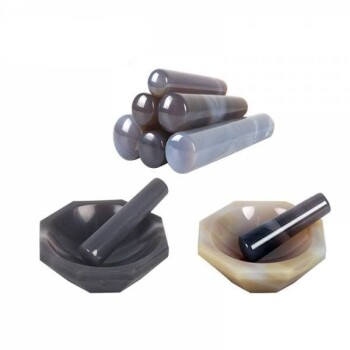
The primary function of using an agate mortar during the precursor mixing stage is to mechanically grind and homogenize raw powder materials—such as Li2S, P2S5, and GeS2—without contaminating the mixture. By leveraging the extreme hardness and chemical inertness of agate, this tool facilitates uniform particle refinement while preventing the introduction of metallic impurities that can occur with other grinding media.
Core Takeaway The success of a solid-state reaction relies heavily on the quality of the precursor mixture. The agate mortar serves a dual purpose: it physically refines particles to improve reaction kinetics and acts as a chemically inert barrier to ensure the final sulfide electrolyte remains free of performance-degrading metal contaminants.
Achieving Chemical Homogeneity
Uniform Component Distribution
The initial mixing stage is critical for systems like Li-Ge-P-S. Using an agate mortar allows for the manual grinding of precursors for extended periods.
Micro-Scale Interaction
This persistent grinding ensures that the different chemical components are distributed evenly at the micro-scale. Thorough distribution is a prerequisite for a complete and uniform reaction during the subsequent high-temperature heating phase.
Particle Size Refinement
Beyond simple mixing, the pestle’s action reduces the particle size of the raw powders. Smaller particles possess a larger surface area, which significantly facilitates the solid-state reaction by increasing the contact points between reactants.
The Critical Role of Material Purity
Chemical Inertness
Sulfide solid electrolytes are often chemically sensitive. Agate is chosen specifically for its chemical inertia, meaning it does not react with the precursor powders even under the friction and heat of grinding.
Preventing Metal Impurities
Standard metal grinding tools can shed microscopic shavings into the mixture. Agate possesses high hardness, which prevents the material from degrading and introducing metal impurities that would compromise the electrolyte's conductivity and stability.
Understanding the Limitations
Manual Labor Intensity
While effective for purity, the process relies on manual grinding. This makes the process labor-intensive and time-consuming compared to automated milling methods.
Consistency Challenges
Because the grinding is manual, achieving perfectly reproducible particle sizes between different batches relies heavily on the operator's technique and consistency over extended periods of grinding.
Making the Right Choice for Your Goal
When preparing sulfide solid electrolytes, the choice of mixing equipment dictates the quality of your final phase.
- If your primary focus is high purity: Rely on the agate mortar to eliminate the risk of metallic contamination, which is critical for accurate electrochemical testing.
- If your primary focus is reaction kinetics: Ensure you grind for extended periods to achieve the finest possible particle size, as this directly influences how easily the solid-state reaction occurs.
Use the agate mortar to secure a pure, reactive baseline before moving your material into the high-temperature synthesis phase.
Summary Table:
| Feature | Benefit for Sulfide Synthesis |
|---|---|
| High Hardness | Prevents degradation and introduction of metallic impurities |
| Chemical Inertness | Ensures no reactions occur between the mortar and sensitive precursors |
| Manual Grinding | Allows for precise control over homogenization at the micro-scale |
| Particle Refinement | Increases surface area to enhance solid-state reaction kinetics |
Elevate Your Battery Research with KINTEK Precision
High-performance sulfide solid electrolytes demand a contamination-free synthesis environment. KINTEK specializes in providing the high-quality laboratory equipment essential for advanced material science, from agate mortars and crushing systems to specialized high-temperature furnaces (muffle, vacuum, and CVD) and hydraulic presses for pellet preparation.
Whether you are refining precursors or scaling up battery research, our comprehensive range of tools—including battery research consumables, electrolytic cells, and cooling solutions—ensures your lab achieves reproducible, high-purity results.
Ready to optimize your synthesis process? Contact us today to discover how our tailored solutions can support your next breakthrough!
Related Products
- Nature Agate Mortar and Pestle for Grinding and Mixing
- Laboratory Jar Mill with Agate Grinding Jar and Balls
People Also Ask
- Why are agate mortars and pestles used for grinding iron oxide? Ensure Sample Purity for XRD Analysis
- What is the function of an agate mortar and pestle? Ensure Purity in Halide Solid-State Electrolyte Synthesis
- What is the primary function of an agate mortar and pestle? Optimize VO2+ CaZn2(PO4)2 Nanopowder Pre-Treatment
- Why is an agate mortar and pestle required for grinding Zr3(Al1-xSix)C2? Ensure Maximum Sample Purity
- Why is an agate mortar and pestle preferred for grinding MAX phase? Ensure Sample Purity & Zero Contamination