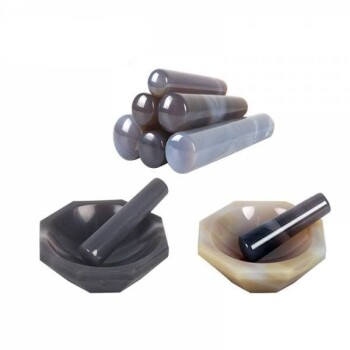
In the fabrication of solid-state batteries, an agate mortar and pestle function as the primary tool for achieving homogenous composite cathodes without compromising chemical purity. Specifically, for systems involving TiS2 active materials and LiBH4 solid electrolytes, these tools utilize their high hardness and wear resistance to uniformly mix powders. This process is critical for creating the intimate solid-solid contact interfaces required for efficient battery performance.
The agate mortar serves as a precision instrument that balances mechanical mixing force with chemical inertness, ensuring uniform particle dispersion while strictly preventing the introduction of performance-degrading impurities.
Ensuring Chemical Purity and Stability
Superior Wear Resistance
The primary function of agate in this context is to provide a mixing surface with high hardness.
Unlike softer materials that might degrade under friction, agate resists abrasion during the grinding process. This low wear rate is essential to prevent the tool itself from shedding material into the delicate cathode mixture.
Preventing Contamination
Agate is chemically inert, acting as a safeguard against impurities.
Using an agate mortar avoids the introduction of metallic contaminants that often result from using steel or brass tools. Such contaminants can be detrimental to high-voltage cathode materials, potentially causing short circuits or side reactions.
Optimizing the Microstructure
Creating Solid-Solid Interfaces
The performance of a solid-state battery relies heavily on the quality of the contact between the active material and the solid electrolyte.
Agate tools facilitate the uniform mixing required to maximize these contact points. By effectively blending components like TiS2 and LiBH4, the mortar ensures a continuous pathway for ionic transport.
Establishing Conductive Networks
Beyond the electrolyte and active material, composite cathodes often require conductive additives like carbon nanofibers.
The smooth surface of the agate mortar aids in dispersing these additives evenly throughout the matrix. This establishes robust ionic and electronic conductive networks, which are fundamental to the battery's power density.
Preserving Particle Integrity
Controlled Mechanical Shear
While mixing is necessary, excessive force can be destructive.
Agate mortars allow for gentle manual mixing, which applies sufficient force to blend powders without crushing them. This is distinct from high-energy mechanical milling, which can degrade the material.
Protecting Sensitive Architectures
Certain active materials, such as single-crystal NCM-811, have specific structural integrities that must be maintained.
The manual control afforded by the agate pestle avoids excessive mechanical shear forces. This prevents the fracture of active material particles and avoids excessive deformation of soft solid electrolytes like LPS.
Understanding the Trade-offs
Scalability and Throughput
While excellent for laboratory precision, the agate mortar and pestle approach is inherently limited by manual operation.
It is a time-consuming process that is difficult to scale for mass production compared to automated ball milling.
Operator Variability
The quality of the "gentle manual mixing" is dependent on the technique of the researcher.
Inconsistent pressure or mixing duration can lead to batch-to-batch variations in the composite cathode's microstructure.
Making the Right Choice for Your Goal
To maximize the effectiveness of your cathode preparation, align your mixing method with your specific research objectives.
- If your primary focus is material purity and interface quality: Rely on the agate mortar to prevent contamination and ensure high-quality solid-solid contact without damaging particle structures.
- If your primary focus is protecting fragile active materials: Use the agate mortar for gentle manual mixing to avoid the excessive shear forces common in automated mechanical milling.
Ultimately, the agate mortar is not just a mixing vessel, but a critical control mechanism for defining the electrochemical integrity of the composite cathode.
Summary Table:
| Feature | Benefit for Solid-State Batteries |
|---|---|
| High Hardness | Resists abrasion to prevent material shedding into the cathode mixture. |
| Chemical Inertness | Prevents metallic contamination and unwanted side reactions. |
| Manual Control | Provides gentle shear force to protect sensitive particle architectures. |
| Surface Texture | Facilitates uniform dispersion of TiS2, LiBH4, and conductive additives. |
| Interface Quality | Maximizes solid-solid contact points for efficient ionic transport. |
Elevate Your Battery Research with KINTEK Precision
Achieving the perfect electrochemical interface requires tools that never compromise on purity. KINTEK specializes in high-quality laboratory equipment designed for the rigorous demands of solid-state battery research. Whether you need agate mortar and pestle sets for contamination-free manual mixing, or advanced crushing and milling systems and hydraulic presses for large-scale pellet preparation, we provide the precision you need.
From high-temperature furnaces for material synthesis to battery research tools and consumables, KINTEK is your partner in driving energy innovation.
Ready to optimize your composite cathode preparation? Contact KINTEK today to discuss your laboratory requirements!
Related Products
- Nature Agate Mortar and Pestle for Grinding and Mixing
- Laboratory Jar Mill with Agate Grinding Jar and Balls
People Also Ask
- Why are agate mortars and pestles used for grinding iron oxide? Ensure Sample Purity for XRD Analysis
- What is the function of an agate mortar and pestle? Ensure Purity in Halide Solid-State Electrolyte Synthesis
- What is the primary function of an agate mortar and pestle? Optimize VO2+ CaZn2(PO4)2 Nanopowder Pre-Treatment
- Why is an agate mortar and pestle required for grinding Zr3(Al1-xSix)C2? Ensure Maximum Sample Purity
- Why is an agate mortar and pestle preferred for grinding MAX phase? Ensure Sample Purity & Zero Contamination