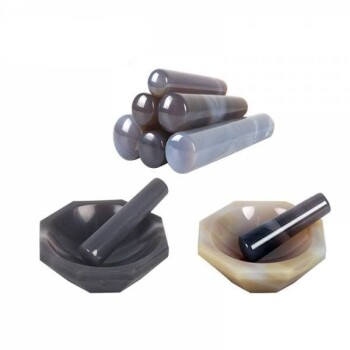
The Agate Mortar and Pestle serves as a critical instrument for the manual mechanical processing of precursor powders during the synthesis of Na3OBr solid electrolytes. Its primary function is to grind and mix components for extended periods to achieve micro-scale uniformity and refine particle size, ensuring the conditions necessary for a successful solid-state reaction.
The use of Agate is essential due to its high hardness and chemical inertia, allowing for aggressive grinding without contaminating the chemically sensitive Na3OBr mixture. It bridges the gap between raw precursors and the final sintered product by ensuring homogeneity and optimal packing density.
The Role of Mechanical Processing
Achieving Micro-Scale Homogeneity
In solid-state reactions, the reaction rate is limited by the contact area between solid particles. The Agate Mortar and Pestle is used to mix precursor powders thoroughly.
This manual grinding ensures a uniform distribution of components. By maximizing the contact points between different precursors, the tool facilitates the diffusion required for the reaction to proceed efficiently.
Refinement of Particle Size
Beyond simple mixing, the high hardness of the agate material allows for the effective reduction of particle sizes.
Grinding the powders for extended periods breaks down agglomerates and reduces the average particle diameter. Finer particles possess higher surface energy, which significantly lowers the activation energy needed for the subsequent solid-state reaction.
Preparation for Spark Plasma Sintering (SPS)
The utility of the Agate Mortar and Pestle extends beyond the initial synthesis. Once the solid-state reaction is complete, the synthesized particles often fuse or aggregate.
The tool is used to regrind these synthesized particles into a fine powder. This step is crucial for mold filling prior to Spark Plasma Sintering (SPS), ensuring the material can be packed densely and sintered effectively.
Why Material Choice Matters
Ensuring Chemical Purity
Sodium-based solid electrolytes like Na3OBr are often chemically sensitive or reactive. Using a mortar and pestle made of agate guarantees chemical inertia.
Unlike softer or reactive materials, agate resists chemical interaction with the precursor powders. This prevents the introduction of foreign impurities that could degrade the ionic conductivity of the final electrolyte.
Durability During Extended Processing
The synthesis process requires grinding for long durations to achieve the necessary fineness.
Agate is characterized by high hardness, making it resistant to abrasion. This durability ensures that the mortar and pestle do not shed material into the sample during the vigorous grinding process, maintaining the stoichiometry of the compound.
Operational Trade-offs
Labor Intensity vs. Control
While effective, using an Agate Mortar and Pestle is a manual process that requires extended periods of physical effort.
This allows for high control over the sample environment but is difficult to scale. It is best suited for laboratory-scale synthesis where precision is prioritized over throughput.
Uniformity Variations
Because the process is manual, the consistency of the grind depends heavily on the operator's technique.
Variations in pressure or duration can lead to slight differences in particle size distribution between batches. This contrasts with automated milling, which offers higher repeatability but may introduce higher contamination risks depending on the media used.
Optimizing Your Synthesis Protocol
To achieve high-quality Na3OBr solid electrolytes, apply the tool strategically based on your processing stage:
- If your primary focus is Reaction Efficiency: Prioritize grinding for extended periods to maximize surface area and component contact before heating.
- If your primary focus is Sintering Density: Ensure you thoroughly regrind the synthesized material to a fine powder to facilitate optimal mold filling for SPS.
Manual processing with Agate remains the gold standard for maintaining purity while achieving the physical characteristics required for high-performance solid electrolytes.
Summary Table:
| Feature | Function in Na3OBr Preparation | Benefit to Final Electrolyte |
|---|---|---|
| High Hardness | Facilitates aggressive grinding & particle refinement | Lowers activation energy for reactions |
| Chemical Inertia | Prevents contamination from tool material | Maintains high ionic conductivity |
| Manual Control | Ensures thorough mixing of precursor powders | Achieves micro-scale homogeneity |
| Post-Reaction Regrinding | Breaks down aggregates for SPS mold filling | Increases final sintered product density |
Elevate Your Solid-State Research with KINTEK
Precision in material preparation is the foundation of breakthrough battery technology. KINTEK specializes in high-quality laboratory equipment designed for the most demanding synthesis protocols. Whether you are grinding sensitive precursors for Na3OBr electrolytes or scaling up production, our premium agate mortar and pestle sets, crushing and milling systems, and hydraulic pellet presses ensure the purity and uniformity your research demands. From high-temperature furnaces for sintering to glovebox-ready consumables, we provide the tools needed to optimize your laboratory's efficiency and results.
Ready to enhance your material purity? Contact our experts today to find the perfect equipment for your specific application!
Related Products
- Nature Agate Mortar and Pestle for Grinding and Mixing
- Laboratory Jar Mill with Agate Grinding Jar and Balls
People Also Ask
- Why are agate mortars and pestles used for grinding iron oxide? Ensure Sample Purity for XRD Analysis
- What is the function of an agate mortar and pestle? Ensure Purity in Halide Solid-State Electrolyte Synthesis
- What is the primary function of an agate mortar and pestle? Optimize VO2+ CaZn2(PO4)2 Nanopowder Pre-Treatment
- Why is an agate mortar and pestle required for grinding Zr3(Al1-xSix)C2? Ensure Maximum Sample Purity
- Why is an agate mortar and pestle preferred for grinding MAX phase? Ensure Sample Purity & Zero Contamination