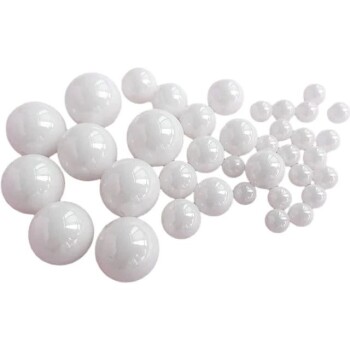
The primary purpose is to maximize collision frequency and grinding precision. By selecting 0.5 mm small-diameter zirconia balls, operators can achieve a significantly higher density of contact points within the milling jar compared to larger media. This increased frequency allows for the intensive shear energy required to refine materials like activated carbon or graphene composites into ultra-fine particle sizes.
Core Takeaway: Selecting 0.5 mm zirconia media transforms the milling process from simple impact-based crushing to high-precision refinement. This specific size and material combination ensures efficient particle breakdown and high chemical purity by leveraging increased collision frequency and superior wear resistance.
The Mechanics of Small-Diameter Media
Increased Collision Frequency and Contact Points
The use of 0.5 mm balls dramatically increases the number of individual grinding units within the same volume. This results in a higher "contact point density," ensuring that the material is struck more frequently during each rotation of the three-dimensional mill.
This high frequency is essential for reaching sub-micron particle sizes. Larger balls may provide more individual impact force, but they lack the surface area coverage required to effectively process microscopic powder agglomerates.
Intensive Shear Energy at High Speeds
When operated at high speeds, such as 300 rpm, these small-diameter spheres generate intensive shear forces. This energy is particularly effective at "peeling" or grinding complex structures like graphene composites or activated carbon.
The result is a more uniform particle size distribution. This uniformity directly improves the packing density of the material, which is critical for the performance of high-tech components.
The Role of Zirconia as a Material
High Density and Hardness
Zirconia is chosen for its high density and extreme hardness. These properties ensure that even at a small 0.5 mm diameter, each ball carries sufficient kinetic energy to break down hard particles upon impact.
Without this high density, small media might simply float or move with the fluid (in wet milling) rather than providing the impact force necessary for refinement. This makes zirconia superior to lighter materials like glass or alumina in high-energy applications.
Maintaining Chemical Purity
A critical advantage of zirconia is its excellent wear resistance and chemical stability. During the prolonged high-energy milling required for materials like SrCoO2.5 electrocatalysts or ceramic substrates, the media undergoes minimal erosion.
This low wear rate prevents the introduction of metallic or foreign impurities into the mix. This is vital for maintaining the electrical performance and thermal conductivity of the final processed materials.
Understanding the Trade-offs
Separation and Handling Challenges
While 0.5 mm balls are highly effective for refinement, they are significantly more difficult to separate from the final product. Standard sieving techniques may be insufficient, often requiring specialized recovery methods to ensure no media is left in the slurry.
Viscosity and Fluid Dynamics
In wet milling processes, the efficiency of 0.5 mm media is highly dependent on the viscosity of the solvent. If the slurry is too thick, the small balls may lose their kinetic energy, leading to "floating" rather than effective grinding.
Heat Generation
The high collision frequency of small-diameter media can lead to rapid heat buildup within the milling jar. This requires careful monitoring or cooling cycles to prevent the degradation of temperature-sensitive organic binders or active materials.
How to Apply This to Your Project
Making the Right Choice for Your Goal
The selection of 0.5 mm zirconia media should be driven by your specific material requirements and the desired final characteristics of your powder.
- If your primary focus is reaching sub-micron particle sizes: 0.5 mm zirconia media is the ideal choice due to its high contact point density and ability to provide intensive shear.
- If your primary focus is maintaining extreme chemical purity: Zirconia’s low wear rate ensures that even during long-term milling, the introduction of impurities remains negligible.
- If your primary focus is improving ion transport or electrical paths: The fine refinement provided by this media size optimizes the packing density of the active materials, directly enhancing performance.
Selecting the correct media size is the most impactful lever for controlling the microstructural uniformity and reactive activity of your final product.
Summary Table:
| Feature | Advantage | Key Outcome |
|---|---|---|
| 0.5 mm Diameter | Maximizes contact point density & shear energy | Sub-micron particle size refinement |
| Zirconia Material | High density, hardness, and wear resistance | Low contamination & high impact force |
| 3D Milling Action | Intensive high-speed collision frequency | Uniform particle size distribution |
| Chemical Stability | Resistant to erosion and metallic impurities | Preserved material electrical/thermal properties |
Elevate Your Milling Precision with KINTEK
Achieving sub-micron particle uniformity requires the right combination of high-performance machinery and premium consumables. KINTEK specializes in advanced laboratory solutions, offering top-tier crushing and milling systems alongside high-density zirconia grinding media to ensure your research meets the highest standards of purity and precision.
Beyond milling, our comprehensive portfolio includes:
- High-Temperature Furnaces: Muffle, tube, vacuum, and CVD systems.
- Sample Preparation: Hydraulic presses (pellet, hot, isostatic) and sieving equipment.
- Lab Essentials: PTFE products, ceramics, crucibles, and cooling solutions.
Ready to optimize your material refinement process? Contact KINTEK today to discover how our expertise and equipment can enhance your lab's efficiency and output.
References
- Nantikron Ngamjumrus, Chesta Ruttanapun. Two Steps for Improving Reduced Graphene Oxide/Activated Durian Shell Carbon Composite by Hydrothermal and 3-D Ball Milling Process for Symmetry Supercapacitor Device. DOI: 10.3390/en16196962
This article is also based on technical information from Kintek Solution Knowledge Base .
Related Products
- Laboratory Jar Ball Mill with Alumina Zirconia Grinding Jar and Balls
- Precision Machined Zirconia Ceramic Ball for Engineering Advanced Fine Ceramics
People Also Ask
- What are the primary functions of using a ball mill for BZCY72 powder? Achieve High Purity and Enhanced Sintering
- In what way does a laboratory ball mill affect material properties when modifying PHBV/pulp fiber composites?
- Why is a laboratory ball mill required for ultra-fine fly ash? Unlock Nano-Scale Adsorption Power
- What is the function of a laboratory ball mill in the preparation of AMMCs? Optimize Dispersion & Grain Refinement
- What is the function of a laboratory ball mill in the pretreatment of waste tire char (WTC)? Optimize Material Reactivity