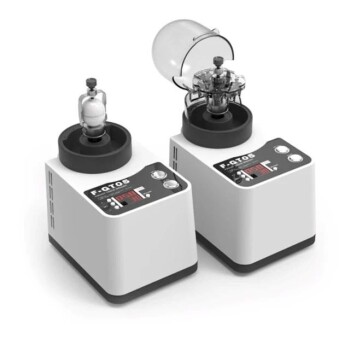
Laboratory ball mills facilitate ZIF-8 synthesis by substituting chemical solvation with intense kinetic energy. Through high-energy impacts and friction, the mill physically breaks the lattice energy of solid precursors like zinc oxide. This allows the precursors to react directly with imidazole ligands in a solid phase, effectively eliminating the necessity for organic solvents.
By replacing solvent-based diffusion with mechanically driven lattice disruption, ball milling enables the cleaner, safer, and scalable production of ZIF-8 at room temperature.
The Mechanics of Solvent-Free Synthesis
Breaking Lattice Energy
The primary barrier to reacting solid materials is the stability of their crystal structure. Ball mills generate mechanical energy through high-speed collisions between the grinding media and the material. This physical force is sufficient to break the lattice energy of solid precursors, specifically zinc oxide.
Triggering Solid-Phase Reactions
Once the lattice structure is disrupted, the zinc oxide becomes chemically active. It reacts directly with imidazole ligands without needing to be dissolved in a liquid first. This process creates a true solid-phase reaction, driven entirely by impact and friction rather than chemical solubility.
Operational Advantages
Enhanced Biosafety
The most significant benefit of this approach is the removal of hazardous chemicals. The mechanochemical method utilizes little to no liquid grinding aids. This eliminates the need for toxic organic solvents, significantly improving the biosafety of the entire synthesis process.
Scalability at Room Temperature
Unlike traditional methods that may require heating to drive reactions, mechanochemistry functions efficiently at room temperature. This lack of thermal dependency, combined with the removal of complex solvent waste management, makes the process highly suitable for large-scale preparation.
Understanding the Operational Shift
Equipment vs. Chemistry
Adopting this method requires a shift in resource allocation. You are trading the complexity of solvent management and thermal regulation for the need for high-energy mechanical equipment.
The Role of Controlled Energy
While the primary reaction is robust, the supplementary context of zeolite synthesis suggests that mechanical energy induces controlled amorphization. This implies that while the process is solvent-free, the intensity of the milling must be calibrated to activate the material without destroying the desired ZIF-8 framework.
Making the Right Choice for Your Goal
To determine if mechanochemical synthesis is the right approach for your ZIF-8 production, consider your primary constraints:
- If your primary focus is Environmental Safety: This method is superior as it eliminates toxic organic solvents and improves overall biosafety.
- If your primary focus is Industrial Scalability: The ability to produce ZIF-8 at room temperature without complex heating apparatus makes this highly efficient for volume production.
Mechanochemistry transforms ZIF-8 synthesis from a complex chemical balancing act into a streamlined, mechanically driven manufacturing process.
Summary Table:
| Feature | Solvent-Based Synthesis | Mechanochemical Ball Milling |
|---|---|---|
| Driving Force | Chemical Solvation / Heat | Mechanical Impact / Friction |
| Solvent Use | High (Toxic Organic Solvents) | Little to None (Solvent-Free) |
| Energy Source | Thermal Dependency | Kinetic Energy |
| Temperature | Often Requires Heating | Ambient / Room Temperature |
| Safety Profile | Higher Risk (Chemical Exposure) | Enhanced Biosafety |
| Scalability | Complex Waste Management | High (Streamlined Process) |
Elevate Your Material Research with KINTEK's Advanced Grinding Solutions
Transition to greener, safer, and more efficient synthesis workflows with KINTEK’s industry-leading laboratory equipment. Whether you are pioneering mechanochemical synthesis of ZIF-8 or optimizing battery research, our high-performance crushing and milling systems and sieving equipment provide the precise energy control required for lattice disruption without structural damage.
Why choose KINTEK?
- Precision Engineering: High-energy ball mills designed for controlled amorphization and solid-phase reactions.
- Comprehensive Portfolio: From high-temperature furnaces and vacuum reactors to hydraulic presses and PTFE consumables, we provide the tools for every stage of material development.
- Expert Support: Specialized solutions tailored for laboratories focusing on environmental safety and industrial scalability.
Ready to transform your ZIF-8 production into a streamlined, mechanically driven process? Contact KINTEK today to find the perfect equipment for your lab!
References
- Zhixin Li, Jun Zan. Zeolitic imidazolate framework-8: a versatile nanoplatform for tissue regeneration. DOI: 10.3389/fbioe.2024.1386534
This article is also based on technical information from Kintek Solution Knowledge Base .
Related Products
- Stainless Steel Laboratory Ball Mill for Dry Powder and Liquid with Ceramic Polyurethane Lining
- Laboratory Planetary Ball Mill Rotating Ball Milling Machine
- Laboratory Ball Mill Jar Mill with Metal Alloy Grinding Jar and Balls
- Laboratory Jar Ball Mill with Alumina Zirconia Grinding Jar and Balls
- Laboratory Planetary Ball Mill Cabinet Planetary Ball Milling Machine
People Also Ask
- What is the primary function of a laboratory ball mill in the modification of sulfide-based solid electrolytes with LiPO2F2?
- How does a laboratory ball mill ensure the mixing quality of Mn3Zn0.8Sn0.2N and Ti? Achieve Perfect Homogeneity
- What is the function of a laboratory ball mill in the preparation of AMMCs? Optimize Dispersion & Grain Refinement
- In what way does a laboratory ball mill affect material properties when modifying PHBV/pulp fiber composites?
- What is the function of a laboratory ball mill in the pretreatment of waste tire char (WTC)? Optimize Material Reactivity