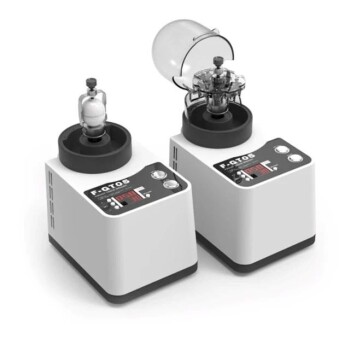
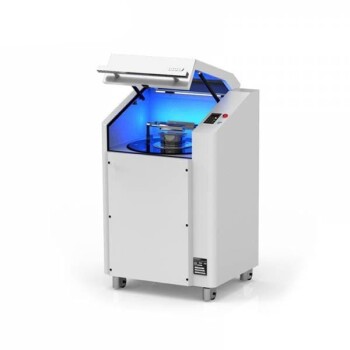
The laboratory ball mill serves as a critical mechanical activator in the pretreatment of waste tire char (WTC). It utilizes high-energy mechanical grinding to physically crush carbon residues into a fine powder. This process is essential for reducing particle size and significantly increasing the specific surface area of the material.
The primary function of a laboratory ball mill is to refine the physical structure of waste tire char to enhance its chemical reactivity. By optimizing particle size, the mill ensures the char can mix uniformly with other fuels and perform efficiently during subsequent combustion processes.
Enhancing Material Reactivity through Physical Refinement
Increasing Specific Surface Area
The high-energy grinding action of the ball mill breaks down the coarse structure of the waste tire char. As the particles are reduced in size, the total exposed surface area relative to the volume increases dramatically. This provides more active sites for chemical reactions to occur.
Boosting Combustion Activity
WTC often contains stable carbon structures that can be difficult to ignite or burn completely. The increase in specific surface area directly improves the reaction activity during combustion experiments. This allows for a more efficient and complete release of energy from the char residues.
Mechanical Activation of Carbon Residues
Beyond simple size reduction, the intense mechanical energy can induce structural changes in the char. This mechanical activation lowers the energy barrier for subsequent thermal processes. Consequently, the pretreated char responds more predictably in laboratory testing and industrial simulations.
Optimizing the Fuel Blend Matrix
Facilitating Uniform Mixing with Biomass
Waste tire char is frequently blended with biomass fuels to create composite energy sources. A laboratory ball mill ensures that the WTC reaches a fineness compatible with the biomass particles. This leads to a high degree of uniform mixing, preventing material segregation during experiments.
Precision Control of Particle Size Distribution
Like its application in iron ore processing, the mill allows researchers to control grinding time to achieve a specific required fineness. Precise control over the particle size distribution ensures that the inter-particle interactions are optimized. This consistency is vital for maintaining the quality and reproducibility of fuel pellets or blends.
Ensuring Reproducible Research Results
Laboratory ball mills are designed for rapid and reproducible pulverizing of a wide variety of materials. By using standardized milling protocols, researchers can ensure that every batch of pretreated WTC has the same physical characteristics. This eliminates "particle size" as a variable when comparing different combustion or gasification trials.
Understanding the Trade-offs
Energy Consumption vs. Refinement
While higher milling speeds and longer durations lead to finer particles, they also increase energy consumption. There is a point of diminishing returns where the energy spent on further grinding does not significantly improve combustion activity. Finding the "optimal grind" is a key technical challenge in pretreatment.
Potential for Sample Contamination
The grinding media (balls) and the mill jar are subject to wear during high-energy processes. This can introduce small amounts of contaminants, such as steel or ceramic wear debris, into the waste tire char. Researchers must select media materials that will not interfere with the specific chemical analysis being performed.
Thermal Effects During Milling
High-energy grinding generates localized heat, which can potentially alter the volatile matter content of the WTC. If the mill temperature is not managed, it may cause premature degassing or minor chemical shifts in the sample. This necessitates careful monitoring of milling intervals and cooling periods.
Applying Ball Milling to Your Project
When integrating laboratory ball milling into your waste tire char pretreatment workflow, your approach should depend on your final research or production goals.
- If your primary focus is combustion efficiency: Prioritize maximizing the specific surface area to ensure the highest possible reaction activity during thermal trials.
- If your primary focus is co-firing with biomass: Focus on achieving a particle size distribution that matches your biomass feedstock to ensure a stable, homogenous fuel blend.
- If your primary focus is analytical reproducibility: Use strictly timed grinding intervals and standardized media-to-sample ratios to ensure every batch of char is physically identical.
Through the precise application of mechanical force, the laboratory ball mill transforms inert waste char into a reactive and versatile fuel component.
Summary Table:
| Key Function | Impact on Waste Tire Char (WTC) |
|---|---|
| Particle Size Reduction | Increases specific surface area for faster, more complete combustion. |
| Mechanical Activation | Induces structural changes to lower the energy barrier for thermal reactions. |
| Homogenization | Ensures uniform mixing with biomass for stable composite fuel blends. |
| Precision Control | Delivers reproducible particle size distributions for consistent research data. |
Elevate Your Material Research with KINTEK
Precision in pretreatment is the foundation of reliable research. KINTEK specializes in high-performance crushing and milling systems designed to optimize the specific surface area and reactivity of materials like waste tire char.
Whether you are focusing on waste-to-energy conversion, biomass co-firing, or advanced carbon material analysis, our comprehensive lab portfolio—including high-temperature furnaces (muffle, vacuum, CVD), high-pressure reactors, and precision hydraulic presses—provides the consistency your laboratory demands.
Ready to achieve superior sample preparation and reproducible results? Contact KINTEK today to discuss our custom solutions and how we can support your specific research goals.
References
- K. V. Slyusarsky, Kirill B. Larionov. Ignition and Emission Characteristics of Waste Tires Pyrolysis Char Co-Combustion with Peat and Sawdust. DOI: 10.3390/en16104038
This article is also based on technical information from Kintek Solution Knowledge Base .
Related Products
- Stainless Steel Laboratory Ball Mill for Dry Powder and Liquid with Ceramic Polyurethane Lining
- Laboratory Planetary Ball Mill Rotating Ball Milling Machine
- Laboratory Ball Mill Jar Mill with Metal Alloy Grinding Jar and Balls
- Laboratory Jar Ball Mill with Alumina Zirconia Grinding Jar and Balls
- Laboratory Planetary Ball Mill Cabinet Planetary Ball Milling Machine
People Also Ask
- How do laboratory ball mills facilitate the mechanochemical synthesis of ZIF-8? Solvent-Free Synthesis Explained
- What is the primary function of a laboratory ball mill in the modification of sulfide-based solid electrolytes with LiPO2F2?
- How does a laboratory ball mill ensure the mixing quality of Mn3Zn0.8Sn0.2N and Ti? Achieve Perfect Homogeneity
- What is the function of a laboratory ball mill in the preparation of AMMCs? Optimize Dispersion & Grain Refinement
- In what way does a laboratory ball mill affect material properties when modifying PHBV/pulp fiber composites?