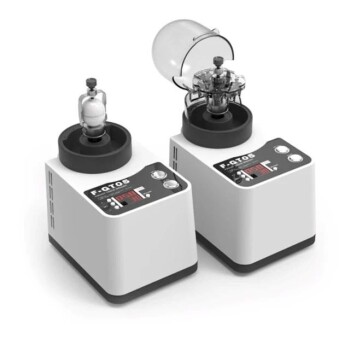
In the specific context of modifying sulfide-based solid electrolytes with LiPO2F2 additives, the laboratory ball mill functions primarily as a mechanical coating and refinement tool. It utilizes mechanical force to apply a uniform coating of the LiPO2F2 additive onto the surface of the electrolyte particles while simultaneously reducing the particle size (e.g., from 5 micrometers to 3 micrometers).
Core Takeaway The ball mill drives the physical interface engineering required for high-performance solid-state batteries. By ensuring intimate contact between the additive and the electrolyte, it facilitates the in-situ formation of a stable cathode-electrolyte interface (CEI) without relying on complex solvent-based processes or high-temperature annealing.
Mechanisms of Mechanical Modification
Uniform Surface Coating
The primary objective of the ball milling process in this application is mechanical fusion. The milling media applies shear and impact forces that spread the LiPO2F2 additive evenly across the surface of the sulfide electrolyte.
This eliminates the inconsistencies often found in wet-coating methods, where solvent evaporation can lead to uneven distribution.
Particle Size Refinement
Beyond coating, the ball mill acts as a precision grinding tool. It reduces the diameter of the electrolyte particles, for instance, refining them from approximately 5 micrometers down to 3 micrometers.
Smaller particles possess a higher specific surface area. This increases the contact area available for the electrochemical reaction, potentially enhancing the overall kinetics of the battery cell.
Facilitating In-Situ CEI Formation
The mechanical pressure ensures intimate contact between the LiPO2F2 and the sulfide electrolyte.
This close physical proximity is a prerequisite for the in-situ formation of a stable Cathode-Electrolyte Interface (CEI). A robust CEI is critical for preventing side reactions and maintaining the long-term stability of the battery.
Operational Trade-offs and Risks
The Balance of Energy Input
It is critical to distinguish between modification (coating) and synthesis (creating the material).
In synthesis, high-energy milling is often used to destroy crystal structures and induce amorphization. However, for coating LiPO2F2, low-energy milling is generally preferred.
Risk of Structural Damage
Using excessive energy during the coating process can be detrimental.
High-intensity impact can damage the original crystal structure of the sulfide solid electrolyte. If the crystallinity is compromised, the material may suffer a significant decrease in lithium-ion transport performance (ionic conductivity).
Process Simplicity vs. Control
While ball milling simplifies the workflow by removing the need for wet chemistry or high-temperature annealing, it offers less control over atomic-level deposition compared to advanced techniques like Atomic Layer Deposition (ALD).
However, for bulk powder processing, ball milling remains a far more scalable and cost-effective solution.
Making the Right Choice for Your Goal
If your primary focus is Interface Stability:
- Prioritize low-energy milling parameters to achieve a uniform LiPO2F2 coating without degrading the sulfide electrolyte’s crystal lattice.
If your primary focus is Process Efficiency:
- Leverage the ball mill to combine particle refinement and coating into a single step, bypassing time-consuming solvent removal and annealing stages.
If your primary focus is Ionic Conductivity:
- Monitor the milling duration and intensity closely; over-milling will reduce particle size effectively but may inadvertently lower conductivity by damaging the crystalline phase.
The laboratory ball mill transforms a complex chemical interface challenge into a straightforward mechanical solution, provided the energy input is carefully managed.
Summary Table:
| Feature | Function in Modification | Benefit |
|---|---|---|
| Mechanical Fusion | Spreads LiPO2F2 evenly over electrolyte surfaces | Creates a uniform coating without solvents |
| Size Refinement | Reduces particles (e.g., 5μm to 3μm) | Increases specific surface area for better kinetics |
| Interface Engineering | Ensures intimate contact between additives/electrolyte | Facilitates in-situ stable CEI formation |
| Energy Control | Low-energy milling parameters | Preserves crystallinity and ionic conductivity |
Elevate Your Solid-State Battery Research with KINTEK
Precision milling is the key to unlocking superior electrolyte performance. At KINTEK, we specialize in high-performance crushing and milling systems designed specifically for the delicate requirements of battery material synthesis and modification. Whether you are engineering interfaces for sulfide-based electrolytes or refining particles for maximum conductivity, our laboratory ball mills provide the precise energy control you need to avoid structural damage.
From high-temperature furnaces and vacuum systems to isostatic hydraulic presses and battery research tools, KINTEK provides a comprehensive range of equipment and consumables tailored for advanced material science.
Ready to optimize your mechanical coating process? Contact our experts today to find the perfect milling solution for your laboratory.
Related Products
- Stainless Steel Laboratory Ball Mill for Dry Powder and Liquid with Ceramic Polyurethane Lining
- Laboratory Planetary Ball Mill Rotating Ball Milling Machine
- Laboratory Ball Mill Jar Mill with Metal Alloy Grinding Jar and Balls
- Laboratory Jar Ball Mill with Alumina Zirconia Grinding Jar and Balls
- Laboratory Planetary Ball Mill Cabinet Planetary Ball Milling Machine
People Also Ask
- How do laboratory ball mills facilitate the mechanochemical synthesis of ZIF-8? Solvent-Free Synthesis Explained
- How does a laboratory ball mill ensure the mixing quality of Mn3Zn0.8Sn0.2N and Ti? Achieve Perfect Homogeneity
- What is the function of a laboratory ball mill in the preparation of AMMCs? Optimize Dispersion & Grain Refinement
- In what way does a laboratory ball mill affect material properties when modifying PHBV/pulp fiber composites?
- What is the function of a laboratory ball mill in the pretreatment of waste tire char (WTC)? Optimize Material Reactivity