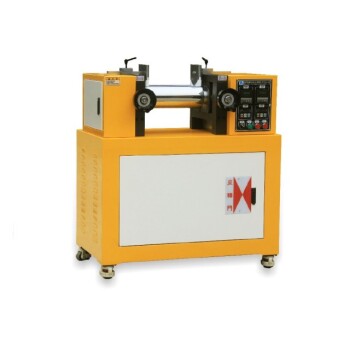
The industrial cutting mill serves as a precision size-reduction engine in the pretreatment of Automotive Shredder Residue (ASR). By utilizing high-speed rotating blades to perform powerful shearing, the mill reduces complex waste into a fine, uniform particle size typically ranging from 0.75 mm to 1 mm. This physical transformation is essential to increase the material's specific surface area, which directly optimizes the efficiency of subsequent chemical and thermal recovery processes.
The core role of an industrial cutting mill is to transform heterogeneous ASR into a high-surface-area powder. This mechanical refinement ensures that carbonaceous materials can react effectively with other elements, such as silica, during high-temperature processing.
The Mechanism of Mechanical Pretreatment
Precision Shearing and Size Reduction
Industrial cutting mills utilize high-speed rotating blades to apply intense shearing forces to ASR. Unlike standard crushing, this shearing action is designed to handle the complex, multi-material composition of automotive waste, which often includes plastics, rubber, and textiles. The goal is to reach a precise output—specifically 0.75-1 mm—which is the optimal range for downstream resource recovery.
Increasing Specific Surface Area
By breaking down bulk ASR into millimeter-scale particles, the mill dramatically increases the apparent specific surface area of the material. This is a critical technical requirement because larger surface areas allow for better penetration of reagents and more consistent thermal exposure. In the context of carbonaceous materials found in ASR, this step is the foundation for achieving high reaction activity.
Optimizing Downstream Chemical and Thermal Reactions
Enhancing Reaction Activity with Silica
A primary objective in ASR pretreatment is preparing the carbonaceous components for high-temperature reactions. The increased surface area provided by the cutting mill ensures a higher contact frequency between these carbon materials and silica particles. This proximity and surface availability are vital for ensuring that chemical reactions occur rapidly and completely during the recovery phase.
Ensuring Thermal and Structural Uniformity
Drawing from similar industrial applications, precision milling ensures uniform heat transfer during subsequent carbonization or energy recovery. When particles are sized consistently at the millimeter level, the entire batch reacts at a similar rate, preventing "cold spots" or incomplete reactions. This leads to a final output—such as biochar or recycled additives—that possesses a consistent and predictable structure.
Understanding the Trade-offs and Challenges
Blade Wear and Maintenance
Because ASR is inherently "dirty" and may contain abrasive glass or residual metals, blade wear is a significant factor. Maintaining the sharp edges required for precision shearing to 0.75 mm requires high-quality alloys and a rigorous maintenance schedule. Dull blades lead to tearing rather than cutting, which results in inconsistent particle sizes and reduced surface area.
Energy Consumption vs. Particle Fineness
There is a direct trade-off between the fineness of the grind and the energy consumed by the mill. While reducing ASR to sub-millimeter levels maximizes reactivity, it requires significantly more power and processing time. Operators must balance the need for high specific surface area with the economic viability of the energy inputs required to achieve those sizes.
How to Apply This to Your Recovery Project
Making the Right Choice for Your Goal
To maximize the value of automotive shredder residue, the milling strategy must align with the intended final use of the material.
- If your primary focus is high-temperature chemical recovery: Prioritize a cutting mill that can consistently hit the 0.75 mm threshold to maximize contact frequency with catalysts or silica.
- If your primary focus is material pelletization for fuel: Focus on mills that offer adjustable screens to ensure uniform mixing and moisture conditioning, which facilitates efficient extrusion molding.
- If your primary focus is minimizing operational costs: Select a mill with heavy-duty, replaceable blade inserts designed specifically for abrasive, complex waste to reduce downtime and maintenance costs.
By precisely controlling particle size and maximizing surface area, the industrial cutting mill turns unpredictable automotive waste into a standardized raw material ready for high-value industrial processing.
Summary Table:
| Key Parameter | Technical Detail | Impact on ASR Recovery |
|---|---|---|
| Target Particle Size | 0.75 mm – 1.0 mm | Maximizes specific surface area for chemical reactivity. |
| Milling Mechanism | High-speed precision shearing | Efficiently processes complex plastics, rubber, and textiles. |
| Reaction Synergy | Increased contact frequency | Enhances interaction between carbonaceous waste and silica. |
| Thermal Advantage | Uniform heat transfer | Prevents 'cold spots' during high-temperature processing. |
| Maintenance Focus | High-quality alloy blades | Ensures consistent output quality despite abrasive waste. |
Maximize Your Material Recovery with KINTEK Precision Solutions
Turning complex Automotive Shredder Residue (ASR) into high-value raw material requires precision at every stage. KINTEK specializes in high-performance laboratory and industrial equipment designed to handle the toughest material challenges.
From advanced crushing and milling systems that achieve the perfect 0.75mm grind to our industry-leading high-temperature furnaces (muffle, vacuum, and atmosphere) and sieving equipment for downstream recovery, we provide the end-to-end tools you need for superior research and production results.
Ready to optimize your recycling workflow? Contact our technical experts today to find the perfect milling and thermal processing solution tailored to your specific recovery goals.
References
- Sepideh Hemati, Veena Sahajwalla. Degradation Kinetics of Automotive Shredder Residue and Waste Automotive Glass for SiC Synthesis: An Energy-Efficient Approach. DOI: 10.3390/cryst13081183
This article is also based on technical information from Kintek Solution Knowledge Base .
Related Products
People Also Ask
- What is a two roll mill for rubber compounding? A Foundational Tool for Polymer Processing
- What is the use of two roll mill? Essential for Polymer Mixing, R&D, and Quality Control
- What is the two roll mill mixing process? Master Polymer Compounding with High Shear
- What is the disadvantage of a two-roll mill? Limited Thickness Reduction Due to Roll Flattening
- What are the advantages of a two roll mill? Achieve Superior Polymer Mixing & Quality Control