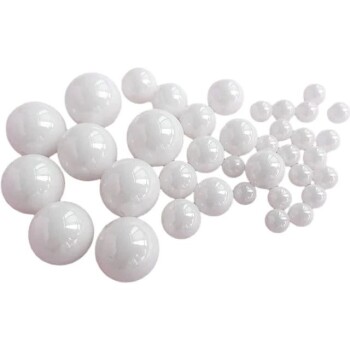
High-density grinding media function as the primary engine for kinetic energy transfer in mechanical alloying. For magnesium-based amorphous powders, media like chromium steel balls are essential because their significant mass enables them to deliver high-intensity impacts during milling. These high-energy collisions provide the necessary mechanical force to refine powder particles and drive the structural changes required for amorphization.
Core Insight High-density media are selected to maximize the kinetic energy generated within the milling jar. This intense energy is required to drive the repeated cycles of cold welding, flattening, and fracturing that force solid-state diffusion, ultimately disrupting the crystalline structure to create a uniform amorphous phase.
The Physics of Mechanical Alloying
Mass as a Kinetic Energy Multiplier
The fundamental reason for using high-density materials, such as chromium steel, lies in the physics of kinetic energy. Since kinetic energy is proportional to mass, heavier balls generate significantly higher impact forces than lighter alternatives when moving at the same speed.
This elevated energy is crucial for high-strength or refractory components. It ensures the media can effectively crush and deform the metal powders rather than glancing off or losing momentum upon contact.
Driving Solid-State Diffusion
Mechanical alloying is not a thermal process; it relies on mechanical force to mix elements at the atomic level. The high-intensity impacts from dense media force the powder particles to undergo severe plastic deformation.
This creates a cycle of fracturing and cold welding. The kinetic energy overcomes atomic potential barriers, forcing different elements to diffuse into one another in a solid state. This is the mechanism that transforms discrete magnesium and alloying element particles into a single, pre-alloyed material.
Achieving the Amorphous Phase
Forming an amorphous (non-crystalline) phase requires preventing the material from organizing into a regular lattice structure. The high-energy collisions provided by dense media introduce massive amounts of lattice defects and strain.
This continuous bombardment refines the grain size to the nanometer scale and eventually destabilizes the crystalline structure entirely. Without the high impact energy provided by high-density balls, the system might not reach the energy threshold necessary to sustain this disordered, amorphous state.
Optimizing the Milling Environment
The Role of Ball Size Variation
While density provides the force, the geometry of the media dictates the efficiency of the process. It is common to use a mixture of ball diameters (e.g., 15 mm and 20 mm) to balance the energy distribution.
Larger, heavier balls provide the massive impact energy needed to crush larger particles and initiate fracturing. Smaller balls fill the gaps, increasing the frequency of contact points. This combination ensures that the powder is refined uniformly and that the amorphization process is comprehensive.
The Importance of Hardness
In addition to density, materials like chromium steel offer high hardness. Hard grinding media resist deformation themselves, ensuring that the kinetic energy is transferred efficiently to the powder rather than being absorbed by the ball.
Understanding the Trade-offs
While high-density steel balls are effective for energy transfer, they introduce a risk of contamination.
The same high-energy impacts that alloy the powder also cause wear on the grinding balls and the jar lining. In the case of chromium steel balls, this can introduce iron or chromium impurities into the magnesium powder.
In some contexts, such as ODS alloys, trace impurities might be acceptable or managed. However, excessive wear can alter the chemical composition of the final product, potentially affecting the glass-forming ability or corrosion resistance of the magnesium amorphous alloy. Balancing the ball-to-powder ratio (e.g., 10:1 or 15:1) is critical to maximizing alloying efficiency while keeping impurity levels within a tolerable range.
Making the Right Choice for Your Goal
When setting up a mechanical alloying protocol for magnesium-based materials, consider how your media choice aligns with your specific constraints.
- If your primary focus is rapid amorphization: Prioritize high-density media and a higher ball-to-powder ratio to maximize the kinetic energy transfer and overcome atomic barriers quickly.
- If your primary focus is process efficiency and uniformity: Utilize a mix of ball diameters to balance the high-impact energy of large balls with the high collision frequency of small balls.
- If your primary focus is chemical purity: Monitor the milling time and ball-to-powder ratio closely to minimize the introduction of iron or chromium contaminants caused by media wear.
Success in mechanical alloying relies on generating enough kinetic energy to force atomic blending without destroying the chemical integrity of the material.
Summary Table:
| Feature | Impact on Mechanical Alloying |
|---|---|
| High Density | Increases kinetic energy for high-intensity impacts and particle refinement. |
| Hardness | Ensures efficient energy transfer to the powder without media deformation. |
| Mixed Ball Sizes | Balances massive crushing force (large balls) with high collision frequency (small balls). |
| Kinetic Energy | Drives solid-state diffusion, cold welding, and fracturing to create amorphous phases. |
| Material Choice | Chromium steel provides necessary mass, though contamination risks must be managed. |
Elevate Your Material Research with KINTEK
Precision in mechanical alloying starts with the right equipment. KINTEK specializes in high-performance laboratory solutions tailored for advanced material science. Whether you are developing magnesium-based amorphous alloys or refining refractory powders, we provide the tools to ensure success:
- Crushing & Milling Systems: High-energy planetary ball mills and robust jars.
- Premium Grinding Media: Chromium steel, ceramics, and PTFE-coated options to balance energy and purity.
- Advanced Research Tools: From vacuum furnaces and CVD systems to hydraulic pellet presses and battery research consumables.
Maximize your amorphization efficiency and ensure repeatable results. Contact KINTEK today to discuss your laboratory needs!
Related Products
People Also Ask
- What are the applications of zirconia ceramics? Unlock High-Performance Solutions for Extreme Environments
- What is the physical mechanism for selecting hard grinding media? Optimize Your ZrC-Al Matrix Composite Production
- Why are zirconia milling balls preferred for P2-type layered oxides? Ensure High Purity and Grinding Efficiency
- What is the purpose of using zirconia milling balls of different diameters? Optimize Solid Electrolyte Processing
- Why are zirconia grinding jars and balls required for solid-state electrolyte powders? Ensure High Purity & Performance