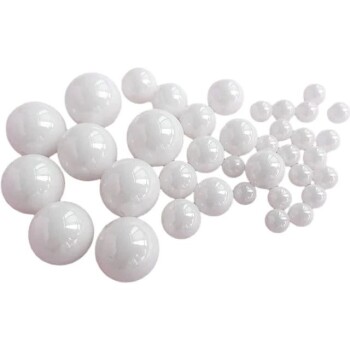
Zirconia grinding balls are the preferred media for synthesizing CsPbI3 because they provide the high kinetic energy required for solid-phase reactions while ensuring the chemical and phase purity of the resulting perovskite. Their unique combination of high density, extreme hardness, and chemical inertness prevents material contamination and ensures the efficient transformation of precursors into a high-quality crystal structure.
The selection of zirconia is driven by the need to balance aggressive mechanical force with strict impurity control. Because CsPbI3 is highly sensitive to its chemical environment, using a media that minimizes wear-induced debris is essential for maintaining its optoelectronic properties.
Maximizing Kinetic Energy for Solid-Phase Reactions
The Role of High Density and Hardness
Mechanochemical synthesis relies on the physical impact between grinding media to drive chemical changes. Zirconia (zirconium dioxide) possesses high density and hardness, which provide the necessary momentum to pulverize precursors like CsI and PbI2. This high-energy impact is critical for achieving the molecular-level mixing required to form the $CsPbI_3$ lattice.
Efficient Particle Size Reduction
The hardness of zirconia allows it to effectively refine hard ceramic precursors into micron-level or even nano-level powders. This reduction in particle size increases the surface area available for reaction, accelerating the synthesis process. High-impact energy ensures that the solid-phase reaction reaches completion without the need for high external temperatures.
Protecting Phase Purity and Optoelectronic Performance
Superior Wear Resistance
$CsPbI_3$ is extremely sensitive to impurities, which can act as "traps" for charge carriers and degrade the material's performance in solar cells or LEDs. Zirconia's excellent wear resistance significantly reduces the amount of media debris that flakes off during high-speed milling. This ensures that the final powder remains free from foreign metallic or ceramic contaminants.
Chemical Inertness and Stability
During the prolonged milling periods often required for perovskite synthesis, the grinding media must not react with the chemical components of the powder. Zirconia is chemically inert, meaning it will not undergo secondary reactions with the lead or iodide ions in the mixture. This stability is vital for maintaining the precise stoichiometry and high phase purity of the $CsPbI_3$ powder.
Understanding the Trade-offs
Cost and Thermal Considerations
While zirconia is technically superior, it is significantly more expensive than alternative media like stainless steel or alumina. Users must also be aware that the high-energy impacts of zirconia generate substantial heat within the grinding jar. In the case of $CsPbI_3$, excessive heat during milling can potentially trigger unwanted phase transitions (from the "black" perovskite phase to the "yellow" non-perovskite phase).
Equipment Compatibility
Because zirconia is so hard, it can cause accelerated wear on grinding jars made of softer materials. To gain the full benefit of zirconia media, it is often necessary to use zirconia-lined grinding jars. This "like-on-like" approach further eliminates the risk of cross-contamination from the jar walls themselves.
How to Apply This to Your Project
When selecting grinding media for your specific synthesis goals, consider the following technical priorities:
- If your primary focus is maximum phase purity: Always utilize high-purity zirconia balls paired with a zirconia-lined jar to eliminate all sources of metallic contamination.
- If your primary focus is rapid particle size reduction: Opt for smaller-diameter zirconia balls (e.g., 1–3 mm) to increase the frequency of high-energy collisions and achieve a finer powder.
- If your primary focus is preventing phase degradation: Monitor the milling temperature closely or use interval milling (short bursts followed by cooling periods) to manage the heat generated by zirconia's high-impact energy.
The strategic use of zirconia grinding media is a fundamental requirement for producing high-performance, contaminant-free $CsPbI_3$ via mechanochemical methods.
Summary Table:
| Key Property | Impact on CsPbI3 Synthesis | Practical Benefit |
|---|---|---|
| High Density & Hardness | Provides maximum kinetic energy for solid-phase reaction | Efficient particle size reduction and lattice formation |
| Superior Wear Resistance | Minimizes media debris and contamination | Ensures high optoelectronic performance and phase purity |
| Chemical Inertness | Prevents reactions between media and precursors | Maintains precise stoichiometry of the perovskite powder |
| High-Impact Energy | Accelerates synthesis without excessive external heat | Facilitates rapid molecular-level mixing |
Elevate Your Material Synthesis with KINTEK
Achieving the perfect $CsPbI_3$ crystal structure requires more than just the right chemistry—it requires the right tools. KINTEK specializes in high-performance laboratory equipment designed for precision and purity. Our high-purity zirconia grinding media and jars are specifically engineered to eliminate contamination in sensitive perovskite research.
Beyond milling, we offer a comprehensive suite of tools for advanced materials research, including:
- Crushing & Milling Systems: Achieve nano-level powder refinement.
- High-Temperature Furnaces: Muffle and tube furnaces for precise thermal treatment.
- Hydraulic Presses: Reliable pellet and isostatic pressing solutions.
- Essential Consumables: High-quality ceramics and crucibles for demanding environments.
Ensure your research achieves maximum phase purity and efficiency. Contact our technical experts today to find the ideal milling configuration for your laboratory needs!
References
- Xuemei Li, Jingwei Hou. Interfacial alloying between lead halide perovskite crystals and hybrid glasses. DOI: 10.1038/s41467-023-43247-6
This article is also based on technical information from Kintek Solution Knowledge Base .
Related Products
- Laboratory Jar Ball Mill with Alumina Zirconia Grinding Jar and Balls
- Precision Machined Zirconia Ceramic Ball for Engineering Advanced Fine Ceramics
- Laboratory Jar Mill with Agate Grinding Jar and Balls
People Also Ask
- What are the primary functions of using a ball mill for BZCY72 powder? Achieve High Purity and Enhanced Sintering
- In what way does a laboratory ball mill affect material properties when modifying PHBV/pulp fiber composites?
- Why is a laboratory ball mill required for ultra-fine fly ash? Unlock Nano-Scale Adsorption Power
- What is the function of a laboratory ball mill in the preparation of AMMCs? Optimize Dispersion & Grain Refinement
- What is the function of a laboratory ball mill in the pretreatment of waste tire char (WTC)? Optimize Material Reactivity