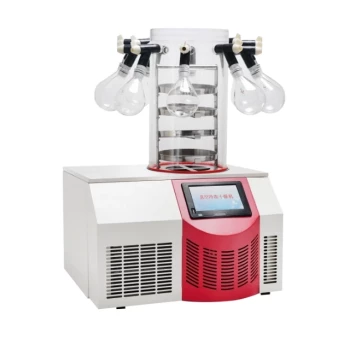
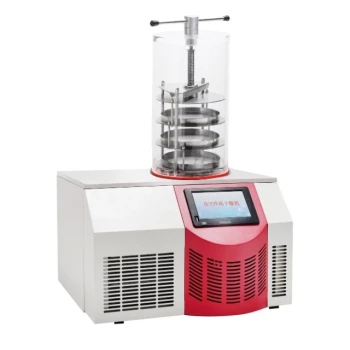
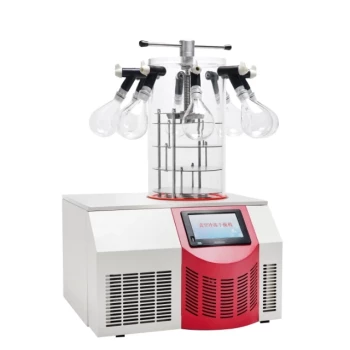
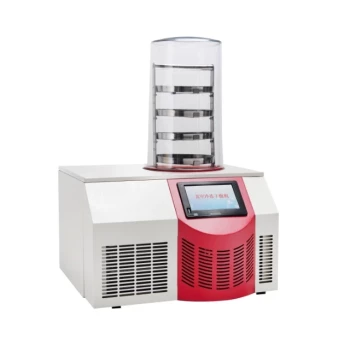
Laboratory freeze drying is preferred because it preserves the complex, microscopic architecture of biochar that traditional heating methods typically destroy. By utilizing sublimation under vacuum conditions, a freeze dryer removes moisture without the material entering a liquid phase, which eliminates the capillary forces responsible for structural collapse. This process ensures the biochar retains maximum porosity and active sites, directly translating to superior kinetic performance and adsorption capacity.
Central Takeaway: While traditional heating causes biochar pores to collapse and particles to agglomerate, laboratory freeze drying uses sublimation to lock the material's structure in place. This preservation of high surface area and structural integrity is essential for creating high-performance adsorbents capable of efficient ion transport and storage.
The Physics of Structural Integrity
Eliminating Capillary Forces
Traditional thermal drying relies on liquid evaporation, which creates significant surface tension as moisture leaves the pores. These capillary forces act like a vacuum, pulling the delicate walls of the biochar's internal network inward until they collapse or "stack."
Freeze drying bypasses this phase entirely by moving moisture directly from a solid (ice) to a gas (vapor). This ensures that the intricate network of micropores and mesopores remains rigid and open.
Preventing Hornification and Hardening
When biochar is subjected to traditional oven drying, it often undergoes hornification, a phenomenon where the internal structures collapse and the outer surface hardens. This "skin" effect reduces the accessibility of the material’s active sites to enzymes or chemical reactants.
A laboratory freeze dryer maintains a loose physical structure, ensuring that the final product remains highly accessible. This is critical for applications like enzymatic hydrolysis, where the substrate must fully bond with enzyme molecules to be effective.
Enhancing Adsorbent Performance
Maximizing Porosity and Surface Area
The effectiveness of a biochar adsorbent is defined by its effective surface area. Freeze drying prevents the agglomeration and stacking of layers—especially in graphene-based composites—that commonly occurs during high-temperature processing.
By keeping these layers separated, the freeze dryer ensures the resulting powder provides a larger surface area for modifications. This structural preservation is what allows for the immobilization of initiators and other functional groups.
Optimizing Ion Storage and Transport
For biochar used in electrochemical or advanced filtration roles, a fine network of micropores and mesopores is non-negotiable. These channels are the "highways" for ion transport and the "warehouses" for ion storage.
Because sublimation maintains these channels in their original state, the finished material exhibits high kinetic performance. In contrast, heat-dried materials often have "clogged" or collapsed pathways that stifle performance.
Operational and Environmental Advantages
Superior Speed and Energy Efficiency
Contrary to the perception that freeze drying is a slow process, modern laboratory freeze dryers can be 3 to 10 times faster than conventional vacuum drying. This speed significantly shortens research and production cycles for biochar development.
Furthermore, these units are highly efficient, often consuming 2 to 3 times less energy than traditional thermal methods. This makes them a more sustainable choice for labs focusing on green chemistry and material science.
Oxygen-Free Processing and Solvent Recovery
The vacuum chamber of a freeze dryer provides an oxygen-free environment, protecting biochar composites from unwanted oxidation or degradation during the final drying stage. This ensures the chemical purity of the adsorbent remains high.
Additionally, freeze dryers are uniquely capable of recycling organic solvents. This capability reduces production costs and minimizes the environmental footprint of the laboratory, especially when working with complex biomass treatments.
Understanding the Trade-offs
Equipment Specificity and Cost
While freeze drying offers superior structural preservation, it requires a higher initial capital investment compared to basic laboratory ovens. The equipment requires precise control over vacuum levels and shelf temperatures to be successful.
Material Preparation Requirements
Freeze drying is most effective when the material is properly pre-frozen. If the freezing process is too slow or inconsistent, large ice crystals can still damage the pore structure before the sublimation process even begins.
Applying This to Your Research
How to Select Your Drying Method
- If your primary focus is Maximum Adsorption Capacity: Use freeze drying to prevent the collapse of micropores and maximize the available surface area for contaminant binding.
- If your primary focus is Rapid Prototyping of Bio-Composites: Utilize the 3-10x faster drying speed of a freeze dryer to accelerate your testing and iteration cycles.
- If your primary focus is Solvent-Based Synthesis: Opt for a freeze dryer with recovery capabilities to lower costs and ensure safe, oxygen-free processing of organic materials.
By prioritizing the preservation of microscopic structures through sublimation, you ensure that your biochar adsorbents achieve their full theoretical potential in practical, high-performance applications.
Summary Table:
| Feature | Laboratory Freeze Drying (Sublimation) | Traditional Thermal Drying (Evaporation) |
|---|---|---|
| Structural Integrity | Preserves microscopic pores and channels | Capillary forces cause pore collapse/stacking |
| Surface Area | Maximized; prevents particle agglomeration | Reduced due to "hornification" and hardening |
| Adsorption Performance | High kinetic transport and storage capacity | Clogged pathways stifle ion/reactant flow |
| Processing Speed | 3–10x faster than conventional vacuum drying | Slower, multi-stage heating required |
| Environment | Oxygen-free vacuum; solvent recovery possible | Risk of oxidation; difficult solvent capture |
| Energy Efficiency | Consumes 2–3x less energy | Higher energy consumption due to heat loss |
Elevate Your Material Research with KINTEK Precision
Unlock the full potential of your high-performance adsorbents with KINTEK’s advanced laboratory solutions. Whether you are synthesizing biochar, graphene composites, or advanced catalysts, our technology ensures your materials maintain the structural integrity required for breakthrough results.
Why choose KINTEK for your lab?
- Superior Preservation: Our high-efficiency freeze dryers and cold traps lock in microscopic architecture, preventing the pore collapse common in thermal processing.
- End-to-End Solutions: From crushing and milling systems to high-temperature high-pressure reactors and vacuum furnaces, we provide a complete ecosystem for material science.
- Unmatched Efficiency: Shorten your R&D cycles with equipment designed for speed, energy savings, and oxygen-free processing.
Don’t let traditional drying methods compromise your data. Contact KINTEK today to find the perfect equipment for your specific research needs and ensure your materials achieve maximum adsorption capacity!
References
- Wei Zhang, Yong Sik Ok. Machine learning based prediction and experimental validation of arsenite and arsenate sorption on biochars. DOI: 10.1016/j.scitotenv.2023.166678
This article is also based on technical information from Kintek Solution Knowledge Base .
Related Products
- High Performance Laboratory Freeze Dryer
- High Performance Laboratory Freeze Dryer for Research and Development
- Benchtop Laboratory Freeze Dryer for Lab Use
- Benchtop Laboratory Vacuum Freeze Dryer
- 808L Precision Laboratory Vertical Ultra Low Temperature Freezer
People Also Ask
- What role does a laboratory freeze dryer play in the synthesis of graphene-based electrocatalysts? Preserve 3D Structures
- What are the technical advantages of using a laboratory freeze dryer for porous carbon precursors? Preserve 3D Networks
- What types of liquid samples can be processed using a laboratory freeze dryer? Preserve Your Sensitive Materials
- How do laboratory freeze dryers support scientific research? Preserve Sample Integrity for Reproducible Results
- What precautions should be taken when using a laboratory freeze dryer? Essential Steps for Reliable Lyophilization