Mechanical mixing is the fundamental catalyst for the sulfurization reduction of Niccolite. By ensuring that ferrous sulfide (FeS) is uniformly distributed, you maximize the interfacial contact area required for the chemical transformation. Without this homogenization, the arsenic within the ore cannot efficiently convert into volatile vapors, leading to incomplete dearsenization and poor furnace throughput.
The success of Niccolite processing depends on the physical proximity of FeS to the ore particles. Because FeS serves a dual role as both a reducing agent and a sulfur source, mechanical mixing is the only way to ensure these chemical reactions occur consistently throughout the material bulk.
Maximizing Reactant Contact and Surface Area
Overcoming Solid-State Diffusion Barriers
In a roasting furnace, the reaction primarily occurs where the surfaces of the Niccolite and FeS particles meet. Mechanical homogenization eliminates "dead zones" where particles are isolated, allowing the reaction to proceed without being bottlenecked by slow natural diffusion.
The Dual Role of Ferrous Sulfide
FeS is not a passive additive; it must act as both a reducing agent and a sulfur donor. Direct contact is required for the FeS to effectively donate sulfur atoms to the arsenic, a process that is physically impossible if the materials are segregated or poorly layered.
Enhancing the Dearsenization Process
Facilitating Arsenic Volatilization
The primary goal of this process is to transform arsenic into volatile arsenic sulfide vapors that can be removed from the system. This chemical shift requires a specific local environment that is only achieved when FeS is pressed firmly against the Niccolite raw materials.
Improving Reaction Kinetics and Depth
Uniform mixing directly influences the reaction rate within the roasting furnace. When the mixture is homogenous, the entire volume of the ore can reach the required depth of dearsenization simultaneously, preventing the need for extended residence times.
Understanding the Trade-offs and Pitfalls
Energy Consumption vs. Chemical Yield
While intensive mixing improves chemical efficiency, it introduces higher operational costs and equipment wear. Finding the "sweet spot" where mixing is sufficient to ensure dearsenization without excessive energy waste is a critical balance for process engineers.
Management of Fine Particles
Aggressive mechanical mixing can lead to particle attrition, creating very fine dust. While high surface area is beneficial for the reaction, excessive fines can be swept away by furnace gases, leading to material loss and potential clogging of the vapor recovery systems.
How to Apply This to Your Process
When optimizing your Niccolite reduction strategy, consider the following recommendations based on your operational priorities:
- If your primary focus is High Purity (Deep Dearsenization): Prioritize high-intensity homogenization to ensure every arsenic atom has immediate access to a sulfur source, minimizing residual impurities.
- If your primary focus is Furnace Throughput: Increase the precision of your mixing to accelerate reaction kinetics, allowing for faster feed rates and shorter roasting cycles.
- If your primary focus is Resource Conservation: Optimize the particle size distribution of the FeS before mixing to maximize contact area without requiring excessive mechanical energy.
Properly executed mechanical mixing transforms a slow, inconsistent roasting process into a predictable and highly efficient chemical extraction.
Summary Table:
| Key Factor | Role in Sulfurization Reduction | Process Impact |
|---|---|---|
| Homogenization | Maximizes interfacial contact between Niccolite & FeS | Eliminates solid-state diffusion barriers |
| Interfacial Area | Facilitates sulfur donation and arsenic reduction | Accelerates arsenic volatilization (vapors) |
| Reaction Kinetics | Ensures consistent chemical environment throughout bulk | Achieves deeper dearsenization in less time |
| Uniform Distribution | Prevents "dead zones" and material segregation | Improves furnace throughput and resource efficiency |
Optimize Your Metallurgy Process with KINTEK
Elevate your ore processing efficiency with KINTEK’s advanced laboratory and industrial solutions. Achieving the perfect sulfurization reduction of Niccolite requires more than just chemistry—it requires the right equipment to ensure total homogenization and precise thermal control.
From high-performance crushing and milling systems for feed preparation to specialized rotary and atmosphere furnaces for roasting, KINTEK provides the tools you need to maximize arsenic removal and minimize material loss. Our portfolio also includes homogenizers, sieving equipment, and essential consumables like crucibles and ceramics to support your entire workflow.
Ready to enhance your lab's extraction yields? Contact us today to find the perfect equipment for your processing needs!
References
- Xiaowei Tang, Yuehui He. A novel optimal formula of nickel extraction: arsenic removal from niccolite by controlling arsenic-containing phases. DOI: 10.3389/fchem.2023.1290831
This article is also based on technical information from Kintek Solution Knowledge Base .
Related Products
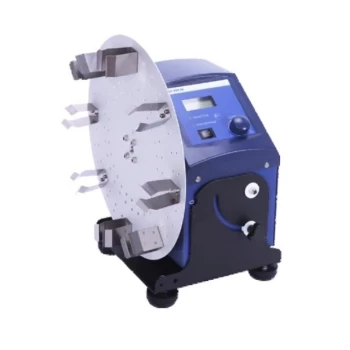
- Laboratory Disc Rotary Mixer for Efficient Sample Mixing and Homogenization
- High Performance Lab Homogenizer for Pharma Cosmetics and Food R&D
- High Shear Homogenizer for Pharmaceutical and Cosmetic Applications
- Lab Sterile Slapping Type Homogenizer for Tissue Mashing and Dispersing
People Also Ask
- What is a laboratory mixer used for? Choose the Right Tool for Liquids or Solids
- What is a laboratory mixer? A Guide to Achieving Perfect Sample Homogeneity
- What are laboratory mixers used for? Achieve Perfect Sample Homogeneity and Reliable Results
- How does a high-efficiency homogenizing mixer contribute to the preparation of Tobermorite and Xonotlite precursors?
- Why is precision mixing required for concrete corrosion studies? Ensure Data Integrity through Homogenization