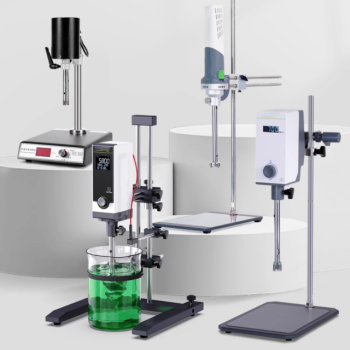
Laboratory mixing equipment serves as the essential gateway to bioenergy synergy by enabling the precise preparation of biomass and waste polymer blends at specific mass ratios. By ensuring a uniform physical distribution of disparate materials, this equipment allows researchers to observe how synchronized chemical reactions improve the energy density and combustion efficiency of the resulting biochars.
The core value of laboratory mixing equipment lies in its ability to create perfectly homogeneous blends of biomass and polymers, which is the necessary foundation for synchronizing chemical bond-breaking during thermal degradation and maximizing the energy output of bio-based fuels.
Achieving Precision in Raw Material Ratios
Defining Exact Mass Ratios
Precision mixing equipment allows researchers to prepare feedstock blends at highly specific mass ratios, such as 25%, 50%, or 75% concentrations. This level of accuracy is the only way to establish a reliable baseline for identifying the exact point where synergistic effects occur between materials like biomass and face mask waste.
Ensuring Physical Uniformity
Uniformity is critical when dealing with diverse materials such as polymer components and biomass fibers. Mechanical mixers ensure these components are distributed evenly throughout the sample, preventing "pockets" of unmixed material that would skew experimental results and hide true synergistic potential.
The Chemical Impact of Uniform Mixing
Synchronizing Thermal Degradation
A primary goal of bioenergy research is to ensure that different materials in a blend react at the same time. High-quality mixing equipment ensures that physical contact between fibers and polymers is maximized, which directly facilitates the synchronization of chemical bond-breaking during the thermal degradation process.
Optimizing Energy Density and Combustion
The degree of mixing directly determines the quality of the final product, such as biochar. When materials are mixed uniformly, the resulting fuel exhibits higher energy density and superior combustion efficiency, as the synergistic interaction between the feedstocks is fully realized during the conversion process.
Understanding the Trade-offs and Limitations
Scalability Discrepancies
While laboratory mixers provide near-perfect homogeneity, these results can be difficult to replicate at an industrial scale. Large-scale processing often relies on continuous feed systems that may not achieve the same intimate contact between polymers and biomass, potentially leading to lower synergistic gains than those observed in the lab.
Material Degradation During Mixing
High-intensity mixing can generate localized heat or mechanical stress that may begin to break down delicate biomass fibers before the thermal conversion even begins. Researchers must balance the need for total uniformity with the risk of altering the physical properties of the raw materials through over-processing.
Applying Mixing Strategies to Research Goals
To achieve the best results in bioenergy feedstock preparation, researchers must align their mixing protocols with their ultimate energy targets.
- If your primary focus is identifying optimal feedstock blends: Use precise incremental mass ratios to map the specific points where synergistic effects on energy density are most pronounced.
- If your primary focus is maximizing combustion efficiency: Prioritize high-shear mixing to ensure the most uniform distribution of polymer components among biomass fibers for synchronized chemical reactions.
- If your primary focus is biochar quality: Ensure mixing durations are optimized to prevent physical degradation of the fibers while maintaining a homogeneous distribution of all raw materials.
Through the precise control of material ratios and physical distribution, laboratory mixing equipment transforms raw waste into a predictable and high-performing energy source.
Summary Table:
| Feature | Research Benefit | Bioenergy Impact |
|---|---|---|
| Precise Mass Ratios | Accurate blending (e.g., 25%, 50%, 75%) | Identifies the exact point of synergistic gain |
| Physical Uniformity | Even distribution of fibers and polymers | Prevents result skewing and ensures reliable data |
| Maximized Contact | Synchronized chemical bond-breaking | Higher energy density and combustion efficiency |
| Controlled Mixing | Optimized duration and intensity | Prevents degradation of delicate biomass fibers |
Elevate Your Bioenergy Research with KINTEK
Achieving the perfect synergistic effect requires more than just mixing—it requires absolute precision. KINTEK specializes in high-performance laboratory equipment designed to help you master feedstock preparation.
Our extensive portfolio includes high-shear homogenizers, shakers, and advanced crushing and milling systems to ensure your biomass and polymer blends achieve the physical uniformity necessary for synchronized thermal degradation. By integrating KINTEK’s precision tools, you can maximize energy output and biochar quality with confidence.
Why choose KINTEK?
- Unmatched Uniformity: Eliminate material "pockets" for more accurate experimental results.
- Total Scalability Insights: Transition from lab-scale success to industrial potential with reliable equipment.
- End-to-End Support: From sample preparation to final thermal processing in our muffle and vacuum furnaces.
Ready to optimize your raw material ratios? Contact KINTEK today to discover how our solutions can accelerate your bioenergy breakthroughs!
References
- Yasirah Yusoff, Firas Basim Ismail. A Comparison of Feedstock from Agricultural Biomass and Face Masks for the Production of Biochar through Co-Pyrolysis. DOI: 10.3390/su152216000
This article is also based on technical information from Kintek Solution Knowledge Base .
Related Products
- Laboratory Vortex Mixer Orbital Shaker Multifunctional Rotation Oscillation Mixer
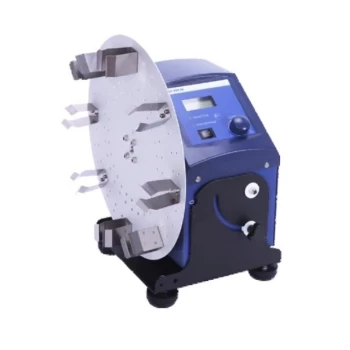
- Laboratory Disc Rotary Mixer for Efficient Sample Mixing and Homogenization
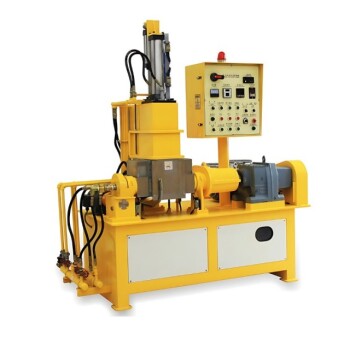
- Lab Internal Rubber Mixer Rubber Kneader Machine for Mixing and Kneading
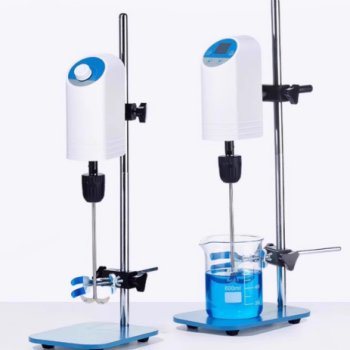
- High Performance Laboratory Stirrers for Diverse Applications
- Laboratory Oscillating Orbital Shaker
People Also Ask
- What is the role of a laboratory orbital shaker in copper recovery? Optimize Industrial Waste Liquid Processing
- What is the role of a laboratory orbital shaker in activated carbon synthesis? Maximize Pore Depth & Surface Area
- What is a laboratory mixer used for? Choose the Right Tool for Liquids or Solids
- What is a laboratory mixer? A Guide to Achieving Perfect Sample Homogeneity
- What are laboratory mixers used for? Achieve Perfect Sample Homogeneity and Reliable Results