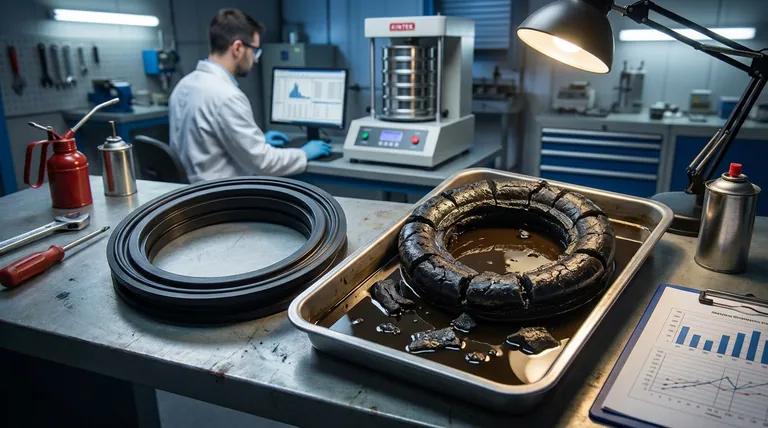
It’s a scenario familiar to many maintenance managers and engineers. You’ve specified and installed a new component—a gasket, a seal, or an impact liner—made from high-quality natural rubber. It feels tough, flexible, and perfectly suited for the job. But weeks or months later, a leak appears, or a machine starts vibrating excessively.
Upon inspection, the part that was once a robust, solid piece of rubber has turned into a swollen, gummy mess. It’s soft, weak, and falling apart at the touch. The immediate conclusion? It must have been a "bad batch" from the supplier. But what if the problem isn't the quality of the rubber at all?
The Cycle of Blame and Replacement
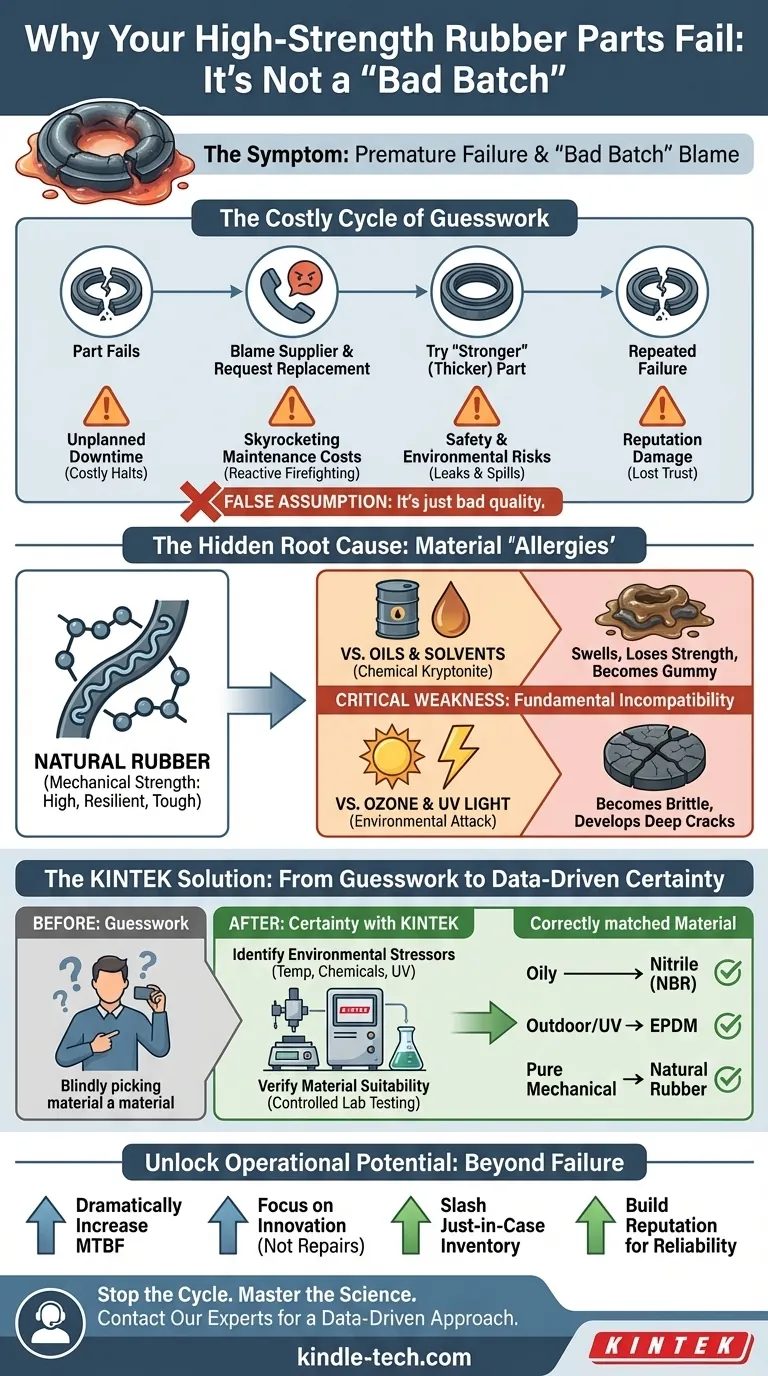
When a seemingly durable part fails, the response is often predictable. First, we blame the component's quality and contact the supplier, demanding a replacement. Second, we might try a "stronger" fix, like ordering a thicker version of the exact same natural rubber part, hoping more material will solve the problem. When that fails too, we resign ourselves to a cycle of frequent inspection and costly, repetitive replacements.
This isn't just an operational headache; it has serious business consequences:
- Unplanned Downtime: A single failed gasket can bring an entire production line to a halt, costing thousands of dollars per hour.
- Skyrocketing Maintenance Costs: The budget for labor and replacement parts balloons as your team shifts from proactive maintenance to reactive firefighting.
- Safety and Environmental Risks: Leaking seals can lead to hazardous spills, creating unsafe working conditions and potential environmental compliance issues.
- Reputation Damage: If these components are part of a product you sell, premature field failures can destroy customer trust and your company's reputation for quality.
This cycle of failure continues because it’s based on a false assumption. The problem isn’t that the natural rubber was "bad." The problem is that it was the wrong material for the environment it was placed in.
The Hidden 'Allergy': Why Mechanical Strength Isn’t Enough
The root of the problem lies in a fundamental misunderstanding of material science. Natural rubber is a phenomenal material, celebrated for its incredible elasticity, resilience, and tear strength. It’s mechanically tough, which is why we choose it for demanding physical jobs.
However, like a person with a severe food allergy, natural rubber has critical weaknesses in specific environments. Its molecular structure makes it highly vulnerable to:
- Oils and Solvents: This is natural rubber’s biggest "allergy." When exposed to petroleum-based oils, fuels, or many industrial solvents, it doesn't just get dirty—it undergoes a chemical reaction. The material swells, loses its strength, and degrades into the soft, gummy substance you discovered on your failed part.
- Ozone and UV Light: Exposure to sunlight (UV) or the ozone generated by electric motors attacks the chemical bonds in natural rubber, causing it to become brittle and develop deep cracks over time.
This is why the "common solutions" fail. Asking for a replacement from the same batch or a thicker piece of natural rubber is like giving a person with a severe peanut allergy a larger portion of peanuts. The problem isn't the quality or the amount; it's the fundamental incompatibility. You chose a material based on its mechanical strengths while unknowingly exposing it to its chemical kryptonite.
From Guesswork to Certainty: A Data-Driven Approach
To break the cycle of failure, you must move beyond just "mechanical toughness" and match the material’s entire profile—both its strengths and its chemical vulnerabilities—to your specific operating environment.
This is where a data-driven approach becomes essential. To make the right choice, you need a method to:
- Identify all the environmental stressors: not just impact and pressure, but also temperature, chemical exposure, and UV light.
- Verify a material's suitability through controlled testing that mimics those exact conditions.
This is precisely why KINTEK provides laboratories and R&D teams with the specialized equipment and high-quality consumables they need. Our tools are designed to move you from expensive guesswork to confident, data-backed decisions. Instead of hoping a material works, our solutions allow you to prove it will. We empower your lab to answer critical questions like:
- How does this elastomer perform after 500 hours of immersion in this specific hydraulic fluid at 80°C?
- What is the change in tensile strength after prolonged UV exposure?
By partnering with KINTEK, you aren't just buying lab equipment; you are investing in certainty. You're building an in-house capability to diagnose material challenges at their root and select the correct elastomer—whether it's Natural Rubber for pure mechanical stress, Nitrile (NBR) for oily environments, or EPDM for outdoor applications—with complete confidence.
What's Possible When Material Failure is Off the Table?
Once you stop treating recurring component failure as an unavoidable cost of doing business, you unlock a new level of operational and engineering potential.
Instead of your best engineers spending their time investigating why another seal failed, they can focus on innovation. Your maintenance budget is no longer drained by emergency repairs, but can be invested in value-adding upgrades.
When material selection is a solved problem, you can:
- Dramatically increase Mean Time Between Failures (MTBF), boosting productivity and output.
- Confidently design products for more demanding applications, opening up new markets.
- Slash your inventory of "just-in-case" replacement parts and the associated carrying costs.
- Build a powerful reputation for reliability, turning your product's durability into a key competitive advantage.
Choosing the right material transforms a chronic, costly problem into a source of lasting value. It's time to stop blaming the batch and start mastering the science.
Stop the cycle of guesswork and costly downtime. Your team has the expertise to solve complex challenges, and our team has the tools to empower them. Let us help you turn material selection from a recurring problem into a powerful competitive advantage. Contact Our Experts to discuss your specific project and how a data-driven approach can transform your reliability.
Visual Guide
Related Products
- Rubber Vulcanizer Vulcanizing Machine Plate Vulcanizing Press for Lab
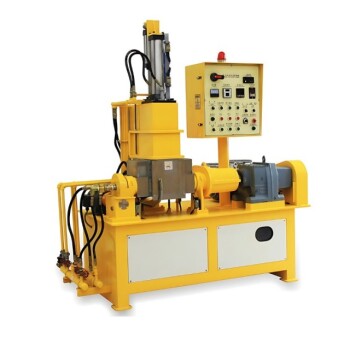
- Lab Internal Rubber Mixer Rubber Kneader Machine for Mixing and Kneading
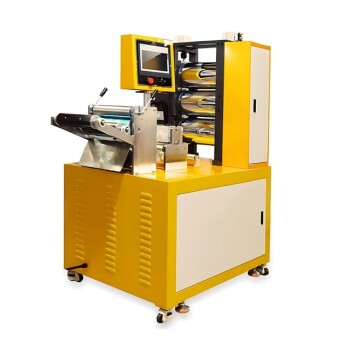
- Small Lab Rubber Calendering Machine
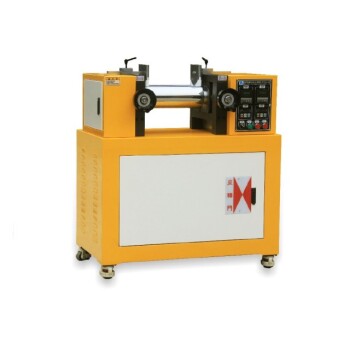
- Open Type Two Roll Mixing Mill Machine for Rubber Crusher
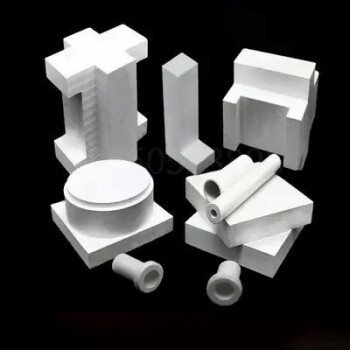
- Advanced Engineering Fine Ceramics Boron Nitride (BN) Ceramic Parts