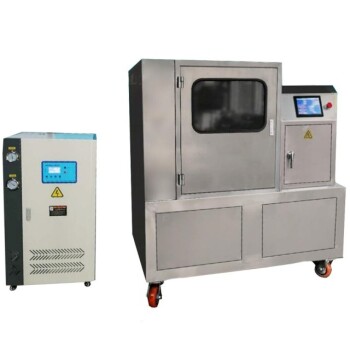
The primary role of water-cooling jackets and cooling air systems is to achieve instantaneous quenching of ash samples. By rapidly dropping the temperature of a sample after its designated exposure time in a furnace, these systems halt high-temperature chemical reactions and stop further potassium volatilization, effectively "freezing" the chemical state at a precise moment in time.
Accurate measurement of potassium release requires stopping volatilization the moment a sample is removed from the furnace. These cooling systems provide the necessary thermal shock to lock in the potassium content, ensuring researchers measure the actual state of the reaction rather than the gradual decay of a cooling process.
The Role of Quenching in Temporal Accuracy
Halting High-Temperature Volatilization
Potassium is highly volatile and continues to escape from ash samples as long as they remain at elevated temperatures. Rapid cooling prevents this "over-reaction," which would otherwise lead to an underestimation of the potassium remaining in the sample.
Locking the Reaction Stage
In combustion studies, it is critical to distinguish between the volatile stage and the char stage. Instantaneous cooling allows researchers to isolate these stages by stopping the reaction at specific intervals, providing a clean "snapshot" of the sample’s composition.
Ensuring Data Repeatability
By removing the variable of ambient cooling time, these systems ensure that every sample is treated identically after furnace removal. This consistency is vital for building a reliable data set across multiple experimental runs.
Enhancing Measurement Objectivity
Reducing Experimental Uncertainty
Without rapid cooling, the chemical reaction continues outside the controlled environment of the furnace. This introduces uncontrolled variables that can skew the data regarding potassium release patterns and release rates.
Enabling Precise Kinetic Analysis
Stopping the clock on chemical reactions allow for more accurate kinetic modeling. Researchers can map exactly how much potassium was released per second of exposure because the measurement is not "blurred" by the transition from furnace to lab bench.
Identifying Stage-Specific Characteristics
These cooling systems make it possible to objectively observe how potassium behaves differently during the initial release of volatiles versus the slower combustion of char. This distinction is essential for understanding the full lifecycle of biomass or coal combustion.
Understanding the Trade-offs
Thermal Stress and Sample Integrity
Rapid quenching can cause physical degradation of the ash sample due to extreme thermal shock. While this rarely affects the chemical mass of the potassium, it can alter the physical morphology of the ash, which may be a concern for structural studies.
Condensation and Moisture Interference
Air-cooling systems must be managed to avoid moisture buildup on the sample surface. If a sample absorbs moisture from the cooling air or the surrounding environment during the quenching process, it can complicate subsequent mass-balance calculations.
System Complexity
Implementing water-cooling jackets requires a constant, regulated flow of coolant and careful insulation to prevent the cooling system from affecting the furnace's internal temperature. This adds a layer of mechanical complexity to the experimental setup.
Applying These Systems to Your Research
When integrating cooling systems into your experimental design, your choice of method should align with your specific data requirements.
- If your primary focus is kinetic modeling: Utilize high-velocity cooling air systems to capture precise data points across the volatile release stage where seconds matter.
- If your primary focus is final ash composition: Water-cooling jackets are often preferred as they provide the thermal mass necessary to ensure larger samples reach stable, inert temperatures quickly.
By effectively "freezing" the chemical state of your samples, you ensure that your findings reflect the true behavior of potassium under high-temperature conditions.
Summary Table:
| Key Mechanism | Primary Function | Research Impact |
|---|---|---|
| Instantaneous Quenching | Halts high-temp chemical reactions | Prevents potassium underestimation |
| Thermal Shock | Drops sample temperature rapidly | "Freezes" reaction stages for analysis |
| Temporal Accuracy | Isolates volatile vs. char stages | Enables precise kinetic modeling |
| Measurement Control | Ensures identical treatment per sample | Increases data repeatability and objectivity |
Achieve Unmatched Research Precision with KINTEK
High-temperature analysis requires absolute control over reaction timing. KINTEK specializes in advanced laboratory equipment, providing high-temperature furnaces (muffle, vacuum, and atmosphere), high-pressure reactors, and critical cooling solutions designed for rigorous research environments. Our portfolio, including precision crushing systems, hydraulic presses, and specialized consumables like PTFE and ceramics, empowers researchers to capture accurate data and ensure repeatability.
Ready to enhance your measurement accuracy? Contact KINTEK today to discover how our high-performance systems can streamline your material science and combustion studies.
References
- Feng Zhang, Lei Deng. Release Characteristics of Potassium during Biomass Combustion. DOI: 10.3390/en16104107
This article is also based on technical information from Kintek Solution Knowledge Base .
Related Products
- Double-Layer Water Bath Electrolytic Electrochemical Cell
- Low-Temperature Water-Cooled Touchscreen Vibratory Ultrafine Pulverizer
People Also Ask
- What does the routine maintenance of a double-layer water-bath electrolytic cell involve? A Guide to Ensuring Precision and Longevity
- What is the typical experimental system used with a double-layer water-bath electrolytic cell? Achieve Precise Electrochemical Control
- What are the procedures for after using a double-layer water-bath electrolytic cell? Ensure Equipment Longevity and Data Accuracy
- When is professional repair required for a double-layer water-bath electrolytic cell? Protect Your Lab's Precision and Safety
- What are the key features of a double-layer water-bath electrolytic cell? Achieve Precise Temperature Control for Your Experiments