
In essence, a drying oven is a precision-heated chamber engineered to remove moisture from objects through a process of controlled heat and airflow. It functions by circulating hot air to achieve a uniform internal temperature, which evaporates water and other solvents from samples, parts, or laboratory equipment placed inside.
A drying oven is more than just a hot box. Its defining purpose is to create a highly controlled environment where uniform temperature and active air exchange work together to systematically remove moisture, making it a precise tool for drying, curing, and sterilization.
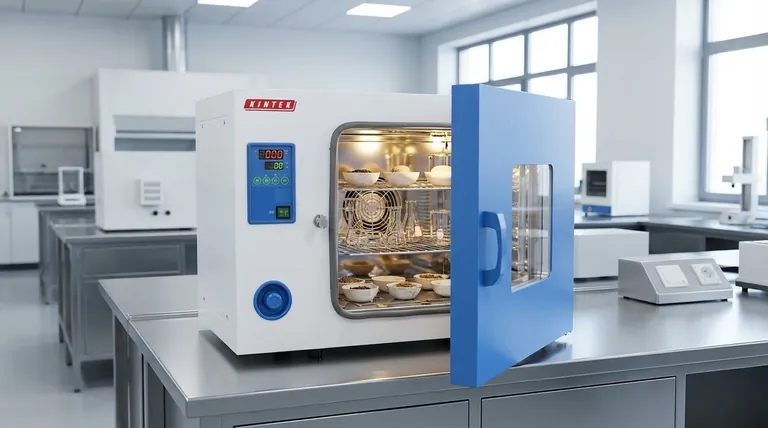
How a Drying Oven Achieves Uniform Results
The effectiveness of a drying oven comes from its ability to manage both heat and air, ensuring every part of an item is treated equally. This is achieved through a few key principles.
The Principle of Forced Convection
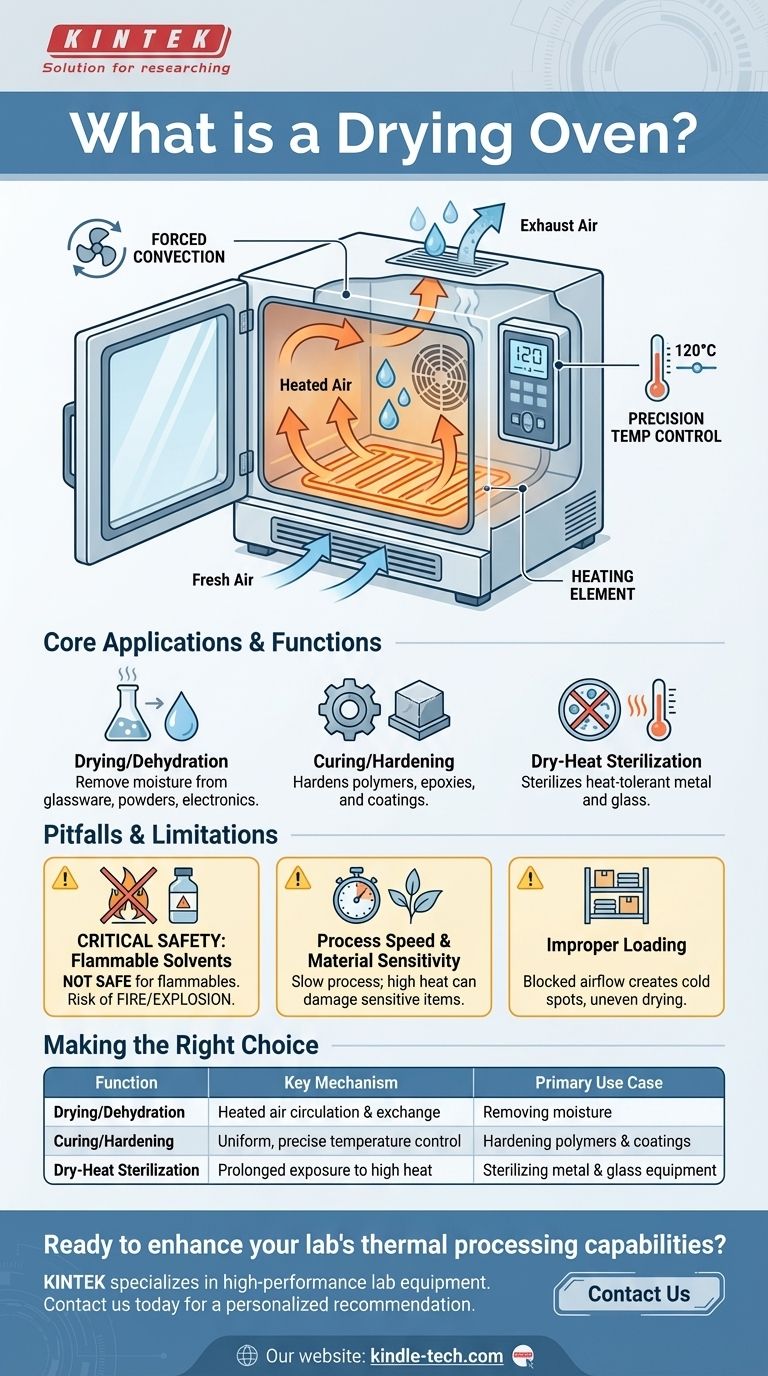
Most laboratory and industrial drying ovens use a fan or turbine. This component actively circulates the heated air throughout the chamber.
This process, known as forced convection, eliminates temperature stratification (hot spots and cold spots), ensuring the entire interior space maintains a consistent, uniform temperature.
The Role of Air Exchange
A drying oven is not a sealed system. It continuously draws in fresh, ambient air and exhausts humid air.
The incoming air is passed over a heating element, and as this dry, hot air circulates, it absorbs moisture from the items inside. This now-saturated air is then vented, making room for more fresh, dry air to continue the process. This constant exchange is what drives the moisture removal.
Precision Temperature Control
Unlike a simple heater, a drying oven is equipped with sophisticated temperature controllers. These systems constantly monitor the internal temperature and adjust the heating elements to maintain a specific setpoint with very little deviation.
This precision is critical for sensitive applications where exact temperatures are required for curing materials or for sterilization protocols.
Core Applications and Functions
While the name implies a single purpose, drying ovens are versatile tools used for several distinct thermal processes in laboratory and industrial settings.
Drying and Dehydration
This is the most common application. It involves removing water or other non-flammable solvents from a wide range of materials, such as glassware, powders, electronics, or biological samples.
Curing and Hardening
Many polymers, epoxies, and industrial coatings require heat to trigger a chemical reaction that hardens or "cures" them. The uniform heat of a drying oven ensures this reaction happens evenly across the entire surface of the part.
Dry-Heat Sterilization
Drying ovens can be used to sterilize equipment, typically metal instruments or glassware, that can withstand high temperatures. This method uses prolonged exposure to high heat (e.g., 160-180°C) to kill microorganisms. It is a different process from an autoclave, which uses steam under pressure.
Understanding the Pitfalls and Limitations
To use a drying oven safely and effectively, you must understand what it is—and is not—designed to do.
Critical Safety: Flammable Solvents
Standard drying ovens are not safe for removing flammable or volatile solvents like alcohol, acetone, or hexane. The heating elements and internal electronics can act as an ignition source, creating a significant risk of fire or explosion.
For these applications, a specially designed explosion-proof or solvent-evaporating oven with safety features is mandatory.
Process Speed and Material Sensitivity
Dry heat is a relatively slow process compared to other methods like vacuum drying, which lowers the boiling point of water.
Furthermore, the high temperatures required for drying or sterilization can damage heat-sensitive materials, such as many plastics or delicate biological specimens.
The Impact of Improper Loading
The oven's performance relies entirely on unobstructed airflow. Overloading the chamber or placing items in a way that blocks air vents will create cold spots and lead to incomplete or uneven drying.
Making the Right Choice for Your Goal
Select your thermal process based on your specific objective and material constraints.
- If your primary focus is simple moisture removal from robust materials: A standard forced-convection drying oven provides an efficient and reliable solution.
- If your primary focus is curing polymers or coatings: Prioritize an oven with highly precise temperature uniformity to ensure a consistent and complete reaction.
- If your primary focus is sterilization: Ensure the oven can reach and hold the required high temperatures for the necessary duration, and confirm your items can withstand dry heat.
- If you are working with flammable solvents: You must use a specifically designed, explosion-proof solvent-evaporating oven; using a standard drying oven is a critical safety hazard.
Understanding its core mechanism of controlled airflow and temperature is the key to leveraging a drying oven effectively and safely for your specific application.
Summary Table:
| Function | Key Mechanism | Primary Use Case |
|---|---|---|
| Drying/Dehydration | Heated air circulation & exchange | Removing moisture from glassware, powders, electronics |
| Curing/Hardening | Uniform, precise temperature control | Hardening polymers, epoxies, and industrial coatings |
| Dry-Heat Sterilization | Prolonged exposure to high heat | Sterilizing heat-tolerant metal and glass equipment |
Ready to enhance your lab's thermal processing capabilities?
KINTEK specializes in high-performance lab equipment, including a full range of drying ovens designed for precision, safety, and reliability. Whether your needs are for drying, curing, or sterilization, our experts can help you select the perfect oven for your specific materials and protocols.
Contact us today to discuss your application and get a personalized recommendation. Let KINTEK be your trusted partner in laboratory efficiency.
Visual Guide
Related Products
- Laboratory Scientific Electric Heating Blast Drying Oven
- 56L Vertical Laboratory Vacuum Drying Oven
- 23L Laboratory Vacuum Drying Oven
- High Temperature Muffle Oven Furnace for Laboratory Debinding and Pre Sintering
- Dental Porcelain Zirconia Sintering Ceramic Vacuum Press Furnace
People Also Ask
- What role does a precision laboratory drying oven play in the synthesis of GO-PANI nanocomposites? Protect Material Integrity
- How does a laboratory electric drying oven contribute to the formation of the initial coating? Expert Insights
- What is the function of a laboratory drying oven in biomass pretreatment? Ensure High-Quality Bio-oil Production
- What is the function of a laboratory drying oven in Zr2.5Nb alloy pretreatment? Ensure Precise Corrosion Test Results
- What is the necessity of using a laboratory drying oven when processing MoO3/GO composite nanopowders? Find out here.




