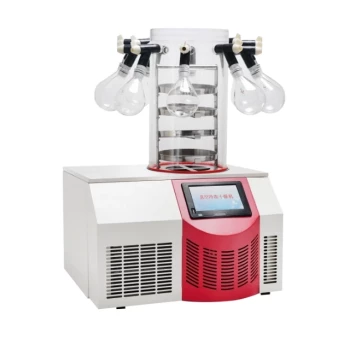
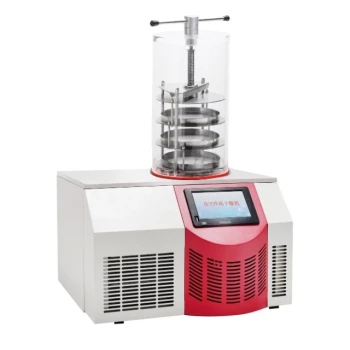
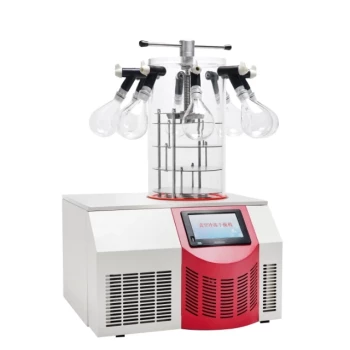
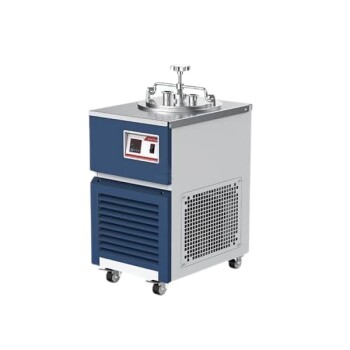
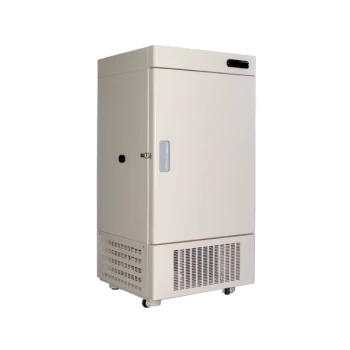
The primary function of a vacuum freeze dryer in preparing sodium alginate-based carbon aerogels is to remove water via sublimation, preserving the material's delicate three-dimensional nanoporous network. By operating under low temperatures and high-vacuum conditions, the dryer transitions ice directly into gas without passing through a liquid phase. This prevents the structural collapse and shrinkage that typically occur during traditional thermal drying, resulting in a dried aerogel with high specific surface area and ideal porosity.
Core Takeaway: Vacuum freeze-drying is the critical bridge between a wet hydrogel and a functional carbon aerogel, as it eliminates the capillary forces that would otherwise destroy the material's internal architecture during the drying process.
The Mechanics of Sublimation in Aerogel Synthesis
Bypassing the Liquid Phase
Traditional drying methods rely on evaporation, which involves a liquid-to-gas transition. In the context of sodium alginate hydrogels, the liquid-gas interface creates significant surface tension and capillary forces within the microscopic pores.
A vacuum freeze dryer circumvents this by utilizing sublimation. This process allows solid ice to turn directly into vapor, effectively removing the solvent while the material remains in a frozen, rigid state.
Eliminating Structural Collapse
Because there is no liquid phase, the capillary forces that usually pull the walls of the pores together are eliminated. This is vital for maintaining the "loose" three-dimensional network induced by the alginate and any additives like cellulose nanocrystals.
By preventing the framework from folding in on itself, the freeze dryer ensures the final aerogel remains ultra-lightweight and structurally sound. This structural preservation is the necessary foundation for the subsequent pyrolysis step.
Impact on Material Properties
Maximizing Specific Surface Area
The performance of carbon aerogels in applications like energy storage or catalysis depends heavily on specific surface area. Vacuum freeze-drying preserves the complex, interconnected nanopores of the sodium alginate precursor.
Maintaining these pores ensures that the final carbonized material has a high density of active sites. This leads to superior performance compared to materials dried through atmospheric or thermal means.
Establishing Uniform Porosity
The vacuum environment allows for a highly controlled removal of moisture, which contributes to a uniform pore size distribution. In many composites, this results in a consistent skeletal structure with pores sized for specific functions, such as electromagnetic wave reflection.
Furthermore, freeze-drying prevents the agglomeration of particles within the alginate matrix. This ensures that when the material is eventually converted to carbon, the distribution of components remains homogenous.
Understanding the Trade-offs
Process Time and Energy Demands
While freeze-drying produces superior material properties, it is a time-intensive process. Sublimation occurs slowly, often requiring several days to ensure complete moisture removal from the core of the hydrogel.
Additionally, maintaining the necessary high-vacuum and cryogenic temperatures requires significant energy. This makes the process more expensive than oven-drying or spray-drying techniques.
Pre-freezing Sensitivity
The final structure of the aerogel is heavily influenced by the initial freezing rate. If the hydrogel is frozen too slowly, large ice crystals can form, which may rupture the delicate alginate walls.
Engineers must carefully control the cooling rate before the vacuum is applied. This adds a layer of operational complexity that requires precise equipment and expertise.
How to Apply This to Your Project
The decision to use a vacuum freeze dryer depends on the final performance requirements of your sodium alginate-based carbon aerogel.
- If your primary focus is Maximum Surface Area: Use vacuum freeze-drying to ensure the nanoporous structure remains fully intact and accessible for chemical reactions.
- If your primary focus is Structural Integrity: Opt for freeze-drying to eliminate the risk of shrinkage and warping caused by liquid surface tension.
- If your primary focus is High-Volume, Low-Cost Production: Evaluate whether the performance gains of freeze-drying justify the increased cycle time and energy costs compared to alternative drying methods.
By effectively managing the transition from ice to vapor, the vacuum freeze dryer serves as the essential tool for transforming soft sodium alginate gels into high-performance, porous carbon architectures.
Summary Table:
| Feature | Role in Aerogel Synthesis | Material Impact |
|---|---|---|
| Drying Mechanism | Sublimation (Solid to Gas) | Eliminates surface tension and capillary forces |
| Structural Control | Bypasses Liquid Phase | Prevents shrinkage and structural collapse |
| Porosity Preservation | Maintains 3D Network | Ensures high specific surface area and uniform pores |
| Pre-pyrolysis Prep | Rigid Framework Stabilization | Creates the ideal foundation for high-performance carbonization |
| Material Density | Moisture Removal under Vacuum | Results in ultra-lightweight, high-porosity architectures |
Elevate Your Material Research with KINTEK Precision
Achieving the perfect nanoporous structure in sodium alginate-based carbon aerogels requires uncompromising control over drying and thermal processing. KINTEK specializes in providing high-performance laboratory equipment designed for advanced material synthesis.
From our high-efficiency vacuum freeze dryers and cold traps that ensure structural integrity during sublimation, to our precision muffle and tube furnaces for consistent carbonization and pyrolysis, we offer a complete workflow solution. Our portfolio also includes high-temperature high-pressure reactors, planetary ball mills, and hydraulic presses, empowering researchers to push the boundaries of energy storage and catalysis.
Ready to optimize your aerogel production and maximize specific surface area? Contact KINTEK today to discover how our tailored laboratory solutions can enhance your project's efficiency and results!
References
- Daryoush Sanaei, Vassilis J. Inglezakis. Synthesis of a novel perovskite-carbon aerogel hybrid adsorbent with multiple metal-Lewis active sites for the removal of dyes from water: experimental and DFT studies. DOI: 10.1039/d2nj05646a
This article is also based on technical information from Kintek Solution Knowledge Base .
Related Products
- Benchtop Laboratory Vacuum Freeze Dryer
- High Performance Laboratory Freeze Dryer
- High Performance Laboratory Freeze Dryer for Research and Development
- Benchtop Laboratory Freeze Dryer for Lab Use
- Vacuum Cold Mounting Machine for Sample Preparation
People Also Ask
- What are the technical advantages of using a laboratory freeze dryer for porous carbon precursors? Preserve 3D Networks
- How do laboratory freeze dryers support scientific research? Preserve Sample Integrity for Reproducible Results
- Why is a laboratory freeze dryer preferred over traditional heating? Preserve Biochar Structure & Maximize Porosity
- What types of liquid samples can be processed using a laboratory freeze dryer? Preserve Your Sensitive Materials
- What role do laboratory freeze dryers play in the food industry? Unlock Superior Food Preservation