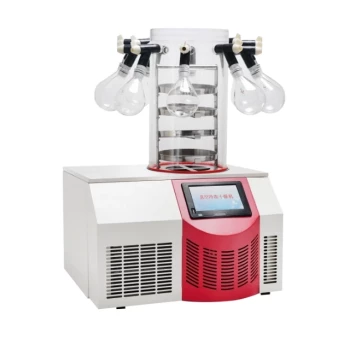
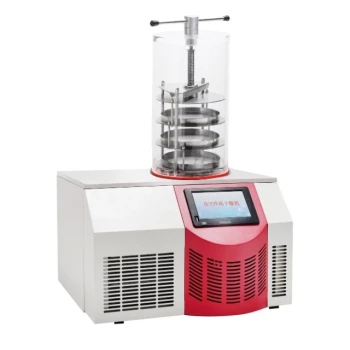
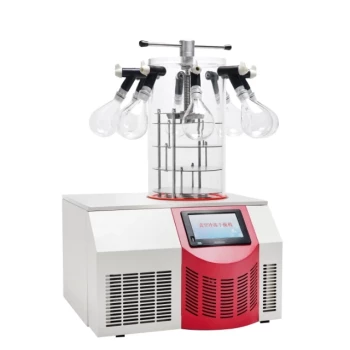
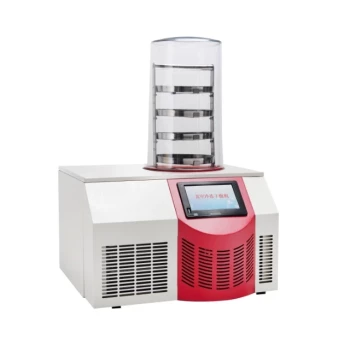
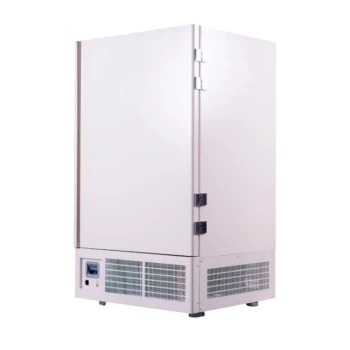
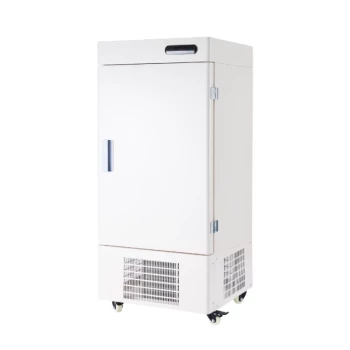
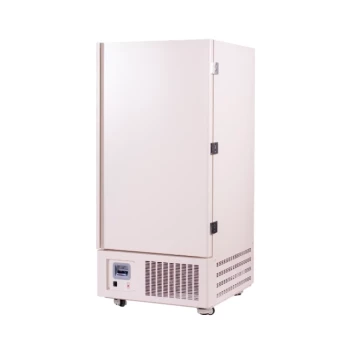
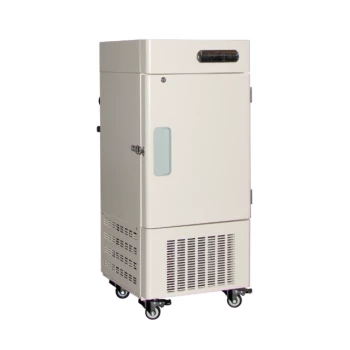
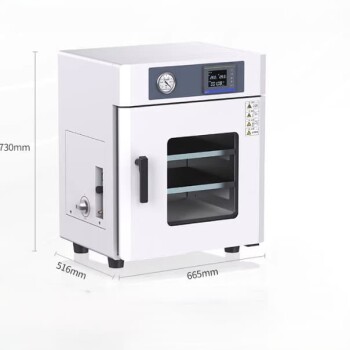
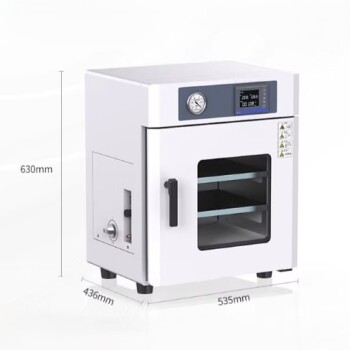
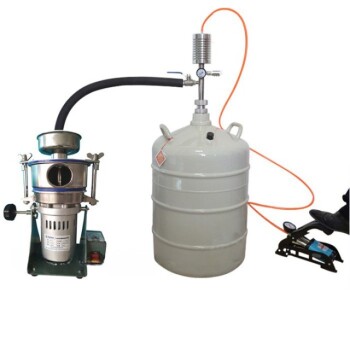
The primary function of a laboratory freeze dryer in this specific synthesis is to remove solvents via sublimation at low temperatures, typically around -40 °C. Unlike traditional heat drying, this process bypasses the liquid evaporation phase entirely to eliminate surface tension forces. This is the critical step that allows ferric citrate to be uniformly loaded onto the sodium chloride (NaCl) carrier without clumping or migrating.
By preventing the surface tension naturally generated during liquid evaporation, freeze drying effectively stops solute recrystallization and agglomeration. This ensures a highly dispersed precursor mixture, which is the absolute prerequisite for synthesizing "flower-like" nanoparticles with high specific surface areas.
The Mechanism of Action
Sublimation Over Evaporation
The freeze dryer operates by freezing the precursor mixture and then reducing the surrounding pressure. This causes the frozen solvent to transition directly from a solid state to a gas phase.
Eliminating Surface Tension
In standard drying, liquid evaporation creates significant surface tension at the gas-liquid interface. By utilizing sublimation, the freeze dryer completely avoids the formation of a liquid phase, thereby nullifying these tension forces.
Impact on Precursor Quality
Preventing Agglomeration
When surface tension is present, it tends to pull particles together, leading to agglomeration (clumping) and solute recrystallization. Freeze drying preserves the structural separation of the components.
Uniform Loading on the Carrier
The ultimate goal is to coat the ferric citrate evenly onto the surface of the sodium chloride (NaCl) carrier. Because the solvent is removed without liquid movement, the ferric citrate remains highly dispersed and locked in place on the carrier surface.
Understanding the Stakes: Why This Step Matters
The Consequence of Standard Drying
It is vital to understand that skipping this step or using heat drying is not a viable alternative for this specific morphology. Standard drying allows liquid surface tension to reorganize the material, destroying the potential for a flower-like structure before it even forms.
The Link to Surface Area
The "flower-like" morphology is prized for its high specific surface area. This high surface area is directly dependent on the precursor remaining dispersed; if the precursor agglomerates during drying, the final surface area will be significantly reduced.
Making the Right Choice for Your Goal
To ensure the successful synthesis of Fe-C@C nanoparticles, apply the following principles based on your specific requirements:
- If your primary focus is maximizing specific surface area: You must utilize freeze drying to prevent the particle collapse and clumping caused by liquid surface tension.
- If your primary focus is structural uniformity: Maintain the process temperature at or below -40 °C to ensure the ferric citrate remains evenly dispersed across the NaCl carrier.
Control the drying phase to master the structure: without sublimation, the flower-like morphology is impossible to achieve.
Summary Table:
| Feature | Freeze Drying (Sublimation) | Standard Heat Drying (Evaporation) |
|---|---|---|
| Physical State Change | Solid to Gas (Direct) | Liquid to Gas |
| Surface Tension | Eliminated | High (Causes Clumping) |
| Particle Distribution | Highly Dispersed & Uniform | Agglomerated & Recrystallized |
| Resulting Morphology | Flower-like (High Surface Area) | Collapsed / Low Surface Area |
| Key Outcome | Preserves Precursor Structure | Destroys Nano-structure |
Elevate Your Nanomaterial Synthesis with KINTEK Precision
Achieving delicate flower-like morphologies requires absolute control over the drying phase. KINTEK specializes in advanced laboratory solutions, offering high-performance freeze dryers and cold traps designed to eliminate surface tension and prevent precursor agglomeration.
Whether you are synthesizing complex nanoparticles or conducting advanced battery research, our comprehensive portfolio—ranging from ULT freezers to high-temperature vacuum furnaces and ball milling systems—ensures your lab has the tools needed for superior structural uniformity.
Ready to maximize your material's specific surface area? Contact KINTEK today to find the perfect drying and thermal processing solution for your research goals.
References
- Lixin Zhao, Chunyong Liang. Synthesis and Characterization of Flower-like Carbon-encapsulated Fe-C Nanoparticles for Application as Adsorbing Material. DOI: 10.3390/ma12050829
This article is also based on technical information from Kintek Solution Knowledge Base .
Related Products
- High Performance Laboratory Freeze Dryer
- High Performance Laboratory Freeze Dryer for Research and Development
- Benchtop Laboratory Freeze Dryer for Lab Use
- Benchtop Laboratory Vacuum Freeze Dryer
- 808L Precision Laboratory Vertical Ultra Low Temperature Freezer
People Also Ask
- What role does a laboratory freeze dryer play in the synthesis of graphene-based electrocatalysts? Preserve 3D Structures
- What are the technical advantages of using a laboratory freeze dryer for porous carbon precursors? Preserve 3D Networks
- What types of liquid samples can be processed using a laboratory freeze dryer? Preserve Your Sensitive Materials
- How do laboratory freeze dryers support scientific research? Preserve Sample Integrity for Reproducible Results
- Why is a laboratory freeze dryer preferred over traditional heating? Preserve Biochar Structure & Maximize Porosity