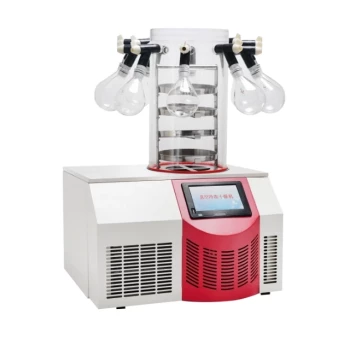
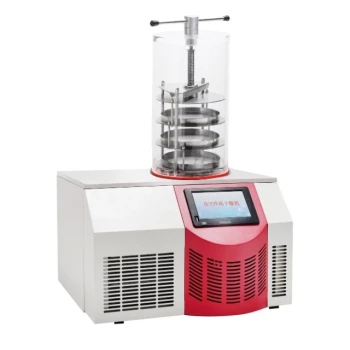
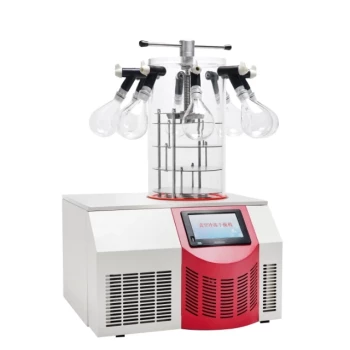
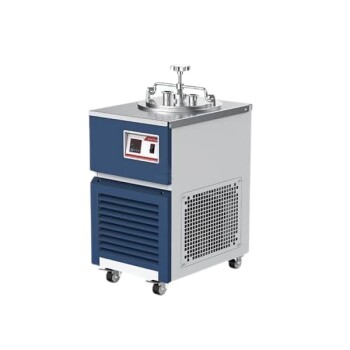
Vacuum freeze-drying is structurally superior because it removes solvents through direct sublimation (ice to vapor) rather than evaporation (liquid to vapor). In the context of hydrogel precursors, this process preserves the original three-dimensional porous network, acting as a physical template that prevents the metal precursors from collapsing into dense clusters.
Core Takeaway Conventional oven drying generates significant capillary forces during liquid evaporation, causing porous structures to collapse and metals to clump. Freeze-drying bypasses the liquid phase entirely, maintaining the hydrogel’s architecture to ensure the final intermetallic nanocrystals are uniformly dispersed and highly active.
The Mechanism of Structural Preservation
Sublimation vs. Evaporation
The fundamental difference lies in how the solvent is removed. Conventional ovens rely on heat to evaporate liquid solvents.
Vacuum freeze-drying utilizes a low-temperature vacuum environment to freeze the solvent and then sublime it directly into gas.
Preserving the Spatial Template
Hydrogel precursors possess a complex, three-dimensional porous network. This network is critical because it acts as a spatial template for the metal ions embedded within it.
When you freeze-dry the sample, this 3D "skeleton" remains intact. It physically separates the metal precursors, locking them in place within the porous structure during the drying phase.
Eliminating Capillary Forces
The primary destructive force in oven drying is capillary tension. As liquid evaporates from a porous solid, surface tension pulls the pore walls together.
By sublimating the ice, freeze-drying eliminates the liquid-gas interface. Without liquid surface tension, the capillary forces that typically crush the hydrogel structure are absent.
Impact on Material Quality
Preventing Hard Agglomeration
Oven drying frequently results in "hard agglomeration." This occurs when particles are pulled tightly together and fuse during the drying process, creating dense, unusable clumps.
Freeze-drying produces a loose, soft-agglomerated powder. Because the particles are not forced together by capillary action, the resulting material retains a fragile, open structure that is easy to process.
Superior Dispersion and Uniformity
The preservation of the hydrogel template ensures that the metal precursors remain isolated from one another until the annealing phase.
This prevents the precursors from merging prematurely. Consequently, the intermetallic nanocrystals formed after heat treatment exhibit significantly higher dispersion and uniformity compared to those dried in an oven.
Understanding the Risks of Conventional Drying
Structural Collapse
In a conventional oven, the evaporation process often causes the porous network of the hydrogel to shrink and collapse.
This destroys the advantages of using a hydrogel in the first place, resulting in a material with reduced surface area and poor porosity.
Reduced Sintering Activity
Material dried in an oven often suffers from lower reactivity. The formation of hard agglomerates makes the powder difficult to disperse and reduces its active surface area.
Freeze-dried powders, by maintaining their original particle size and loose structure, demonstrate higher sintering activity and better dispersibility in subsequent processing steps.
Making the Right Choice for Your Goal
To maximize the performance of your intermetallic compounds, align your drying method with your specific structural requirements:
- If your primary focus is Uniformity and Dispersion: Use vacuum freeze-drying to utilize the hydrogel network as a barrier against particle aggregation.
- If your primary focus is Reactivity and Sintering: Use vacuum freeze-drying to prevent hard agglomeration and maintain a high-surface-area, loose powder structure.
Freeze-drying is not merely a method of water removal; it is a critical architectural step that defines the final performance of your nanomaterial.
Summary Table:
| Feature | Vacuum Freeze-Drying | Conventional Oven Drying |
|---|---|---|
| Phase Transition | Sublimation (Ice to Vapor) | Evaporation (Liquid to Vapor) |
| Capillary Forces | Eliminated (No liquid-gas interface) | High (Causes structural collapse) |
| Material Structure | Preserved 3D porous network | Shrunken and collapsed network |
| Agglomeration | Loose, soft-agglomerated powder | Dense, hard-agglomerated clumps |
| Final Quality | Uniform dispersion & high activity | Poor dispersion & reduced surface area |
Elevate Your Material Research with KINTEK Precision
Don't let structural collapse compromise your nanotech innovations. KINTEK specializes in advanced laboratory solutions designed for high-performance material synthesis. From high-capacity freeze dryers and cold traps that preserve delicate hydrogel architectures to high-temperature furnaces (vacuum, tube, atmosphere) for precise annealing of intermetallic compounds, we provide the tools you need for superior dispersion and uniformity.
Whether you are developing catalysts or advanced batteries, our comprehensive portfolio—including high-pressure reactors, crushing systems, and specialized ceramics—ensures your research translates into results.
Ready to optimize your drying and sintering process? Contact KINTEK experts today to find the perfect equipment for your lab.
References
- Jiawei Liu, Qingyu Yan. Recent progress in intermetallic nanocrystals for electrocatalysis: From binary to ternary to high‐entropy intermetallics. DOI: 10.1002/smm2.1210
This article is also based on technical information from Kintek Solution Knowledge Base .
Related Products
- Benchtop Laboratory Vacuum Freeze Dryer
- High Performance Laboratory Freeze Dryer
- High Performance Laboratory Freeze Dryer for Research and Development
- 56L Vertical Laboratory Vacuum Drying Oven
- 23L Laboratory Vacuum Drying Oven
People Also Ask
- What are the technical advantages of using a laboratory freeze dryer for porous carbon precursors? Preserve 3D Networks
- How do laboratory freeze dryers support scientific research? Preserve Sample Integrity for Reproducible Results
- Why is a laboratory freeze dryer preferred over traditional heating? Preserve Biochar Structure & Maximize Porosity
- What types of liquid samples can be processed using a laboratory freeze dryer? Preserve Your Sensitive Materials
- What role do laboratory freeze dryers play in the food industry? Unlock Superior Food Preservation