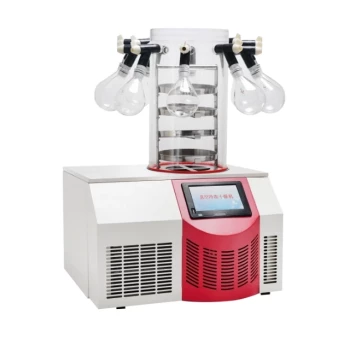
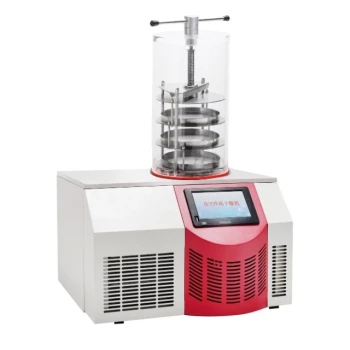
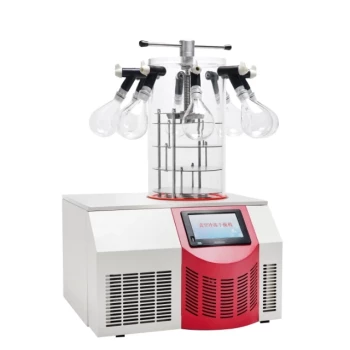
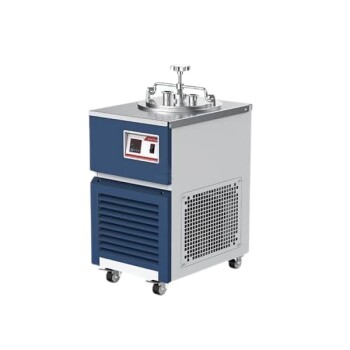
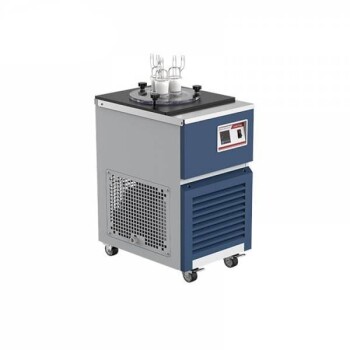
A vacuum freeze dryer serves as the critical solidification step in processing Cu/Ti3SiC2/C composite powders, responsible for converting the wet-milled slurry into a dry precursor without compromising the material's integrity. It functions by freezing the solvent—typically tert-butanol—and removing it via sublimation under vacuum at low temperatures (e.g., -50°C), which protects the copper matrix from oxidation and preserves the particle distribution achieved during milling.
Core Takeaway While traditional drying methods introduce heat and surface tension that can degrade composite powders, vacuum freeze drying bypasses the liquid phase entirely. This ensures the copper remains oxide-free and the particles remain uniformly dispersed, preventing the formation of hard agglomerates that would otherwise compromise the final material's performance.
The Mechanism of Solvent Removal
Sublimation vs. Evaporation
The defining characteristic of this process is sublimation. In a standard dryer, heat causes the solvent to evaporate from liquid to gas.
In a vacuum freeze dryer, the slurry is frozen first. The machine then lowers the pressure, allowing the frozen solvent (such as tert-butanol) to transition directly from a solid state to a gaseous state.
Eliminating Surface Tension
This phase transition is crucial for structural integrity. Liquid evaporation generates surface tension forces that pull particles together.
By bypassing the liquid phase, freeze drying eliminates these capillary forces. This prevents the "restacking" or clumping of particles that typically occurs during thermal drying.
Preserving Chemical Purity
Preventing Copper Oxidation
Copper (Cu) powders are highly susceptible to oxidation, especially when exposed to heat and air simultaneously.
Standard thermal drying accelerates chemical reactions, leading to the formation of unwanted oxides on the metal surface.
The vacuum freeze dryer operates in an oxygen-deprived environment at extremely low temperatures. This effectively halts oxidation, ensuring the metallic copper retains its purity for the subsequent sintering phase.
Maintaining Material Homogeneity
The primary goal of the preceding ball milling step is to achieve a uniform dispersion of Cu, Ti3SiC2, and C particles.
If the slurry acts as a liquid during drying, particles of different densities may segregate or settle.
Because the solvent is frozen immediately, the particles are "locked" in their dispersed state. This ensures that the dry powder retains the exact uniform dispersion achieved during the wet-milled stage.
Understanding the Trade-offs
Process Speed and Complexity
While technically superior for quality, vacuum freeze drying is significantly slower than vacuum oven drying or spray drying.
The process requires precise control over freezing rates and vacuum levels to ensure successful sublimation.
Solvent Requirements
This method is highly dependent on the solvent used in the slurry.
The primary reference notes the use of tert-butanol. This solvent is chosen because it has a favorable freezing point and high vapor pressure, making it ideal for sublimation, whereas other common solvents may not freeze-dry as efficiently.
Making the Right Choice for Your Process
If you are establishing a processing line for Cu/Ti3SiC2/C composites, consider your specific quality requirements:
- If your primary focus is microstructural uniformity: Choose freeze drying to prevent hard agglomerates and maintain the high specific surface area of the particles.
- If your primary focus is chemical purity: Rely on freeze drying to strictly prevent the oxidation of the copper matrix, which is critical for electrical and thermal conductivity applications.
By decoupling the drying process from heat and surface tension, vacuum freeze drying ensures the final composite powder faithfully represents the quality of the raw materials.
Summary Table:
| Feature | Vacuum Freeze Drying | Traditional Thermal Drying |
|---|---|---|
| Phase Change | Sublimation (Solid to Gas) | Evaporation (Liquid to Gas) |
| Oxidation Risk | Extremely Low (Vacuum/Cold) | High (Heat/Air Exposure) |
| Particle Structure | Uniform Dispersion (No Clumping) | Hard Agglomerates (Surface Tension) |
| Solvent Handling | Ideal for Tert-butanol | Rapid but High-Tension |
| Outcome | High-Purity Precursor | Potential Microstructural Defects |
Precision materials require precision cooling. KINTEK specializes in advanced laboratory solutions designed to protect your sensitive composite powders. Our high-performance vacuum freeze dryers, cold traps, and ULT freezers ensure your Cu/Ti3SiC2/C materials remain oxide-free and perfectly dispersed. Beyond drying, we offer a comprehensive range of high-temperature furnaces, crushing and milling systems, and hydraulic presses to support every stage of your material research. Contact KINTEK today to discover how our equipment can enhance your lab's efficiency and material integrity.
Related Products
- Benchtop Laboratory Vacuum Freeze Dryer
- High Performance Laboratory Freeze Dryer
- High Performance Laboratory Freeze Dryer for Research and Development
- Benchtop Laboratory Freeze Dryer for Lab Use
- Vacuum Cold Mounting Machine for Sample Preparation
People Also Ask
- What are the technical advantages of using a laboratory freeze dryer for porous carbon precursors? Preserve 3D Networks
- How do laboratory freeze dryers support scientific research? Preserve Sample Integrity for Reproducible Results
- Why is a laboratory freeze dryer preferred over traditional heating? Preserve Biochar Structure & Maximize Porosity
- What types of liquid samples can be processed using a laboratory freeze dryer? Preserve Your Sensitive Materials
- What role do laboratory freeze dryers play in the food industry? Unlock Superior Food Preservation