Vacuum freeze drying is the superior method for preparing yttrium oxide precursors because it effectively eliminates liquid-phase surface tension. By removing solvents through sublimation rather than evaporation, this technique prevents the formation of hard agglomerates, preserving the precursor's original loose structure and nanoscale particle size.
The Core Insight Conventional heat drying introduces capillary forces that pull particles together into hard, dense clumps. Vacuum freeze drying bypasses this entirely by transitioning solvent from solid to gas, yielding a soft, porous powder essential for high-performance sintering and dispersion.
The Mechanism of Structure Preservation
Eliminating Capillary Forces
The primary advantage of vacuum freeze drying is the avoidance of capillary forces.
In conventional oven drying, as the liquid solvent evaporates, the surface tension of the receding liquid pulls the solid particles tightly together.
Freeze drying freezes the solvent first, then removes it via sublimation (direct transition from ice to vapor). Since there is no liquid phase during drying, these crushing forces never occur.
Preserving the 3D Network
Because the solvent is removed without collapsing the material, the original microstructure is preserved.
The frozen solvent acts as a spatial template until it sublimates away.
This leaves behind the original three-dimensional porous network structure of the hydrogel, rather than a collapsed, dense mass.
Impact on Powder Characteristics
Soft vs. Hard Agglomeration
Conventional drying typically results in hard agglomerates. These are tightly bonded clusters that are mechanically difficult to break down.
Freeze drying results in soft agglomerates. While particles may touch, they are maintained in a loose, fluffy state.
This loose structure is critical because it retains the original particle size of the precipitate, often keeping particle diameters controlled below 100 nanometers.
Superior Dispersibility
The porous nature of freeze-dried powder significantly improves dispersibility.
Because the particles are not fused together by capillary action, they can be easily re-dispersed in liquids or mixed with other powders.
This uniformity ensures that the material behaves predictably during subsequent processing steps.
Downstream Performance Benefits
High Sintering Activity
For yttrium oxide ceramics, the final density and strength depend heavily on sintering activity.
High sintering activity requires small particles with high surface area.
By preventing hard agglomeration, freeze drying ensures the nanopowder remains reactive, allowing for better densification during the final firing process.
Microstructural Uniformity
The quality of the final ceramic is determined by the uniformity of the precursor.
The freeze-drying process prevents the segregation and severe agglomeration of metal precursors during dehydration.
This leads to intermetallic nanocrystals that exhibit higher dispersion and greater uniformity after annealing.
Understanding the Trade-offs
The Risk of Conventional Drying
The "trade-off" here is one of process simplicity versus material integrity.
Conventional heat drying is generally simpler, but it fundamentally alters the material's physical state.
Choosing conventional drying creates a need for aggressive mechanical milling later to break up hard agglomerates, which can introduce impurities and rarely restores the original nanoscale distribution.
The Necessity of Sublimation
Freeze drying is not merely a different way to remove water; it is a structural preservation technique.
If your process cannot tolerate a vacuum environment or low temperatures, you effectively sacrifice the porous network structure.
Without this structure, achieving high-end specifications for dispersion and sintering becomes exponentially more difficult.
Making the Right Choice for Your Goal
To maximize the quality of your yttrium oxide ceramics, align your drying method with your performance metrics:
- If your primary focus is Sintering Density: rapid densification is driven by the high surface area retained through freeze drying.
- If your primary focus is Particle Dispersion: the soft agglomerates produced by sublimation are essential for achieving a uniform mixture without aggressive milling.
In summary, vacuum freeze drying is not just a drying step; it is a critical morphological control tool that safeguards the nanostructure of your precursor.
Summary Table:
| Feature | Vacuum Freeze Drying | Conventional Heat Drying |
|---|---|---|
| Drying Mechanism | Sublimation (Solid to Gas) | Evaporation (Liquid to Gas) |
| Surface Tension | Eliminated (No liquid phase) | High (Capillary forces present) |
| Agglomeration Type | Soft (Loose, easy to disperse) | Hard (Dense, difficult to break) |
| Particle Size Control | Preserves nanoscale distribution | Results in coarse, fused clusters |
| Sintering Activity | High (High surface area) | Low (Requires aggressive milling) |
| Microstructure | Porous 3D network preserved | Collapsed and dense structure |
Elevate Your Material Research with KINTEK Precision
Maximize the performance of your yttrium oxide nanopowders and advanced ceramics with KINTEK’s high-performance laboratory equipment. Whether you need vacuum freeze dryers (cold traps) to preserve nanostructures, high-temperature furnaces for superior sintering, or crushing and milling systems for precise particle control, we provide the tools necessary for scientific excellence. Our comprehensive range—from PTFE products and crucibles to centrifuges and ULT freezers—is designed to support researchers and manufacturers in achieving predictable, high-quality results.
Ready to optimize your drying and sintering processes? Contact KINTEK experts today to find the perfect solution for your lab’s specific needs!
Related Products
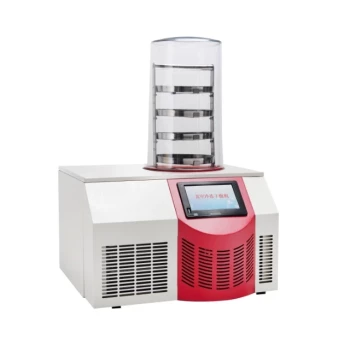
- Benchtop Laboratory Vacuum Freeze Dryer
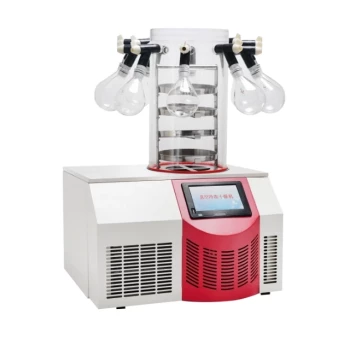
- High Performance Laboratory Freeze Dryer
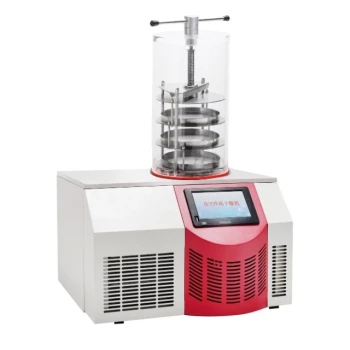
- High Performance Laboratory Freeze Dryer for Research and Development
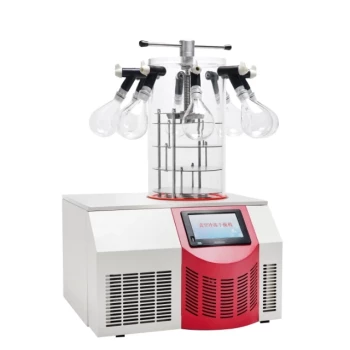
- Benchtop Laboratory Freeze Dryer for Lab Use
- Vacuum Cold Mounting Machine for Sample Preparation
People Also Ask
- What are the technical advantages of using a laboratory freeze dryer for porous carbon precursors? Preserve 3D Networks
- How do laboratory freeze dryers support scientific research? Preserve Sample Integrity for Reproducible Results
- Why is a laboratory freeze dryer preferred over traditional heating? Preserve Biochar Structure & Maximize Porosity
- What types of liquid samples can be processed using a laboratory freeze dryer? Preserve Your Sensitive Materials
- What role do laboratory freeze dryers play in the food industry? Unlock Superior Food Preservation