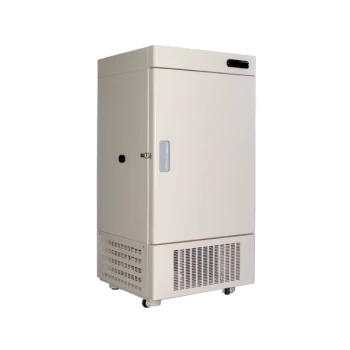
Vacuum freeze drying is essential for maintaining the functional integrity of sulfur and nitrogen co-doped carbon dots (cys-CDs). Unlike conventional thermal drying, which relies on heat evaporation, freeze drying utilizes sublimation to remove moisture in a frozen state. This effectively prevents the irreversible clumping of nanoparticles and the degradation of sensitive surface chemical groups.
Core Takeaway By avoiding liquid-phase surface tension and high heat, vacuum freeze drying yields a loose, porous powder rather than a hardened aggregate. This ensures that the cys-CDs fully retain their original fluorescence and biological activity upon reconstitution, making the technique critical for long-term storage and precise biological applications.
The Mechanism of Preservation
Sublimation Over Evaporation
The primary advantage of a vacuum freeze dryer is its ability to remove moisture via sublimation.
In this process, solvents transition directly from a solid (ice) to a gas, bypassing the liquid phase entirely. This low-temperature approach protects the delicate structure of the nanomaterials.
Preventing Irreversible Aggregation
Conventional drying introduces surface tension as the liquid evaporates, which often pulls nanoparticles together.
This leads to agglomeration, where the dots stack and bond tightly. Freeze drying eliminates this tension, keeping the particles separated and preventing the formation of dense, unusable clusters.
Impact on Material Quality
Protecting Surface Functional Groups
The performance of cys-CDs relies heavily on their surface chemistry, specifically the sulfur and nitrogen doping.
High temperatures in thermal drying can inactivate these functional groups. Freeze drying preserves the chemical environment, ensuring the material remains reactive.
Retaining Fluorescence and Bio-activity
The ultimate utility of carbon dots is often defined by their optical properties and ability to interact with biological systems.
Because freeze drying prevents structural collapse and chemical alteration, the resulting powder maintains its original fluorescence characteristics. Upon reconstitution, the dots exhibit the same biological activity as they did prior to drying.
Ensuring Reconstitutability
The physical output of a freeze dryer is a loose and fragile powder.
Unlike the hardened or "hornified" surfaces often resulting from thermal drying, this loose structure allows the powder to dissolve instantly and completely when solvents are reintroduced.
Understanding the Trade-offs
The Cost of Quality
While freeze drying offers superior quality for cys-CDs, it is a resource-intensive process.
It requires specialized vacuum equipment and significantly longer processing times compared to a standard laboratory oven. Thermal drying is faster and simpler, but it comes at the cost of potential oxidation and sintering (fusion) of particles, rendering the sample less effective for high-precision applications.
Making the Right Choice for Your Goal
To ensure your cys-CDs perform as expected, select your drying method based on your end-use requirements:
- If your primary focus is Long-Term Storage and Bio-Applications: Use vacuum freeze drying. It is the only method that guarantees the preservation of fluorescence, preventing aggregation and ensuring the powder can be perfectly redissolved later.
- If your primary focus is Rough Bulk Processing: You might consider thermal vacuum drying (e.g., at 70°C), but only if the specific fluorescence efficiency is not critical, as you risk surface oxidation and particle sintering.
For high-performance nanomaterials like cys-CDs, the preservation of the single-particle state through sublimation is usually non-negotiable.
Summary Table:
| Feature | Vacuum Freeze Drying (Sublimation) | Conventional Thermal Drying (Evaporation) |
|---|---|---|
| Mechanism | Solid to gas (ice to vapor) | Liquid to gas (heat-induced) |
| Physical State | Loose, porous, fragile powder | Hardened, dense aggregates |
| Particle Integrity | Prevents clumping and sintering | Causes irreversible aggregation |
| Chemical Stability | Preserves S and N functional groups | Risk of oxidation and inactivation |
| Reconstitution | Dissolves instantly and completely | Difficult to redissolve due to hornification |
| Optical Properties | Retains full fluorescence intensity | Potential loss of fluorescence efficiency |
Elevate Your Nanomaterial Research with KINTEK Precision
Don't let thermal degradation compromise your carbon dots' fluorescence and biological activity. KINTEK specializes in advanced laboratory solutions designed for high-performance material science. From high-efficiency vacuum freeze dryers and cold traps that ensure perfect sublimation to our comprehensive range of high-temperature furnaces, crushing systems, and cooling solutions, we provide the tools needed for precision synthesis and preservation.
Whether you are working on bio-imaging or long-term storage of sensitive cys-CDs, our expert team is ready to help you select the ideal equipment to optimize your workflow and maintain material integrity.
Ready to achieve superior results? Contact us today to explore our freeze drying solutions!
References
- Yujia Cheng, Guang Yu. N-S-co-Doped Carbon Dot Blue Fluorescence Preparation and Baicalein Detection. DOI: 10.3390/inorganics12060154
This article is also based on technical information from Kintek Solution Knowledge Base .
Related Products
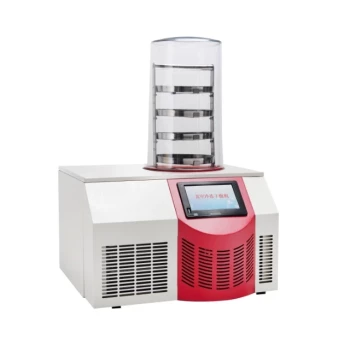
- Benchtop Laboratory Vacuum Freeze Dryer
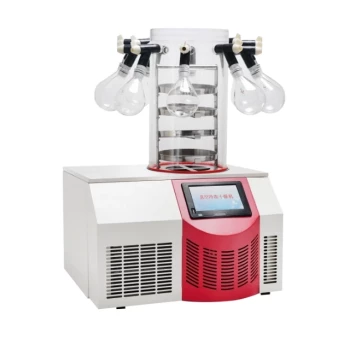
- High Performance Laboratory Freeze Dryer
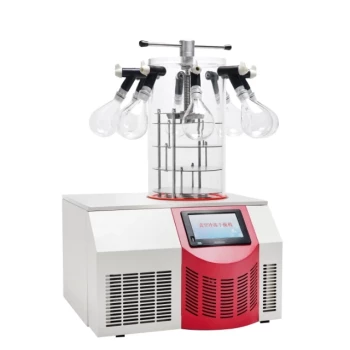
- Benchtop Laboratory Freeze Dryer for Lab Use
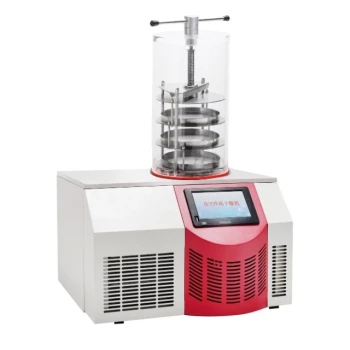
- High Performance Laboratory Freeze Dryer for Research and Development
- 56L Vertical Laboratory Vacuum Drying Oven
People Also Ask
- What are the technical advantages of using a laboratory freeze dryer for porous carbon precursors? Preserve 3D Networks
- How do laboratory freeze dryers support scientific research? Preserve Sample Integrity for Reproducible Results
- Why is a laboratory freeze dryer preferred over traditional heating? Preserve Biochar Structure & Maximize Porosity
- What types of liquid samples can be processed using a laboratory freeze dryer? Preserve Your Sensitive Materials
- What role do laboratory freeze dryers play in the food industry? Unlock Superior Food Preservation