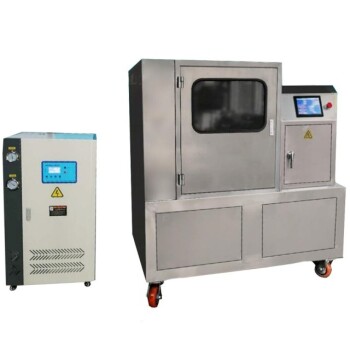
The water-cooled copper hearth serves as a high-efficiency thermal barrier and a non-reactive containment system for melting high-temperature materials. Its primary function is to enable the synthesis of high-purity alloys by preventing chemical reactions between the molten metal and the furnace body, while simultaneously controlling the solidification rate to refine the alloy's internal structure.
This technology allows for the "crucible-less" melting of refractory metals by creating a protective skull-crust of the alloy itself. This mechanism ensures that the final high-entropy alloy remains free of impurities while establishing a fine-grained foundation for downstream processing.
Thermal Protection and Equipment Integrity
Managing Extreme Arc Temperatures
Vacuum arc melting uses high-energy electric arcs to melt metals with exceptionally high melting points, such as tungsten, tantalum, and hafnium.
The water-cooled copper hearth utilizes high-efficiency circulating water to dissipate this intense heat rapidly. This prevents the hearth itself from melting or sustaining structural damage during the process.
Sustaining the Cooling Gradient
The high thermal conductivity of copper, combined with active water cooling, creates a significant temperature gradient between the melt and the hearth.
This gradient is essential for maintaining the stability of the furnace environment, ensuring that the localized heat of the arc stays concentrated on the alloy sample rather than the equipment.
Ensuring High Purity through the "Skull-Crust" Mechanism
Eliminating Crucible Contamination
Traditional ceramic crucibles often react with molten high-entropy alloys, introducing unwanted oxygen or silicon impurities.
The water-cooled hearth solves this by forming a thin solidified skull-crust of the alloy on its inner wall. The molten pool is essentially contained within a shell of its own material, ensuring extreme chemical purity.
Preventing Hearth Erosion
High-melting-point alloy liquids are often highly corrosive to metallic surfaces.
The cooling system ensures that the liquid metal never makes direct contact with the copper surface. This condensation shell acts as a sacrificial barrier that prevents the melt from eroding the hearth or alloying with the copper.
Microstructural Refinement and Solidification Control
Forming Fine Dendritic Structures
The rapid heat removal provided by the hearth facilitates high cooling rates during the initial melting stage.
This results in the formation of fine dendritic structures, which serve as a critical foundation for achieving a high-performance, homogeneous final product.
Preventing Chemical Segregation
High-entropy alloys contain multiple elements that can easily separate or "segregate" if cooled too slowly.
The hearth's ability to provide rapid solidification once the arc is deactivated helps preserve high-temperature microstructural features. This prevents significant chemical segregation and ensures the alloy maintains a uniform as-cast microstructure.
Understanding the Trade-offs
The Necessity of Repeated Melting
While the hearth ensures purity, the rapid cooling creates highly localized melting zones.
To achieve atomic-level mixing and eliminate component segregation, the alloy ingot must be flipped and re-melted multiple times. This is a labor-intensive but necessary step to ensure the final sample is truly homogeneous.
Thermal Stress and Internal Cracking
The same rapid cooling that prevents segregation can introduce significant internal thermal stresses.
In certain brittle high-entropy alloys, the extreme cooling rate of the copper hearth can lead to quenching cracks. This requires careful management of the arc power ramp-down to mitigate potential structural failures.
How to Apply This to Your Project
Making the Right Choice for Your Goal
- If your primary focus is extreme chemical purity: Use a water-cooled hearth to eliminate the need for ceramic crucibles, ensuring your sample remains free of oxygen and silica contamination.
- If your primary focus is refractory alloy synthesis: Leverage the high heat dissipation of the copper hearth to safely melt high-melting-point elements like Zirconium or Tungsten.
- If your primary focus is microstructural uniformity: Perform multiple melting and flipping cycles on the hearth to overcome the localized nature of the arc and achieve a single-phase FCC or BCC structure.
By effectively managing the thermal and chemical interactions at the hearth interface, researchers can produce high-entropy alloys that meet the rigorous standards required for advanced material science and corrosion research.
Summary Table:
| Key Function | Mechanism | Impact on Alloy Quality |
|---|---|---|
| Thermal Protection | High-efficiency water circulation | Prevents equipment damage & sustains heat gradients |
| Contamination Control | "Skull-crust" formation | Eliminates crucible reactions for extreme chemical purity |
| Microstructural Refinement | Rapid heat removal | Creates fine dendritic structures and uniform as-cast phases |
| Solidification Control | High cooling rates | Prevents chemical segregation during alloy formation |
Achieve Unmatched Alloy Purity with KINTEK Solutions
Precision is the foundation of advanced material science. KINTEK specializes in high-performance laboratory equipment designed for the rigorous demands of high-entropy alloy research and refractory metal synthesis.
From advanced vacuum arc melting components and induction melting systems to our comprehensive range of high-temperature furnaces (vacuum, CVD, atmosphere) and high-pressure reactors, we provide the tools you need to eliminate contamination and ensure microstructural homogeneity.
Ready to elevate your lab's capabilities? Contact us today to explore our full portfolio of high-purity crucibles, cooling solutions, and specialized furnace systems tailored to your research goals.
References
- Artashes Ter-Isahakyan, T. John Balk. Evaluation of Equiatomic CrMnFeCoNiCu System and Subsequent Derivation of a Non-Equiatomic MnFeCoNiCu Alloy. DOI: 10.3390/ma16062455
This article is also based on technical information from Kintek Solution Knowledge Base .
Related Products
People Also Ask
- What is the function of an industrial vibratory mill? Optimize Fe-Cr-Al Alloy Powder Production
- How does a Vibratory Mill improve niobium recovery efficiency? Optimize Waste Pre-treatment for Maximum Yield
- Why use stainless steel jars and balls for solid-state battery slurries? Maximize Dispersion and Conductivity
- What role does ultra-low temperature cooling equipment play in hydrogel preparation? Master Light-Driven Actuation
- Why is a low-temperature cooling solution necessary for nanoparticle toxicity? Ensure Scientific Accuracy & Stability