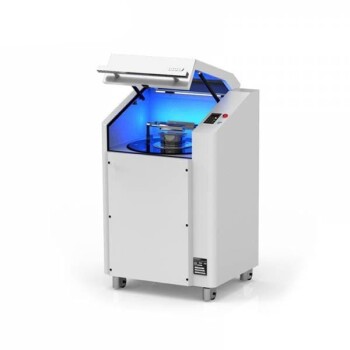
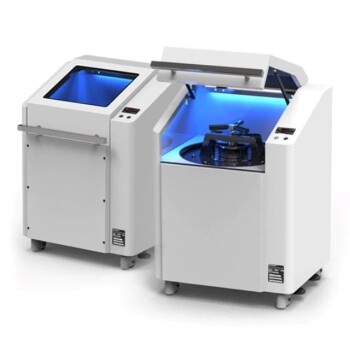
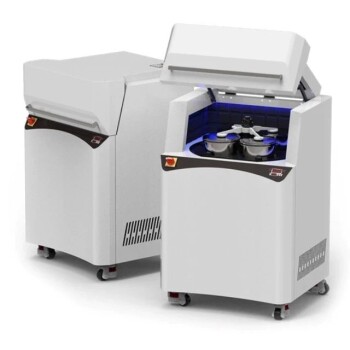
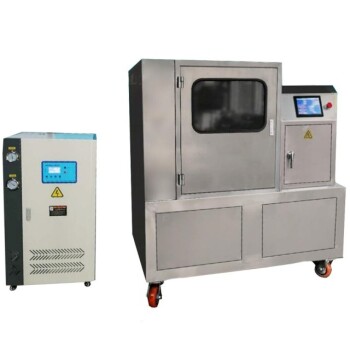
The primary function of an industrial vibratory mill is to pulverize hard Fe-Cr-Al master alloys into reactive, micron-sized powders using high-frequency vibration. This process utilizes significant impact and friction forces to mechanically break down coarse materials, preparing them for high-performance applications like sintering.
The core value of this process lies in increasing specific surface area. By reducing particles to a micron scale, the mill enhances the powder's reactivity, which is the prerequisite for obtaining a uniform solid solution during the subsequent heat treatment.
The Mechanism of Pulverization
Generating Impact and Friction
The mill operates by generating high-frequency vibrations. These vibrations create an environment of intense kinetic energy within the milling chamber.
This energy translates into significant impact and friction forces applied to the material. These mechanical forces are aggressive enough to fracture and grind the inherently hard Fe-Cr-Al master alloys.
Reaching Micron-Level Precision
The ultimate goal of this mechanical process is extreme size reduction. The mill is capable of reducing coarse alloy chunks down to a micron-level particle size.
Similar to laboratory-scale applications for other materials, this precision allows for tight control over the final particle size distribution, often targeting ranges as fine as 1 to 5 µm depending on the specific application requirements.
The Critical Role in Material Science
Increasing Specific Surface Area
As the particle size decreases, the specific surface area of the powder increases partially.
This increase is not merely cosmetic; it fundamentally changes the physical characteristics of the powder. A larger surface area exposes more material to the surrounding environment, making it physically primed for chemical interaction.
Enabling Uniform Diffusion
The preparation of Fe-Cr-Al alloys relies heavily on this increased reactivity.
During the subsequent sintering process, the high surface area facilitates the sufficient diffusion of the alloy's components. This diffusion is necessary to form a uniform solid solution, ensuring the final material has consistent mechanical and chemical properties.
Operational Trade-offs
The Requirement for Time
Achieving micron-level fineness in hard alloys is not an instantaneous process.
The primary reference notes that effective grinding can require extended periods, such as 32 hours. This significant time investment is a necessary trade-off to generate the friction required to break down hard master alloys.
Mechanical Intensity
Because the process relies on high-frequency vibration and impact, it is energy-intensive.
Operators must balance the need for fine particle sizes with the operational costs of running high-impact machinery for long durations.
Making the Right Choice for Your Goal
When integrating an industrial vibratory mill into your powder metallurgy line, consider your specific end-goals:
- If your primary focus is Sintering Quality: Prioritize the grinding duration to ensure particles reach the micron level, as maximum surface area is required for complete component diffusion.
- If your primary focus is Process Efficiency: Analyze the hardness of your master alloy beforehand; harder materials will dictate longer cycle times (up to 32 hours) which affects production throughput.
The industrial vibratory mill is the bridge between raw, coarse alloy and a reactive, sinter-ready powder capable of forming high-quality solid solutions.
Summary Table:
| Feature | Function in Fe-Cr-Al Processing |
|---|---|
| Primary Mechanism | High-frequency vibration, impact, and friction |
| Output Particle Size | Micron-level precision (typically 1-5 µm) |
| Core Objective | Increase specific surface area for higher reactivity |
| Key Benefit | Ensures uniform diffusion for solid solution formation |
| Operational Note | Requires extended grinding time (e.g., 32 hours) for hard alloys |
Elevate Your Powder Metallurgy with KINTEK Precision
High-performance Fe-Cr-Al alloys demand the highest standards in material preparation. KINTEK specializes in advanced laboratory equipment and industrial solutions, offering high-efficiency crushing and milling systems, sieving equipment, and hydraulic presses tailored for the most demanding applications.
Whether you are refining alloy powders or preparing samples for sintering in our high-temperature muffle or vacuum furnaces, KINTEK provides the reliability and precision your research and production require. From high-temperature reactors to specialized PTFE and ceramic consumables, we empower your lab to achieve uniform solid solutions and superior material properties.
Ready to optimize your milling process? Contact our technical experts today to find the perfect equipment for your specific material goals!
References
- Г Мягков Виктор, Baryshnikov Ivan. Special features of the phase formation during sintering of high porous cellular materials of the Fe-Cr-Al system. DOI: 10.17212/1994-6309-2016-2-51-58
This article is also based on technical information from Kintek Solution Knowledge Base .
Related Products
- Vibrating Disc Mill Small Laboratory Grinding Machine
- Lab Vibration Mill
- Laboratory Disc Cup Vibratory Mill for Sample Grinding
- Disc Cup Vibrating Mill Multi-Platform for Lab
- Hybrid High Energy Vibratory Ball Mill for Lab Use
People Also Ask
- What role do disc mills play in the wet or dry pretreatment of lignocellulosic waste? Scalable Biomass Solutions
- What is the function of a laboratory grinding mill? Achieve Precise Sample Preparation for Accurate Results
- What laboratory apparatus is used for grinding? Match the Right Mill to Your Sample Material
- Why use stainless steel jars and balls for solid-state battery slurries? Maximize Dispersion and Conductivity
- How does a Vibratory Mill improve niobium recovery efficiency? Optimize Waste Pre-treatment for Maximum Yield