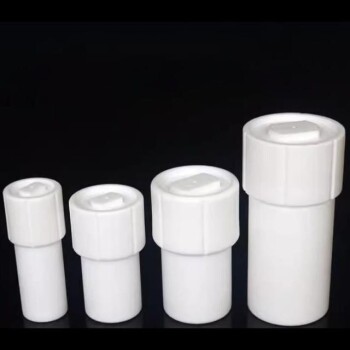
The stainless steel high-pressure digestion tank serves as the critical solvothermal reactor for the controlled synthesis of Vanadium Nickel Foam (VNF). It creates a sealed environment where methanol and precursor chemicals reach a subcritical state, enabling the uniform anchoring of nickel sulfide nanosheets onto the nickel foam substrate. This high-pressure thermal treatment is the foundational step required to establish the structural integrity of the final heterostructure.
The high-pressure digestion tank facilitates a subcritical reaction environment that maximizes precursor solubility and reactivity. This allows for the precise, in-situ construction of uniform thin films on nickel substrates, ensuring high structural stability and material purity.
Engineering the Subcritical Reaction Environment
Achieving Solvent Subcriticality
The digestion tank allows the methanol solution to be heated significantly beyond its ambient boiling point while remaining contained. Under these high-temperature and high-pressure conditions, the solvent reaches a subcritical state, which drastically changes its physical properties.
In this state, the solvent's viscosity decreases and its diffusivity increases. This allows the chemical precursors to permeate the intricate pores of the nickel foam more effectively than at standard pressure.
Enhancing Precursor Solubility
The intense environment within the tank enhances the solubility and reactivity of the thiourea (sulfur source). By maintaining high pressure, the tank forces a thorough interaction between the dissolved sulfur and the surface of the nickel substrate.
This level of reactivity is essential for the molecular-level nucleation of new crystal structures. Without the containment of the high-pressure tank, the precursors would not achieve the energy state required for uniform growth.
Facilitating Material Transformation and Anchoring
In-Situ Growth of Nickel Sulfide Nanosheets
The primary role of the tank in VNF synthesis is to promote the in-situ construction of nickel sulfide nanosheets. As the sulfur source reacts with the nickel foam surface, it forms a dense layer of nanosheets that are chemically bonded to the substrate.
This process provides a structural foundation for the subsequent preparation of the heterostructure. The uniformity of this layer is directly dependent on the stable, pressurized environment provided by the digestion tank.
Ensuring Chemical Purity and Resistance
High-pressure digestion tanks are typically equipped with a Polytetrafluoroethylene (PTFE) liner. This liner is vital for resisting corrosion from organic solvents and chemical precursors like thiourea.
By isolating the reaction from the stainless steel outer shell, the PTFE liner prevents metal contamination. This ensures that the synthesized reaction products maintain the high purity required for advanced material applications.
Understanding the Trade-offs and Limitations
Safety and Pressure Management
While high pressure is necessary for the reaction, it introduces significant safety risks. If the temperature is not precisely controlled, the internal pressure can exceed the structural limits of the tank, leading to equipment failure.
Thermal Lag and Reaction Consistency
Stainless steel tanks have significant thermal mass, which can lead to thermal lag during the heating and cooling phases. This delay can make it difficult to pinpoint the exact duration the precursors spend at the target subcritical temperature.
Challenges in Scalability
The batch-style nature of high-pressure digestion tanks makes mass production difficult. Scaling the self-assembly process of VNF requires larger, more complex pressure vessels that can maintain uniform temperature gradients across a greater volume.
Applying This Technology to Your Synthesis Goals
Strategic Recommendations for Implementation
- If your primary focus is material uniformity: Ensure the digestion tank is filled to the manufacturer-recommended volume to maintain consistent vapor pressure and subcritical solvent behavior.
- If your primary focus is preventing contamination: Always inspect the PTFE liner for cracks or staining before starting the solvothermal process to protect the purity of the nickel sulfide nanosheets.
- If your primary focus is structural stability: Use the tank to maintain a slower, controlled ramp-down of temperature to prevent thermal shock from damaging the anchored nanosheets.
By mastering the high-pressure environment within the digestion tank, researchers can achieve the precise molecular engineering required to produce high-performance Vanadium Nickel Foam.
Summary Table:
| Feature | Role in VNF Synthesis | Primary Benefit |
|---|---|---|
| Subcritical State | Increases solvent diffusivity and precursor solubility | Uniform anchoring of nanosheets on nickel foam |
| PTFE Liner | Prevents corrosion from solvents like methanol/thiourea | Ensures high chemical purity of the final product |
| Pressure Shell | Maintains high temperatures above ambient boiling points | Facilitates molecular-level nucleation and growth |
| Thermal Control | Manages heating/cooling ramps during reaction | Protects structural integrity of the heterostructure |
Optimize Your Solvothermal Synthesis with KINTEK
Precision is paramount in the production of high-performance Vanadium Nickel Foam. KINTEK provides industry-leading high-pressure reactors and autoclaves, along with high-quality PTFE products and crucibles, designed to withstand the intense subcritical conditions required for molecular-level nucleation.
Whether you are conducting advanced battery research or developing complex heterostructures, our equipment ensures consistent results, maximum safety, and material purity.
Contact KINTEK Experts Today to discuss your specific laboratory requirements and enhance your material synthesis efficiency.
References
- Xingxing Zhu, Qing Jiang. Charge Self‐Regulation of Metallic Heterostructure Ni<sub>2</sub>P@Co<sub>9</sub>S<sub>8</sub> for Alkaline Water Electrolysis with Ultralow Overpotential at Large Current Density. DOI: 10.1002/advs.202303682
This article is also based on technical information from Kintek Solution Knowledge Base .
Related Products
- Custom PTFE Teflon Parts Manufacturer for Microwave Digestion Tank
- Stainless High Pressure Autoclave Reactor Laboratory Pressure Reactor
- Desktop Fast High Pressure Laboratory Autoclave Sterilizer 16L 24L for Lab Use
- Mini SS High Pressure Autoclave Reactor for Laboratory Use
- Custom PTFE Teflon Parts Manufacturer for PTFE Containers
People Also Ask
- Why are PTFE containers required for PCT leaching tests? Ensure Chemical Inertness and Analytical Precision
- Why use high-quality PTFE containers for CO2 reduction electrolytes? Eliminate silicon contamination and ensure data.
- Why is PTFE Mandatory for Hydrofluoric Acid (HF) Handling? Ensure Safety and Data Integrity in Corrosion Testing
- Why is a PTFE container required for acid leaching of silicon nanosheets? Ensure High Purity and Safety
- Why are polytetrafluoroethylene (PTFE) containers essential for assessing the corrosion resistance of glassified waste?