At its core, wet ashing is a chemical digestion process used to break down an organic sample, like food or biological tissue, to measure its inorganic mineral content. Unlike burning a sample in a furnace, wet ashing uses strong liquid oxidizing agents, such as nitric and sulfuric acids, to decompose the organic matrix at relatively low temperatures. This process leaves behind an inorganic residue for analysis.
The fundamental difference between ashing methods lies in how the organic material is destroyed. While dry ashing uses high-temperature combustion in air, wet ashing uses chemical oxidation in a liquid acid solution, which is often faster and better at preserving volatile minerals.
How Wet Ashing Works
Wet ashing, often called wet digestion, is a hands-on laboratory procedure. It relies on the chemical power of strong acids to achieve what high heat does in other methods.
The Role of Oxidizing Acids
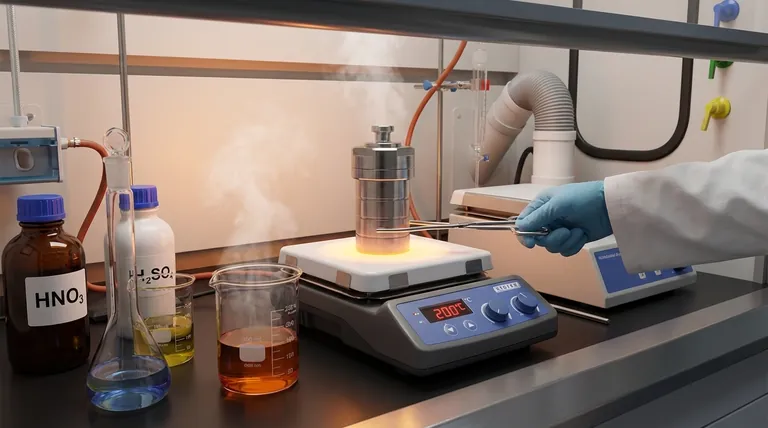
The process begins by adding strong oxidizing agents to the sample in a flask or beaker. Common acids used include nitric acid (HNO₃), sulfuric acid (H₂SO₄), and sometimes hydrogen peroxide (H₂O₂) or perchloric acid (HClO₄).
These chemicals aggressively attack and break the chemical bonds of the organic matter (proteins, fats, carbohydrates), converting them into carbon dioxide, water, and other gases.
The Digestion Process
The sample and acid mixture is gently heated, typically on a hot plate or in a specialized digestion block.
Temperatures are usually kept relatively low, often between 100°C and 350°C. This controlled heating accelerates the chemical reaction without boiling away the acids too quickly or losing volatile minerals.
The Final Result
The process is complete when the solution becomes clear, indicating all organic material has been destroyed. What remains is a liquid solution containing the sample's inorganic minerals, which can then be diluted and analyzed using advanced instruments.
Wet Ashing vs. Dry Ashing: A Critical Comparison
Understanding wet ashing requires comparing it to its counterpart, dry ashing. Many people picture dry ashing when they think of determining "ash content."
The Key Difference: Oxidation Method
Dry ashing uses a muffle furnace to heat a sample to very high temperatures (typically 500-600°C). The sample's organic matter combusts by reacting with the oxygen in the air.
Wet ashing uses liquid chemicals to oxidize the sample at a much lower temperature. It is a chemical digestion, not a combustion process.
Temperature and Speed
Dry ashing requires hours in a furnace to ensure complete combustion.
Wet ashing is generally much faster, often completed in under an hour. The powerful acids break down the sample far more rapidly than high-temperature air oxidation.
Equipment and Labor
Dry ashing is simple: place a crucible in a furnace and wait. It requires minimal direct supervision.
Wet ashing is labor-intensive. It must be performed in a fume hood due to hazardous acid vapors and requires a technician's constant attention.
Understanding the Trade-offs
Neither method is universally superior. The choice depends entirely on the analytical goal, as each has distinct advantages and disadvantages.
Advantage of Wet Ashing: Preserving Volatile Minerals
This is the primary reason to choose wet ashing. The lower temperatures prevent volatile elements like lead, zinc, arsenic, and mercury from turning into vapor and being lost, which can easily happen in a 600°C muffle furnace.
Disadvantage of Wet Ashing: Safety and Contamination
Working with hot, concentrated acids is inherently dangerous and requires specialized safety equipment like a fume hood. Furthermore, the reagents themselves can introduce trace amounts of mineral contaminants, potentially skewing results if not accounted for.
Advantage of Dry Ashing: Simplicity and Safety
Dry ashing is safer for the operator and requires less specialized technique. It is excellent for determining total ash content when the specific elemental profile is not critical.
Disadvantage of Dry Ashing: Mineral Loss
The extreme heat can cause significant loss of certain key minerals. This makes it unsuitable for analyses where retaining these volatile elements is the primary objective.
Making the Right Choice for Your Goal
To select the correct method, you must first define your analytical objective.
- If your primary focus is analyzing for volatile or trace minerals (e.g., lead, mercury, selenium): Wet ashing is the necessary choice to prevent their loss during sample preparation.
- If your primary focus is determining the total ash content of a food for a nutrition label: Dry ashing is often the simpler, safer, and sufficiently accurate method.
- If your primary focus is speed and your lab is equipped for acid digestion: Wet ashing is significantly faster for preparing samples for elemental analysis.
Ultimately, choosing the right ashing method is a strategic decision that directly impacts the accuracy of your final mineral analysis.
Summary Table:
| Aspect | Wet Ashing | Dry Ashing |
|---|---|---|
| Method | Chemical oxidation with acids | High-temperature combustion in air |
| Typical Temperature | 100°C - 350°C | 500°C - 600°C |
| Speed | Faster (often under 1 hour) | Slower (several hours) |
| Key Advantage | Preserves volatile minerals (e.g., Pb, Hg, As) | Simpler and safer operation |
| Primary Use | Trace element analysis | Total ash content determination |
Ready to enhance your lab's sample preparation accuracy?
Choosing the right ashing method is critical for reliable mineral analysis. KINTEK specializes in providing the precise lab equipment and consumables you need for both wet and dry ashing techniques.
Whether you require durable muffle furnaces for dry ashing or safe, efficient hot plates and digestion blocks for wet ashing, our solutions are designed to meet the rigorous demands of your laboratory.
Let our experts help you select the ideal equipment for your specific analytical goals. Contact KINTEK today to discuss your lab's needs!
Visual Guide

Related Products
- Laboratory Vibratory Sieve Shaker Machine for Dry and Wet Three-Dimensional Sieving
- Three-dimensional electromagnetic sieving instrument
- Laboratory Wet Three-Dimensional Vibratory Sieve Shaker Machine
People Also Ask
- How are vibratory sieve shakers and standard sieves utilized to analyze the effects of biomass torrefaction? Optimize Grindability
- Why use a vibratory sieve shaker for PET powder? Achieve Precise Particle Size Control for Chemical Research
- How is a vibratory sieve shaker used in the particle size analysis of mechanically alloyed powders? Expert Guide
- What is the principle of vibratory sieve shaker? Achieve Accurate Particle Size Analysis
- How does a laboratory vibratory sieve shaker facilitate the microstructural study of gas-atomized alloy powders?