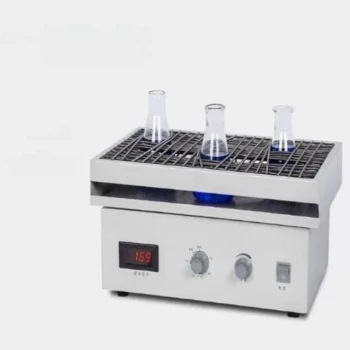
Vibratory sieve shakers and standard sieves function as the primary analytical tools for quantifying the physical transformation of biomass during torrefaction. By fractionating ground hydrochar through a specific stack of sieves (ranging from 63 micrometers to 1000 micrometers), researchers can measure the shift in particle size distribution. This process provides objective data on how process variables, such as temperature and water ratios, alter the material's brittleness.
Core Takeaway Sieve analysis acts as a proxy for measuring the "grindability" of treated biomass. By tracking the increase in fine powders, you can objectively verify if wet torrefaction has successfully improved the material's brittleness, a critical factor for efficient industrial milling.
The Mechanics of the Analysis
The Equipment Setup
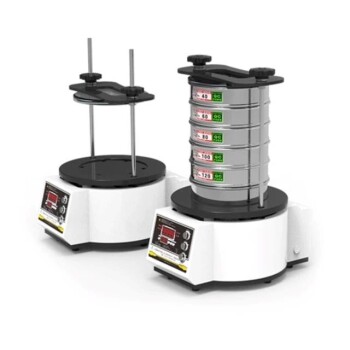
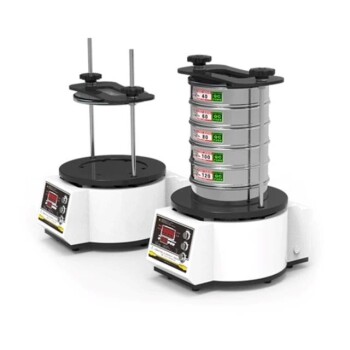
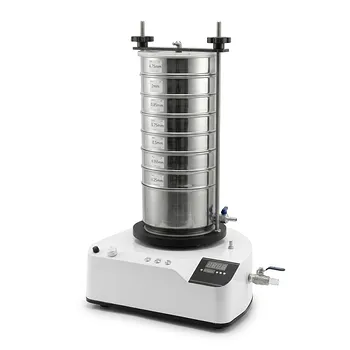
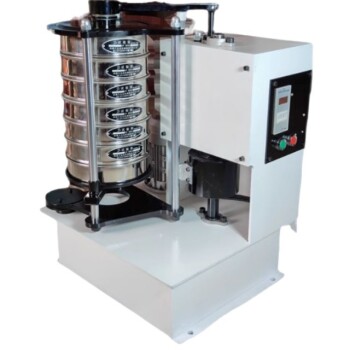
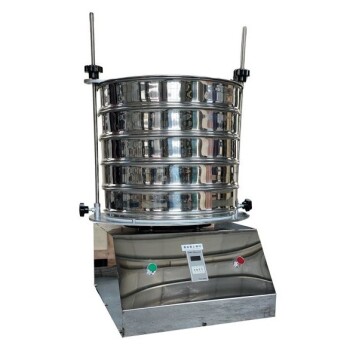
To analyze hydrochar, researchers utilize a vibratory sieve shaker equipped with a stack of standard sieves.
The specific mesh sizes typically range from 63 micrometers to 1000 micrometers.
Generating Particle Distribution Profiles
The vibratory action stratifies the ground biomass, trapping particles at different levels based on their dimensions.
This results in a precise particle size distribution profile. It reveals exactly what percentage of the total mass exists at each size fraction after grinding.
Correlating Data to Biomass Quality
Measuring Brittleness Through Fines
The primary goal of this analysis is to evaluate brittleness, particularly in feedstocks like Miscanthus.
An increase in the proportion of fine powder (particles passing through smaller mesh sizes) indicates higher brittleness. This physical change confirms that the biomass structure has been effectively degraded.
Evaluating Process Variables
Researchers use sieve data to compare different production scenarios.
They analyze samples produced under varying torrefaction temperatures and water-to-solid ratios.
By correlating these variables with the sieve results, they can identify which specific conditions yield the most brittle, easily grindable product.
Understanding the Trade-offs
The Dependency on Grinding Consistency
Sieve analysis measures the result of a grinding process, not just the material properties alone.
Therefore, the data is only valid if the mechanical grinding method used prior to sieving remains strictly constant. Any variation in the grinding force or duration will skew the particle distribution, leading to false conclusions about the biomass's brittleness.
Discrete vs. Continuous Data
Standard sieves provide data in discrete ranges (e.g., between 63 and 1000 micrometers).
While effective for general categorization, this method may miss subtle nuances in particle size changes that occur within those defined intervals.
Making the Right Choice for Your Goal
To utilize sieve analysis effectively for biomass characterization, align your approach with your specific objectives:
- If your primary focus is Process Optimization: Identify the temperature and water-to-solid ratio that consistently maximizes the portion of fine powder in the <63 µm range.
- If your primary focus is Industrial Scale-up: Use the particle size distribution data to define the necessary energy and design parameters for your industrial milling equipment.
Accurate sieve analysis transforms raw biomass research into actionable engineering parameters.
Summary Table:
| Component | Parameter / Range | Impact on Analysis |
|---|---|---|
| Sieve Mesh Sizes | 63 μm to 1000 μm | Defines the resolution of particle size distribution (PSD). |
| Vibratory Action | Constant Frequency | Ensures consistent stratification and repeatable data sets. |
| Key Metric | Fine Powder Proportion | High concentration of <63 μm particles indicates successful torrefaction. |
| Variable Focus | Temp & Water Ratios | Used to determine the optimal conditions for maximum biomass brittleness. |
Maximize Your Lab's Analytical Precision with KINTEK
Transitioning from raw biomass research to industrial-scale production requires equipment that delivers absolute consistency. KINTEK specializes in high-performance vibratory sieve shakers, standard sieves, and crushing and milling systems designed to withstand the rigorous demands of biomass characterization.
Whether you are refining hydrochar brittleness in a high-temperature muffle furnace or preparing samples with our precision hydraulic presses, our comprehensive laboratory solutions ensure your data is accurate and actionable.
Ready to optimize your material processing workflow? Contact our technical experts today to discover how KINTEK's premium laboratory equipment and consumables can enhance your research efficiency.
References
- Mateusz Wnukowski, Łukasz Niedźwiecki. WET TORREFACTION OF MISCANTHUS – CHARACTERIZATION OF HYDROCHARS IN VIEW OF HANDLING, STORAGE AND COMBUSTION PROPERTIES. DOI: 10.12911/22998993/2950
This article is also based on technical information from Kintek Solution Knowledge Base .
Related Products
- Vibratory Sieve Shaker Machine Dry Three-Dimensional Vibrating Sieve
- Laboratory Wet Three-Dimensional Vibratory Sieve Shaker Machine
- Laboratory Vibratory Sieve Shaker Machine for Dry and Wet Three-Dimensional Sieving
- Laboratory Test Sieves and Vibratory Sieve Shaker Machine
- Laboratory Vibratory Sieve Shaker Machine Slap Vibrating Sieve
People Also Ask
- How is a vibratory sieve shaker used in the particle size analysis of mechanically alloyed powders? Expert Guide
- Why use a vibratory sieve shaker for PET powder? Achieve Precise Particle Size Control for Chemical Research
- What is the principle of vibratory sieve shaker? Achieve Accurate Particle Size Analysis
- What is the function of a vibratory sieve shaker? Achieve Precise Particle Size Analysis
- What is the use of vibratory sieve shaker? Achieve Precise Particle Size Analysis for Your Lab