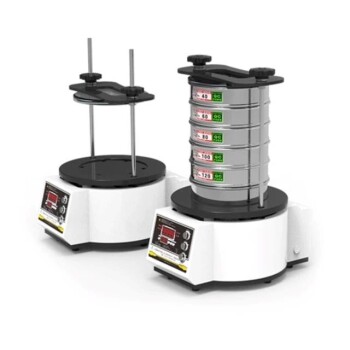
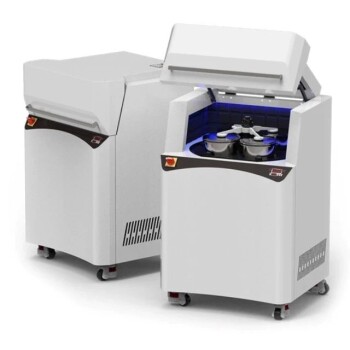
A vibratory sieve shaker serves as the primary validation tool for the mechanical alloying process, transforming raw output into actionable data. It employs mechanical vibration to pass alloy powders through a stack of standard sieves with progressively smaller aperture sizes, physically separating the batch into distinct fractions based on particle dimensions.
Mechanical alloying is only effective if the resulting powder meets specific dimensional targets. Sieve analysis provides the essential quantitative data to confirm the ball milling process has achieved the correct average particle size necessary for optimal pressing quality and downstream performance.
The Mechanics of Separation
Utilizing Standard Sieves
The process relies on a vertical stack of calibrated screens. Each sieve in the stack features a mesh with a specific aperture size, arranged from largest openings at the top to smallest at the bottom.
Mechanical Agitation
The shaker applies consistent mechanical vibration to the stack. This energy forces the mechanically alloyed powder—which often consists of irregularly shaped particles—to orient itself and pass through the mesh openings until it encounters a screen too fine for it to pass.
Quantitative Data Generation
By weighing the powder retained on each sieve, you calculate the mass percentage of different size components. This generates a particle size distribution curve, moving the analysis from visual estimation to hard metrics.
Evaluating Milling Effectiveness
Confirming Process End-points
In mechanical alloying, "ball milling" is used to reduce particle size and blend materials. The sieve shaker is the critical checkpoint to determine if the milling has been sufficient or if the powder requires further processing to reach the target average size.
Optimizing Pressing Quality
The primary reference highlights that specific particle sizes are required for optimal pressing quality. If the powder is too coarse or the distribution too wide, the resulting green body (the pressed powder before sintering) may lack structural integrity or density.
Refining Characterization
Obtaining a narrow size distribution is vital for consistency. By removing oversized or undersized particles, you ensure uniformity, which improves the resolution of characterization techniques like X-ray diffraction (XRD) used to analyze phase composition.
Understanding the Trade-offs
The Lower Limit on Precision
While effective for general analysis, vibratory sieving has physical limitations. It is generally suitable for particle sizes down to 50 µm; below this threshold, electrostatic forces and particle agglomeration can make physical sieving difficult or inaccurate.
Simplicity vs. Complexity
The major advantages of this method are its low cost, small footprint, and simple operation. However, it is a mechanical process; it may not provide the microscopic resolution of laser diffraction, but it offers high reproducibility for standard powder metallurgy applications.
Making the Right Choice for Your Goal
To maximize the utility of your particle size analysis, align your approach with your specific objective:
- If your primary focus is Process Control: Use the shaker to verify the duration of ball milling, ensuring the powder has reached the target size required for successful pressing.
- If your primary focus is Material Characterization: Use the shaker to isolate a narrow size fraction, removing outliers to improve the accuracy of lattice constant and phase analysis (e.g., XRD).
The vibratory sieve shaker provides the definitive "go/no-go" metric that bridges the gap between raw milling output and a refined, press-ready engineering material.
Summary Table:
| Feature | Application in Mechanical Alloying |
|---|---|
| Primary Function | Physically separating alloy powders by particle dimension using calibrated mesh stacks. |
| Process Validation | Confirms if ball milling has achieved the target average particle size for pressing. |
| Data Output | Mass percentage per sieve fraction used to generate size distribution curves. |
| Sieving Limit | Typically effective down to 50 µm; below this, electrostatic forces impact accuracy. |
| Key Benefit | Low-cost, highly reproducible, and essential for ensuring green body structural integrity. |
Elevate Your Powder Metallurgy Precision with KINTEK
Achieving the perfect particle size distribution is critical for the success of your mechanical alloying and sintering processes. At KINTEK, we specialize in providing high-performance laboratory equipment designed for accuracy and durability. Whether you need precise vibratory sieve shakers and sieving equipment for process control, or ball milling systems to refine your powders, we have the solution.
Our extensive portfolio also includes:
- Crushing and Milling Systems: For optimal powder preparation.
- Hydraulic Presses (Pellet, Hot, Isostatic): To ensure superior density in your green bodies.
- High-Temperature Furnaces: Including muffle, vacuum, and atmosphere furnaces for perfect sintering.
- Advanced Lab Tools: High-pressure reactors, autoclaves, and specialized ceramics/crucibles.
Don't leave your material quality to chance. Our experts are ready to help you select the right tools for your specific research or production goals. Contact KINTEK today to optimize your lab's efficiency and achieve superior material characterization!
References
- Laura Elena Geambazu, Vasile Dănuț Cojocaru. Microstructural Characterization of Al0.5CrFeNiTi High Entropy Alloy Produced by Powder Metallurgy Route. DOI: 10.3390/ma16217038
This article is also based on technical information from Kintek Solution Knowledge Base .
Related Products
- Vibratory Sieve Shaker Machine Dry Three-Dimensional Vibrating Sieve
- Laboratory Wet Three-Dimensional Vibratory Sieve Shaker Machine
- Laboratory Vibratory Sieve Shaker Machine for Dry and Wet Three-Dimensional Sieving
- Laboratory Test Sieves and Vibratory Sieve Shaker Machine
- Laboratory Vibratory Sieve Shaker Machine Slap Vibrating Sieve
People Also Ask
- Why use a vibratory sieve shaker for PET powder? Achieve Precise Particle Size Control for Chemical Research
- What is the principle of vibratory sieve shaker? Achieve Accurate Particle Size Analysis
- What is the function of a vibratory sieve shaker? Achieve Precise Particle Size Analysis
- What is the use of vibratory sieve shaker? Achieve Precise Particle Size Analysis for Your Lab
- How are vibratory sieve shakers and standard sieves utilized to analyze the effects of biomass torrefaction? Optimize Grindability