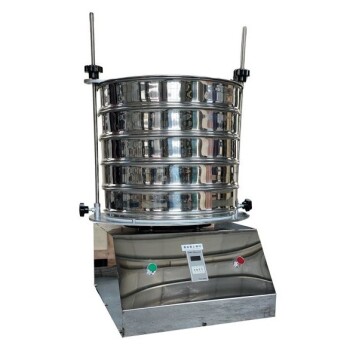
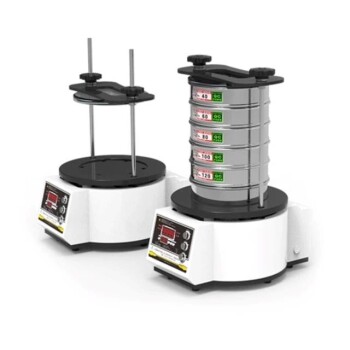
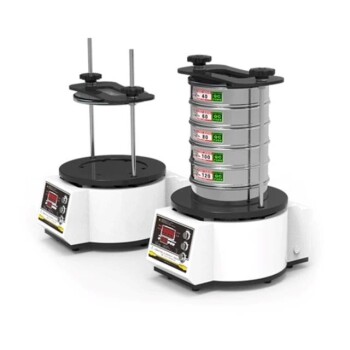
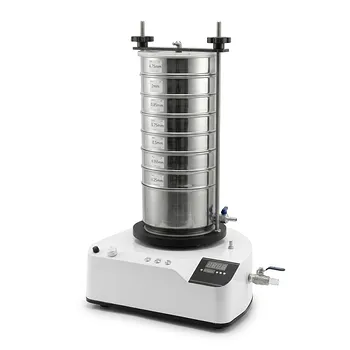
The primary purpose of using standard sieves in the pretreatment of natural siderite is to rigorously control particle size uniformity, typically within a specific range like 40-60 mesh. This physical standardization is the prerequisite for stable thermal dynamics and consistent reactor hydrodynamics during catalyst preparation and evaluation.
Core Takeaway Sieving is not merely a sorting mechanism; it is a fundamental control variable for experimental validity. By ensuring all particles are geometrically similar, you eliminate random variables that lead to uneven heating and fluctuating pressure, thereby guaranteeing that your resulting kinetic data is reproducible and accurate.
The Critical Role of Particle Uniformity
Establishing a Baseline
After raw materials like natural siderite are crushed and ground, they exist as a chaotic mix of sizes.
Using standard sieves serves as a mechanical filter to isolate a specific fraction (e.g., 40-60 mesh).
This step transforms a heterogeneous raw material into a standardized feedstock ready for scientific evaluation.
Optimizing Thermal Treatment
Precise particle size control is directly linked to uniform heat transfer.
During the thermal treatment stages of catalyst preparation, particles must be heated evenly to transform their chemical structure.
If particle sizes vary significantly, heat penetrates them at different rates, potentially leading to inconsistent chemical phases within the final catalyst batch.
Stabilizing Reactor Hydrodynamics
In a fixed-bed reactor, the way particles pack together dictates the flow of gas and liquid.
Uniform particles ensure stable bed pressure drop, preventing channeling or blockages that distort flow patterns.
Without sieving, fines can clog voids while large chunks create bypasses, making it impossible to obtain accurate performance data.
Ensuring Data Integrity
Maximizing Repeatability
The ultimate goal of pretreatment is experimental reliability.
When the physical properties of the feedstock are constant, any change in results can be attributed to chemical variables rather than physical inconsistencies.
Consistently sieved siderite ensures that the experimental data is repeatable across multiple test runs.
Enhancing Accuracy
Accurate reaction evaluations depend on eliminating external interferences.
By controlling the particle size, you minimize noise in the data caused by physical anomalies.
This allows for a precise assessment of the catalytic material's true performance.
Understanding the Trade-offs
Balancing Pressure and Diffusion
Choosing the specific sieve range (e.g., 40-60 mesh vs. 350-500 µm) involves a necessary compromise.
Finer particles reduce internal diffusion limitations, allowing reactants to access active sites easily, but they significantly increase the pressure drop across the reactor bed.
Coarser particles stabilize pressure but may suffer from poor heat transfer or mass transfer resistance within the particle itself.
Material Loss and Processing Time
Strict sieving protocols inevitably lead to lower material yields, as "off-spec" sizes are discarded or re-processed.
This adds time and cost to the preparation phase but is a non-negotiable investment for high-quality data.
Making the Right Choice for Your Goal
When designing your pretreatment protocol for siderite or similar catalyst precursors, consider your specific analytical needs:
- If your primary focus is kinetic accuracy: Prioritize narrower, smaller sieve ranges to minimize internal diffusion limitations, accepting higher pressure drops.
- If your primary focus is process stability: Select a slightly coarser mesh range to prioritize uniform packing and stable pressure drops over maximum surface area exposure.
Sieving is the invisible foundation of catalyst preparation; without it, sophisticated chemistry is undermined by physical randomness.
Summary Table:
| Factor | Benefit of Standardized Sieving | Impact on Catalyst Preparation |
|---|---|---|
| Particle Size | Ensures uniformity (e.g., 40-60 mesh) | Establishes a consistent baseline for feedstock. |
| Heat Transfer | Eliminates thermal gradients | Guarantees uniform chemical phase transformation. |
| Hydrodynamics | Stabilizes bed pressure drop | Prevents gas/liquid channeling and reactor clogging. |
| Data Integrity | Maximizes repeatability | Attributes performance results to chemical variables. |
| Diffusion | Balances mass transfer | Optimizes the trade-off between pressure and active site access. |
Elevate Your Material Preparation with KINTEK
Precision in catalyst performance starts with the physical standardization of your raw materials. KINTEK specializes in high-performance laboratory equipment designed to eliminate experimental variables. From high-precision sieving equipment and crushing systems to our advanced high-temperature furnaces (muffle, vacuum, CVD) and high-pressure reactors, we provide the tools you need for reproducible results.
Whether you are refining natural siderite or developing advanced battery research tools, KINTEK offers the consumables—including crucibles, ceramics, and PTFE products—and the heavy-duty hydraulic presses required for professional-grade material pretreatment.
Ready to achieve superior kinetic accuracy? Contact our laboratory specialists today to find the perfect equipment solution for your research goals.
References
- Fuwei Sun, Dong Chen. The Characterization and SCR Performance of Mn-Containing α-Fe2O3 Derived from the Decomposition of Siderite. DOI: 10.3390/min9070393
This article is also based on technical information from Kintek Solution Knowledge Base .
Related Products
- Custom PTFE Teflon Parts Manufacturer for PTFE Mesh F4 Sieve
- Laboratory Test Sieves and Sieving Machines
- Vibratory Sieve Shaker Machine Dry Three-Dimensional Vibrating Sieve
- Laboratory Vibratory Sieve Shaker Machine Slap Vibrating Sieve
- Three-dimensional electromagnetic sieving instrument
People Also Ask
- What are the primary reasons for selecting PTFE as a matrix? Enhance Composites with Carbon Nanotube Reinforcement
- How is PTFE utilized for insulation in Alloy 22 corrosion setups? Ensure Signal Purity & Accuracy
- Is PTFE corrosion resistant? Discover the Ultimate Chemical Resistance for Your Lab
- What are the specific applications of PTFE in micro-batch slug flow systems? Enhance Your Microfluidic Reaction Purity
- What is the mesh size of a sieve? A Guide to Particle Size and Sieve Selection